What Is Artificial Intelligence? A Human-Centered Guide to Modern AI Systems
Artificial intelligence (AI) refers to computer systems capable of performing tasks that normally require human cognition, including reasoning, pattern recognition, prediction, language understanding, decision support, and automation. Modern AI systems combine machine learning, large language models (LLMs), data architectures, workflow integration, and governance frameworks to support operational intelligence across healthcare, hospitality, enterprise operations, and digital transformation initiatives.
Artificial intelligence is often misunderstood as a collection of tools. In reality, AI is a system—one that integrates data, models, infrastructure, and human decision-making. This guide explains how AI works at a foundational level and how those components come together to create reliable, real-world systems.Whether you are an executive evaluating AI strategy or a technologist building systems, this page provides the conceptual framework needed to move from experimentation to implementation.
Start with the foundational overview, then move into appendices, applied use cases, strategic tools, and white papers based on your needs.
Most explanations of artificial intelligence focus on individual tools or models. In practice, AI creates value only when it is implemented as a system—integrating data, models, workflows, and human decision-making into a cohesive architecture.
Table of Contents
- What Is Artificial Intelligence?
- Why AI Matters Today
- How AI Works (Simple Explanation)
- Common Types of AI
- Real-World Examples of AI
- What AI Can and Cannot Do
- Common Misconceptions About AI
- AI in Business and Everyday Life
- How to Start Thinking About AI
- Next Step: Understanding How AI Works
How Modern Artificial Intelligence Systems Work
Modern artificial intelligence systems are built from interconnected layers of data, machine learning, large language models, retrieval systems, automation frameworks, and human governance. Enterprise AI is no longer a single model—it is an integrated operational architecture designed to improve decision-making, workflow efficiency, prediction, automation, and organizational intelligence.
Data Layer
Artificial intelligence systems begin with data. Structured databases, enterprise systems, sensors, wearable devices, electronic health records, customer platforms, and operational workflows provide the contextual information AI systems use to recognize patterns and generate insights.
Machine Learning
Machine learning enables AI systems to identify patterns, classify information, make predictions, and improve performance over time. These models are trained using large datasets and are commonly used in forecasting, recommendation systems, medical analysis, fraud detection, and operational optimization.
Large Language Models (LLMs)
Large language models are advanced AI systems trained on massive amounts of text data to understand language, generate responses, summarize information, assist decision-making, and support conversational interfaces. Modern generative AI platforms rely heavily on LLM architectures.
Retrieval-Augmented Generation (RAG)
Retrieval-Augmented Generation combines large language models with external knowledge sources such as enterprise databases, documents, policies, or live operational systems. This architecture improves accuracy, contextual awareness, explainability, and real-time decision support.
Automation & Decision Systems
AI systems increasingly connect directly into workflows, business operations, customer service environments, healthcare systems, hospitality platforms, and enterprise software ecosystems to automate repetitive tasks, optimize operations, and support real-time decisions.
Human Oversight & AI Governance
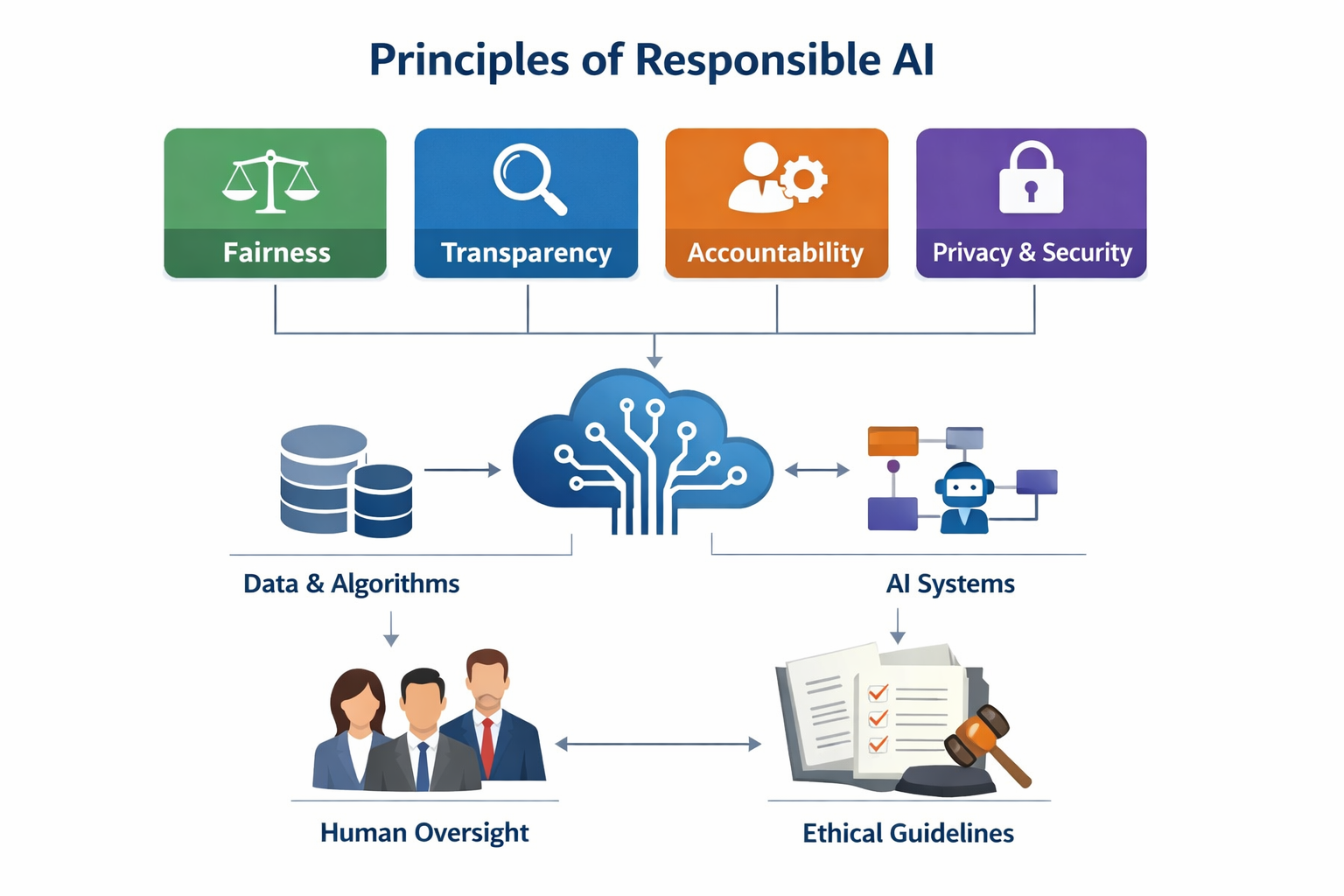
Human-centered AI systems require governance frameworks, validation layers, ethical safeguards, transparency, and operational oversight. Successful enterprise AI deployment depends not only on model performance, but also on workflow integration, accountability, security, compliance, and measurable business outcomes.
Modern artificial intelligence architecture combines machine learning, generative AI, large language models, enterprise workflow integration, retrieval systems, governance frameworks, and human oversight to create scalable AI ecosystems capable of supporting healthcare, hospitality, finance, manufacturing, cybersecurity, research, and enterprise operations.
Why Many Artificial Intelligence Projects Fail
Most artificial intelligence failures are not caused by weak AI models. They occur because organizations deploy AI without proper workflow integration, governance frameworks, operational architecture, data strategy, or measurable business alignment. Successful enterprise AI systems require coordination between technology, people, processes, oversight, and operational execution.
Disconnected Enterprise Systems
Many organizations attempt to deploy AI into fragmented operational environments where data systems, workflows, customer platforms, and decision systems are poorly connected.
Poor Workflow Integration
Artificial intelligence creates little value when it operates outside the real workflows employees use every day across healthcare, hospitality, finance, operations, and enterprise environments.
Weak Governance & Oversight
AI systems require governance frameworks, human oversight, validation layers, accountability structures, compliance controls, and operational safeguards to ensure trustworthy deployment.
Unclear ROI & Business Alignment
Organizations frequently invest in AI technologies without clearly defining measurable operational outcomes, implementation strategy, performance metrics, or long-term business value.
Successful AI transformation requires more than deploying a model. It requires a human-centered strategy that integrates enterprise architecture, workflow intelligence, governance, operational design, and measurable ROI.
Explore Why AI Projects FailWhy Most Artificial Intelligence Initiatives Fail
Despite massive investment in artificial intelligence, many AI initiatives fail to produce measurable operational value. In most cases, the problem is not the AI model itself—it is the surrounding enterprise system architecture, workflow integration strategy, governance framework, and operational execution model.
- Enterprise data remains fragmented across disconnected systems, preventing AI platforms from accessing accurate, contextual, and operationally relevant information.
- AI models are deployed outside real workflows, limiting adoption, operational impact, and day-to-day usability across enterprise environments.
- Governance, oversight, and validation frameworks are incomplete, increasing operational risk, compliance exposure, and decision-making uncertainty.
- AI pilots fail to transition into scalable production systems because organizations underestimate integration complexity, operational change management, and long-term deployment requirements.
Successful enterprise artificial intelligence deployment requires more than selecting a model. Organizations must understand how AI systems interact with data architecture, workflows, governance, operations, and measurable business outcomes. Human-centered AI strategy and systems integration are essential for sustainable AI transformation.
Explore Why AI Projects FailTechnical Foundations — Executive Overview
What Is Artificial Intelligence? A Systems-Level Explanation for Real-World Application
Artificial intelligence is often described as machines that learn from data. While technically accurate, this definition misses the larger reality: AI is not just a model or a tool—it is a system.
In practice, artificial intelligence creates value only when data, models, infrastructure, and human decision-making are integrated into a cohesive architecture. This page explains what AI is, how it works at a foundational level, and how those components come together to support real-world outcomes.
Whether you are exploring AI for business, healthcare, or advanced technical systems, understanding this systems-level perspective is essential to moving from experimentation to implementation.
What Artificial Intelligence Actually Is
Artificial intelligence (AI) refers to computer systems capable of learning patterns from data and using those patterns to make predictions, generate content, automate tasks, support decision-making, and improve operational efficiency. Modern AI systems are commonly built using machine learning, large language models (LLMs), neural networks, retrieval systems, and enterprise data architectures.
AI systems are trained using both structured and unstructured data, including databases, documents, images, operational workflows, customer interactions, healthcare records, and real-time enterprise information. These systems are then deployed within larger operational environments to support automation, analytics, forecasting, personalization, and intelligent decision support.
Artificial intelligence is not a single technology or standalone model. Modern enterprise AI platforms are built from interconnected systems that combine:
- Data pipelines that collect, organize, clean, and process enterprise information for AI analysis and machine learning.
- Machine learning models and large language models trained to identify patterns, generate predictions, classify information, and support intelligent automation.
- Compute infrastructure including cloud computing, GPUs, edge AI systems, and scalable enterprise processing environments.
- Application interfaces and workflow integrations that connect artificial intelligence systems into healthcare, hospitality, finance, cybersecurity, manufacturing, and enterprise operations.
- Governance, validation, and monitoring systems that provide oversight, explainability, compliance, safety, security, and operational accountability for responsible AI deployment.
Understanding artificial intelligence as a complete operational system— rather than simply a chatbot or standalone AI model—is essential for successful enterprise AI strategy, workflow integration, governance, and long-term digital transformation.
How Artificial Intelligence Works in Simple Terms
At a high level, artificial intelligence works by learning patterns from data and using those patterns to make predictions, generate responses, automate tasks, or support human decision-making. Modern AI systems use machine learning models, neural networks, large language models, data pipelines, and computing infrastructure to identify relationships that would be difficult for humans to detect manually.
Training on Data
AI systems are trained using large datasets that may include text, images, transactions, sensor data, healthcare records, customer interactions, operational workflows, or enterprise documents. This training process allows machine learning models to identify patterns, structures, and relationships.
Pattern Recognition
The AI model identifies recurring patterns in the data, such as how words relate to one another, how customer behavior changes over time, how medical signals vary, or how operational events predict future outcomes.
Prediction and Inference
Based on what it has learned, the AI system makes predictions or inferences. This may involve predicting the next word in a sentence, detecting risk, recommending an action, forecasting demand, or identifying the most likely outcome.
Output Generation
The system produces an output such as text, recommendations, classifications, alerts, summaries, images, decisions, or workflow actions. In enterprise AI systems, these outputs should be governed, validated, monitored, and integrated into real workflows.
While the underlying mathematics behind artificial intelligence can be complex, the core concept is straightforward: AI learns from data, identifies patterns, makes predictions, and produces outputs that can support automation, analytics, decision-making, and enterprise digital transformation.
Types of Artificial Intelligence
Artificial intelligence can be categorized by capability, application, and level of autonomy. Most AI systems used today are narrow AI systems designed for specific tasks, while generative AI, large language models, and emerging agentic AI systems are expanding how organizations use AI for automation, analytics, decision support, customer experience, and enterprise workflow optimization.
Narrow AI or Weak AI
Narrow artificial intelligence refers to AI systems designed to perform specific tasks such as recommendation engines, fraud detection, search ranking, predictive analytics, customer service chatbots, medical image analysis, or enterprise workflow automation. This is the most common form of AI used today.
General AI or Artificial General Intelligence
Artificial general intelligence (AGI) refers to a theoretical form of AI that could perform the full range of intellectual tasks a human can perform across many domains. AGI has not yet been achieved, and most modern AI systems remain task-specific, data-dependent, and limited by their training and architecture.
Generative AI and Large Language Models
Generative AI systems create new content such as text, images, audio, video, software code, summaries, and business insights. Large language models (LLMs) are a major category of generative AI used in AI assistants, enterprise knowledge systems, content generation, research, and decision-support workflows.
Understanding the different types of artificial intelligence helps organizations distinguish between practical AI tools available today, future AI concepts such as AGI, and enterprise AI systems that combine machine learning, generative AI, retrieval-augmented generation, governance, and workflow integration.
Examples of Artificial Intelligence in Everyday Life
AI is already embedded in many systems and services across industries:
- Search engines delivering relevant results
- Streaming platforms recommending content
- Virtual assistants like Siri and Alexa
- Healthcare systems supporting diagnosis and treatment decisions
- Fraud detection in banking and finance
- AI-powered personalization in hospitality and retail
From Basic Concepts to Real-World Systems
While understanding what AI is provides a foundation, real value comes from how AI systems are designed, integrated, and deployed within organizations. The sections below explore how artificial intelligence moves beyond theory into practical systems, architecture, and measurable business impact.
Limits, risk, and governance
AI can improve speed and scale, but it is not always accurate, fair, or transparent. Common risks include biased outputs, privacy concerns, misinformation, weak reliability in the wrong use case, and exposure to misuse by bad actors [web:33][web:37][web:39].
- Bias can appear when training data reflects historic or social inequalities, leading to unfair outcomes [web:39].
- Hallucinations and misinformation can cause AI systems to present false or misleading information with confidence [web:33][web:37].
- Privacy risks can arise when personal or sensitive data is overcollected, reused, or exposed in model outputs [web:33][web:39].
- Security and abuse risks increase when AI is used for fraud, phishing, cyberattacks, or other harmful purposes [web:33][web:37].
Governance helps organizations reduce those risks by defining who owns the system, what data is allowed, how outputs are reviewed, and when humans must override automation. Current governance frameworks emphasize transparency, accountability, data handling, monitoring, and human oversight, with examples including NIST AI RMF, ISO/IEC 42001, and the EU AI Act [web:34][web:36][web:38][web:42].
For a business audience, the key message is simple: use AI where it helps, but keep humans responsible for high-impact decisions, especially in areas like hiring, finance, healthcare, and customer trust [web:37][web:39][web:41].
Why AI matters for organizations
AI matters because it helps organizations work faster, make better decisions, and improve customer experiences at scale [web:43][web:46]. It is no longer just a technical trend; it is becoming a practical tool for efficiency, cost control, and growth across industries [web:45][web:48].
- It automates repetitive work, freeing employees for higher-value tasks [web:43][web:46].
- It improves decision-making by finding patterns in data faster than manual analysis [web:43][web:44].
- It lowers costs by streamlining workflows, reducing errors, and improving operational efficiency [web:43][web:45][web:46].
- It strengthens customer engagement through personalization, faster responses, and better service [web:43][web:46].
- It supports innovation by helping teams develop new products, services, and ways of working [web:45][web:46][web:48].
For organizations, the real value of AI is not replacing people, but giving teams better tools to scale work, reduce friction, and respond more quickly to change .
How Modern AI Systems Are Structured — From Understanding to Real-World Application
Modern AI solutions are built in layers. They start with foundational technical concepts, move through system architectures and design patterns, and extend into strategic evaluation and practical implementation. This structure helps leaders and professionals see not just how AI works, but how it can be thoughtfully evaluated, designed, and applied in real environments.
Core Concepts
Foundational explanations of how modern AI systems function at the model level.
- Tokenization and embeddings
- Attention mechanisms and inference
- Parameters, alignment, and safety layers
Architectures & Patterns
Technical patterns that show how individual AI capabilities are combined into reliable, deployable systems.
- Retrieval-Augmented Generation (RAG)
- Hybrid and edge orchestration
- Inference optimization and system design
Strategic Evaluation
Frameworks for assessing value, risk, governance, and organizational readiness.
- Prioritization and sequencing
- Governance and responsible use
- Measuring outcomes and ROI
Applied Systems
Real-world examples of how AI integrates into service, operational, and workflow environments.
- Service industry applications
- Biometric and sensor intelligence
- Human-centered operating models
Implementation Pathways
Practical considerations for deployment, integration, scaling, and continuous improvement.
- Technical blueprints and integration strategies
- Deployment models and performance tuning
- Measurement frameworks and iteration
Why a layered approach matters
Most resources focus only on individual tools or surface-level explanations. A layered model connects foundational knowledge with system design and real-world application, helping leaders move from basic understanding to confident, responsible decisions and measurable results.
For executive and strategic readers
Begin with Strategic Evaluation to understand opportunity, risk, and organizational fit. Then explore Applied Systems to see how these concepts translate into practical environments.
For technical and implementation readers
Start with Core Concepts and Architectures & Patterns to grasp how the systems function, then move to later layers for deployment and operating implications.
Strategic Evaluation
Strategic evaluation focuses on identifying where AI delivers measurable value, aligning initiatives with business objectives, and ensuring that implementation is both feasible and sustainable within the organization’s operational context.
This includes assessing data readiness, workflow integration, ROI potential, governance requirements, and organizational readiness before committing to AI deployment.
Explore the Technical Foundations and System Structures Behind Modern AI
This section serves as a guided navigation layer into the technical concepts and architectural patterns that underpin contemporary AI systems. It is intended to help readers understand how these systems function, how they are assembled, and how they should be evaluated in practical settings.
This is one layer of the Strategic Advisory Hub. Additional strategic frameworks, applied industry models, implementation resources, and NDA-based materials are organized separately below.
Explore Core AI Concepts
This structured index highlights the foundational concepts that underpin modern AI systems. It is designed as a guided entry point—not a complete library—focusing on the most critical elements required to understand, evaluate, and discuss AI in real-world environments.
Strategic Advisory & Applied Systems
Beyond technical foundations, the Strategic Advisory Hub includes executive frameworks, applied operating models, industry-specific systems, and implementation pathways designed to support measurable outcomes and human-centered deployment.
Strategic Advisory
Executive-level guidance for AI readiness, governance, adoption, and business value creation.
Applied Systems
Industry-focused models translating AI into real operational and experience systems.
Implementation Resources
Roadmaps, operating blueprints, KPI structures, and case-oriented deployment guidance.
Restricted / NDA Resources
Advanced architecture, financial models, and proprietary deployment materials available by request.
Additional strategic resources, industry frameworks, and implementation models are available throughout the Strategic Advisory Hub and are integrated contextually within each section.
Why a Structured Approach Matters
Artificial intelligence is shifting from isolated experiments to core operational infrastructure in many organizations. Success depends on understanding not just what the technology can do, but where it creates genuine value, how it integrates with existing systems, and how to deploy it responsibly without disrupting trust, culture, or service quality. Most available resources stop at tool tutorials or high-level overviews. This guide aims to provide clarity at the decision-making level: what to prioritize, how to evaluate trade-offs, how to measure outcomes, and how to keep human judgment at the center.
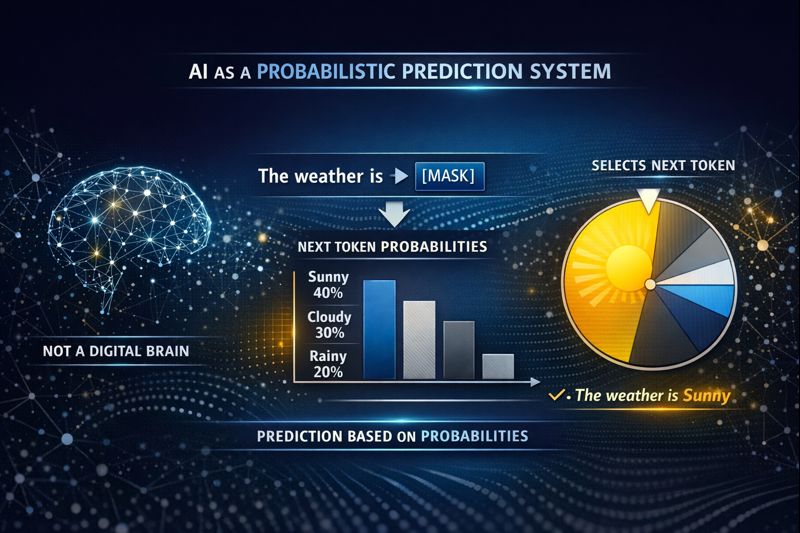
The Key Idea: AI Predicts What Comes Next
When you ask an AI a question, it is not searching a database for a perfect answer. It is predicting the most likely next word, then the next, and the next—based on everything it has learned before.
This is why AI can sound intelligent. It produces responses that statistically “fit” the situation. But it is also why AI can be wrong. It does not know truth—it only knows probability.
What AI Can Do Well
- Recognize patterns in large amounts of data
- Automate repetitive decisions
- Generate text, images, and recommendations
- Find connections humans might miss
What AI Cannot Do
- Understand meaning the way humans do
- Guarantee correctness
- Use common sense reliably
- Know when it is wrong
Why This Matters
The real power of AI is not that it replaces human thinking—it is that it enhances it. AI can process information at a scale no person can match, but it still requires human judgment, oversight, and decision-making to be useful and trustworthy.
Glossary
Key AI Terms, Plainly Explained
Algorithm
“The recipe the AI follows to get smarter.”
A step-by-step procedure or set of rules the AI uses to learn patterns and make decisions from data.
Neural Network
“A digital brain made of millions of tiny decision-makers.”
A layered structure of interconnected nodes (neurons) that processes input data to recognize patterns and make predictions.
Parameters / Weights
“The dials the AI tweaks to remember what it learned.”
The adjustable numerical values inside the model that store learned knowledge and are tuned during training.
Tokens / Tokenization
“Chopping language into bite-sized puzzle pieces.”
Text is split into smaller units (tokens) — words, subwords, or characters — and converted to numbers the model can process.
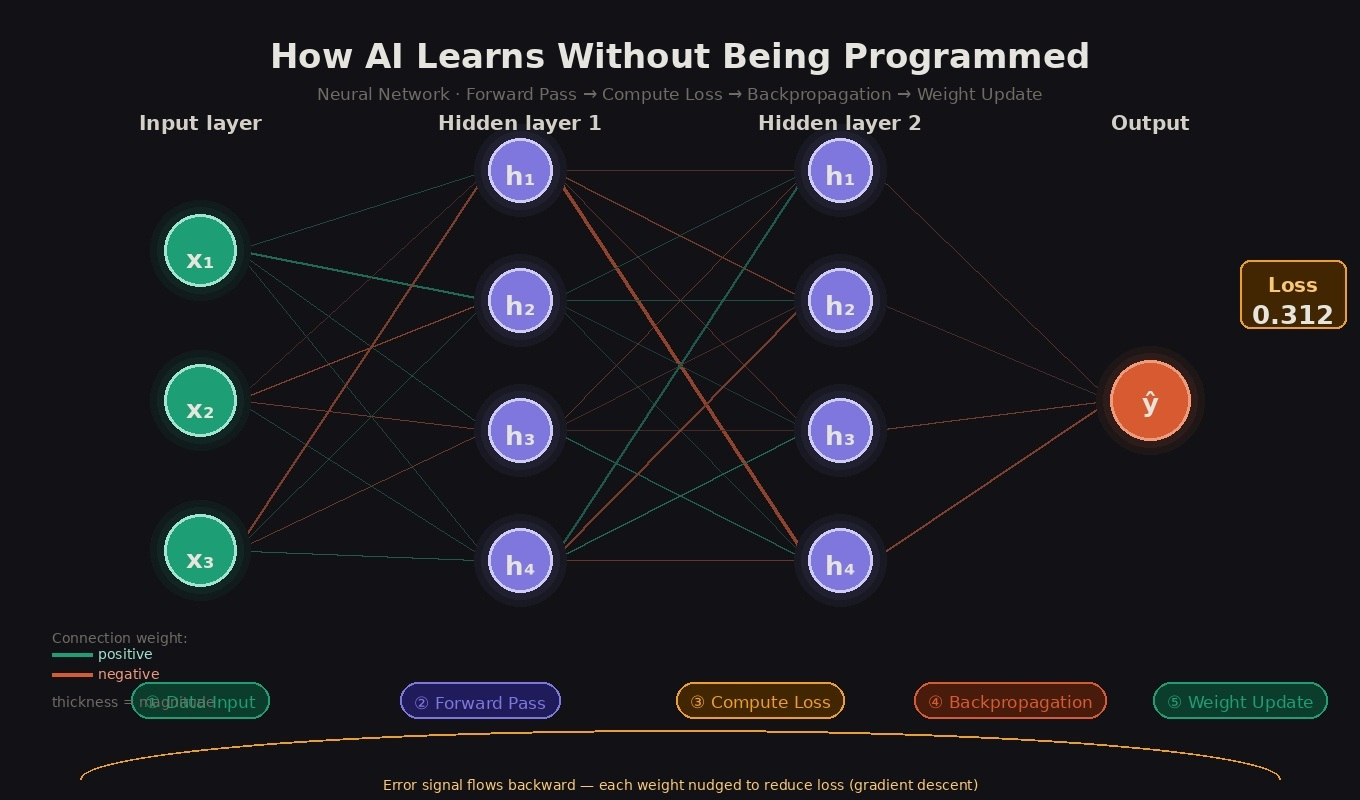
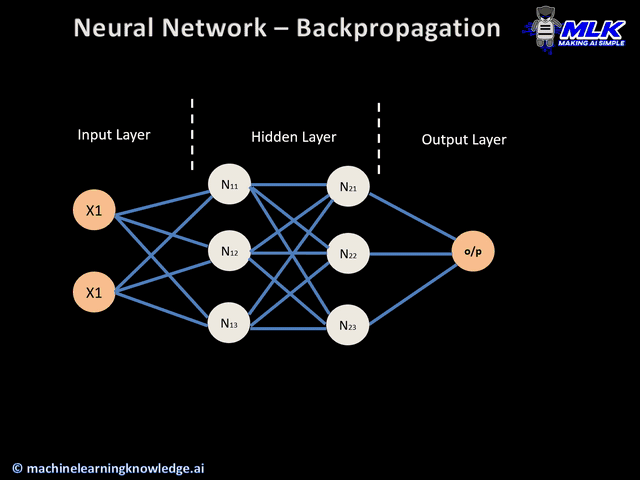
Backpropagation
“Telling each part of the AI ‘you were wrong — fix it!’”
The core algorithm that computes errors and propagates them backward through the network to update weights and reduce mistakes.
Loss (Function)
“The AI’s report card score — lower is better.”
A numerical score that quantifies how far off the model's prediction is from the correct answer. Training aims to minimize this value.
Inference
“The AI doing its job in real time.”
The phase where a trained model generates outputs for new inputs — no learning occurs, only application of what was learned.
Modern AI systems generate outputs by estimating probabilities based on learned statistical patterns rather than true understanding.
Why AI Outputs Require Judgment
AI Does Not “Know” — It Predicts
Before examining how artificial intelligence generates answers, it is important to understand one core principle: modern AI systems do not reason, verify truth, or understand meaning in the human sense. They generate outputs by estimating what response is most probable based on patterns learned from data.
AI as a Probabilistic Prediction System
Artificial intelligence is best understood as a system that recognizes patterns and makes predictions—not as a system that thinks or understands in the human sense.
Modern AI models learn statistical relationships from large datasets. When generating a response, they estimate what output is most likely to fit the context based on those learned patterns.
This is why AI can produce highly useful results at scale—but also why it can be confidently wrong. It does not know truth; it predicts probability. Effective use of AI therefore requires human judgment, validation, and oversight.
A Human-Centered Starting Point
AI should support people — not replace them.
Used correctly, AI helps professionals think more clearly, communicate more consistently,
and reduce time spent on repetitive work. The most effective AI systems are designed around people, not technology alone. This means:
Keeping humans involved in decisions
Designing systems that are transparent and explainable
Respecting privacy and dignity
Supporting, rather than replacing, human roles
Human-centered AI focuses on improving outcomes for individuals and communities, especially in sensitive areas such as healthcare, aging, and wellness.
This is especially important in environments where trust, care, and experience matter — such as healthcare, hospitality, and community-focused businesses.
How AI Learns Without Being “Programmed”
Traditional software follows explicit rules written by humans. AI works differently.
Modern AI systems are trained by showing them vast numbers of examples. From these examples, the system learns patterns—how words tend to follow other words, how images relate to descriptions, or how behaviors relate to outcomes.
Rather than being told what is right or wrong in every situation, AI learns statistically. This allows it to handle new situations it has never seen before, but it also means it does not have true understanding or judgment.
Collect Examples
AI learns by studying examples — lots of them. Think of it like teaching a child using flashcards.
These examples are often labeled. For example:
- An email labeled “professional”
- A photo labeled “cat” or “dog”
- A sentence labeled “positive” or “negative”
Key idea: AI learns from what it is shown. Better data = better results.
Make a Guess
At first, the AI has no idea what the right answer is — so it guesses.
Early guesses are often wrong. That’s expected — it’s how learning begins.
Like learning a new skill, the first attempts create a baseline to improve from.
Measure the Error
After guessing, the AI checks how far off it was. This difference is called the “error.”
This step tells the AI what needs to improve.
- What it got wrong
- How far off it was
Simple idea: AI learns by measuring its mistakes.
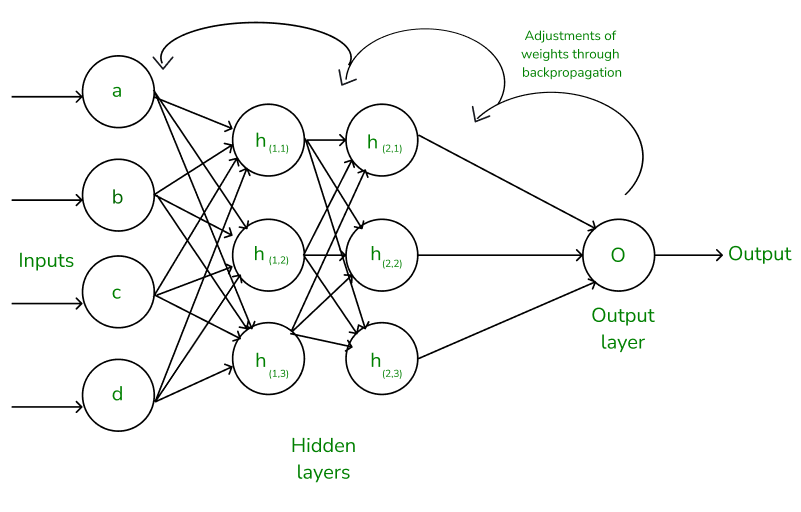
Adjust & Repeat
The AI makes small adjustments and tries again.
This cycle repeats thousands or millions of times:
- Guess
- Measure
- Adjust
Over time, the results improve dramatically.
Apply What It Learned
After training, the AI uses what it learned to respond to new questions.
It no longer sees “correct answers” — it relies on learned patterns.
- Writes emails
- Answers questions
- Generates content
Important: It predicts what sounds right — it does not truly understand.
How AI Works: System Architecture Diagram
Figure 9. A Diagram Illustrating How AI Works with Interaction.
This diagram illustrates how artificial intelligence systems process input, transform data into tokens, apply attention mechanisms, generate predictions through neural networks, and improve through backpropagation and training loops.
Understanding AI Means Understanding Systems
Artificial intelligence is not a single invention or a single algorithm. It is an ecosystem of mathematical models, computational infrastructure, and human guidance working together.
Modern AI systems combine several layers of technology:
- Algorithms that learn patterns from massive datasets
- Neural architectures that extract hierarchical representations
- Training pipelines that refine billions of parameters
- Inference systems that generate real-time outputs
- Human oversight that shapes behavior and safety
When these components are engineered correctly, AI becomes a powerful tool for accelerating research, improving healthcare outcomes, automating workflows, and expanding human creativity.
But understanding its architecture is essential. Without that understanding, AI can appear almost magical — when in reality it is the product of disciplined engineering, mathematics, and system design.
Key Performance Indicators (KPIs) for Successful AI Initiatives
These practical metrics help you measure real business value while maintaining human oversight and strategic control.
| Category | KPI | Typical Target Improvement | Why It Matters (Human-Centered View) |
|---|---|---|---|
| Efficiency | Administrative Time Saved | 60–87% | Frees your team for meaningful client work (e.g., wellness studio reduced admin from 12 hours to 90 minutes per week) |
| Efficiency | Repetitive Task Automation Rate | 40–70% | Reduces burnout in scheduling, documentation, and daily operations |
| Financial | ROI on AI Implementation | 3x–10x within 6–12 months | Delivers compounding returns through efficiency gains and new capabilities |
| Experience | Guest / Client Satisfaction (NPS or CSAT) | +15–35% | AI handles personalization while humans deliver the personal touch |
| Quality & Compliance | Error Reduction in Admin Processes | 50–80% | Fewer mistakes in documentation, reporting, and compliance tasks |
| Staff Impact | Percentage of Time Spent on Client-Facing Work | +25–50% | Shifts focus from admin drudgery to high-value service and relationships |
Strategic Advisory & Applied Systems
This section bridges technical foundations with practical business execution. It provides executive guidance on AI readiness, governance, and sequencing, while showing how modern AI translates into real operational and experience systems across hospitality, wellness, and healthcare.
Strategic Advisory – Executive Guidance
Leaders need more than tools — they need clear frameworks to evaluate opportunities, govern deployment, sequence adoption, and create sustainable value. Athena Fusion Solutions helps organizations answer:
- Where will AI create the highest impact with the lowest risk?
- How do we build governance and responsible-use policies that fit our culture?
- What operating models and decision frameworks ensure strong ROI?
- How do we sequence initiatives so we start small, prove value, and scale confidently?
Applied Systems – Industry-Relevant Implementation
We translate strategy into concrete systems designed for service-driven environments:
- Hospitality: Personalized guest experiences, dynamic scheduling, and operational automation
- Wellness & Longevity: Client journey mapping, biometric insights, and personalized coaching support
- Healthcare: Compliant documentation, intake automation, and workflow intelligence (HIPAA-aligned)
- Service-Centered Models: Human-in-the-loop designs that enhance — rather than replace — staff expertise
Measurable Outcomes & ROI
Successful AI adoption requires clear metrics. Here are practical KPIs we help clients track:
| Category | KPI | Typical Target | Why It Matters |
|---|---|---|---|
| Efficiency | Administrative Time Saved | 60–87% | Frees staff for client care (e.g., wellness boutique: 12 hrs → 90 min/week) |
| Efficiency | Repetitive Task Automation Rate | 40–70% | Reduces burnout in daily operations |
| Financial | ROI on AI Implementation | 3x–10x within 6–12 months | Compounding returns through efficiency and new capabilities |
| Experience | Guest / Client Satisfaction Lift | +15–35% | AI enables personalization while humans deliver the relationship |
| Quality | Error Reduction Rate | 50–80% | Fewer mistakes in documentation and reporting |
| Staff Impact | Time on Client-Facing Work | +25–50% | Shifts focus from admin tasks to high-value service |
Athena Fusion Solutions delivers strategic advisory and applied systems that produce measurable outcomes while preserving the human-centered experience that defines premium service environments.
How to Start Using AI Effectively
Artificial Intelligence delivers real value when used with intention. The most successful organizations start with clear goals, human oversight, and small, low-risk tasks — not with every tool at once.
The smartest approach is simple: start small, build confidence, and always keep humans in control.
Start Small. Build Confidence. Stay Human.
The organizations that gain the most from AI are not the fastest adopters — they are the most thoughtful ones. Used wisely, AI strengthens expertise, improves service, and frees professionals to focus on what truly matters.
Step-by-Step: A Simple Path to Getting Started
1) Start with One AI Tool — and Master It
Choose a single platform (ChatGPT, Claude, Gemini, or your enterprise tool) and personalize it with your role, goals, tone, and industry context. Think of it as training your digital assistant.
Takeaway: Don’t tool-hop. Master one first.
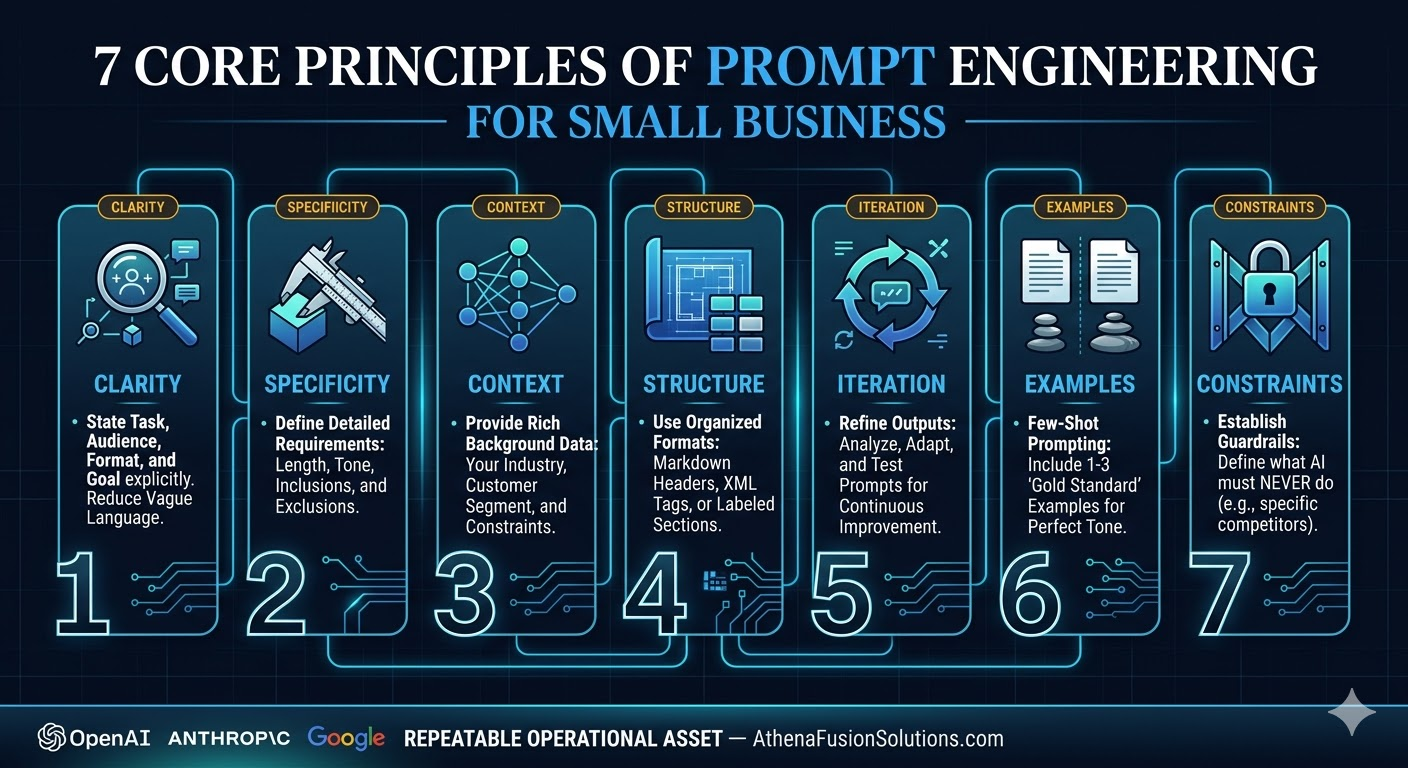
2) Develop Strong Prompt Habits
AI results depend on how you ask. Be specific: state the task, define tone/audience, set length/format, and give context.
Takeaway: Better prompts = dramatically better output.
3) Begin with Low-Risk, High-Value Tasks
Start where mistakes are easy to fix and wins are immediate:
- Drafting emails and documents
- Summarizing reports or meetings
- Brainstorming ideas
- Organizing notes or content
Avoid high-stakes decisions until you’ve built trust.
4) Always Review and Refine
Treat every AI output as a first draft. Always check facts, edit tone, and improve clarity. Human judgment is the final authority.
Important: Never outsource critical thinking.
5) Build Consistency Over Time
The real power comes from daily use. Refine your prompts, save winning workflows, and expand to more tasks. Over weeks, AI becomes a seamless part of how you work.
Big picture: Start simple, stay consistent, and let capability grow naturally.
Examples of Effective AI Requests
Instead of: “Write an email”
Try:
“Draft a clear, professional email explaining a schedule change to a client.
Keep the tone calm and respectful. Limit to 150 words.”
Instead of: “Summarize this”
Try:
“Summarize this document for a non-technical audience.
Highlight key risks, benefits, and next steps in bullet points.”
AI vs Traditional Software: A Quick Comparison
Understanding the fundamental differences helps clarify why modern AI delivers stronger strategic value — especially when paired with thoughtful human oversight.
| Aspect | Traditional Software | Modern AI Systems |
|---|---|---|
| Core Approach | Rule-based (if-this-then-that logic explicitly programmed by developers) | Data-driven (learns patterns from examples and makes probabilistic predictions) |
| Learning & Adaptation | None — behavior is fixed until humans update the code | Continuously improves with more data and feedback |
| Decision Making | Deterministic — always produces the same output for the same input | Predictive and contextual — can handle ambiguity and new situations |
| Data Handling | Primarily structured data and predefined formats | Handles large volumes of structured + unstructured data (text, images, voice, etc.) |
| Flexibility | Low — requires manual reprogramming for changes | High — adapts automatically to new patterns and conditions |
| Human Role | High ongoing involvement for updates and maintenance | Focus shifts to oversight, strategy, and governance (humans stay in control) |
| Best For | Repetitive, well-defined tasks with clear rules | Complex, dynamic tasks involving prediction, personalization, or pattern recognition |
| ROI & Business Impact | Predictable but limited gains. ROI comes mainly from reduced manual labor on fixed processes. Typical payback: 12–36 months. Gains plateau once rules are optimized. |
Higher long-term ROI through compounding efficiency and new capabilities. Real examples: • Wellness studio: Admin time reduced 87% (12 hours → 90 minutes/week), freeing staff for client care and growth. • Hospitality scheduling: 20–40% staff time savings on repetitive tasks. • Healthcare admin (e.g., documentation/onboarding): 30–70% faster processing, reduced errors, and lower burnout. • Small business overall: Often 3–10x return within 3–12 months via automation and better personalization. |
Case Study: Small Business AI Automation
From 12 Hours a Week in Admin to 90 Minutes — Without Adding Staff
A 6-person wellness studio was spending the equivalent of 1.5 full days per week on repetitive administrative tasks. Staff burnout was rising and growth was constrained by limited capacity.
Key Results
- 87% reduction in admin time (from 12 hours to about 90 minutes per week)
- 3× increase in operational capacity
- Full implementation completed in 14 days
- No sensitive customer data processed by external AI systems
This example illustrates how targeted AI application can deliver measurable efficiency gains in small service-based businesses while keeping humans firmly in control of client-facing work. Results depend heavily on the specific processes, data quality, and implementation approach.
Still Have Questions About How AI Works?
Ask our AI assistant anything about AI systems, strategy, ROI, automation, hospitality and wellness applications, or implementation guidance.
Start Small. Build Confidence. Stay Human.
The organizations that benefit most from AI are not the fastest adopters — they are the most thoughtful ones.
Instead of trying to implement AI everywhere at once, successful teams begin with small, manageable use cases. They test, learn, and refine over time, building confidence without creating confusion or unnecessary risk.
This approach helps people understand how AI behaves in real working situations. It also creates early wins, which are often the best way to build support across a team or organization.
Used with care, AI can strengthen expertise, improve service, and give professionals more time to focus on what matters most — relationships, judgment, communication, and decision-making.
The goal is not to replace human thinking, but to support it. When AI is used as a tool rather than a substitute, it becomes a practical extension of human capability.
Key idea: Start with simple use cases, build trust gradually, and keep people in control of important decisions.

Use AI Responsibly
AI systems can make mistakes, sound confident when wrong, or reflect bias from their training data. These limitations are not flaws — they are characteristics of how AI works.
Responsible use does not require complex policies. It starts with a few practical guardrails that help reduce risk while still allowing you to benefit from the technology.
- Protect sensitive data: Never share personal, medical, or confidential information
- Keep humans in control: Do not allow AI to make final decisions involving people or safety
- Verify before acting: Always check important facts and outputs
- Maintain transparency: Document where and how AI is being used
When used with awareness and oversight, AI becomes a powerful tool that supports human judgment rather than replacing it.
Strategic Reference: AI Platform Landscape
Selecting the right AI platform requires understanding how different systems vary across reasoning capability, multimodal intelligence, enterprise integration, safety architecture, and deployment flexibility.
Our strategic comparison helps leaders evaluate today’s most important AI systems across technical capability, deployment models, and enterprise readiness.
Appendix A — Technical Foundations of Artificial Intelligence
This appendix presents selected technical modules from Athena Fusion Solutions’ broader AI Strategic Hub. The current release begins with later modules in the sequence, which is why section numbering starts at A5. Earlier foundational modules will be incorporated into the full expanded release.
- A5 — Embeddings and Vector Representation
- A6 — Training, Optimization, and Backpropagation
- A7 — Inference, Deployment, and Runtime Behavior
- A8+ — Additional technical modules as published
- A1–A4 — Core conceptual and system foundations
- Integrated executive framing and technical cross-links
- Expanded diagrams, equations, and implementation context
- Full hub navigation across Appendix A–D
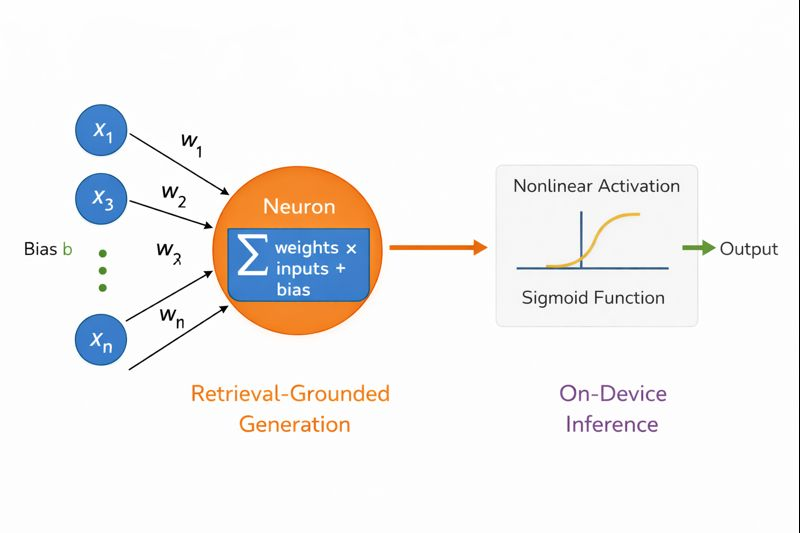
Artificial Neurons and Nonlinear Activations
Neural networks are constructed from computational units known as artificial neurons. Each neuron receives a vector of inputs, multiplies them by learned weights, adds a bias term, and applies a nonlinear activation function. This structure allows networks to approximate complex functions and learn patterns that cannot be represented with linear models alone.
Mathematically the neuron performs the transformation: y = φ( Σ (wᵢxᵢ) + b ). The summation aggregates weighted signals from previous layers, while the activation function introduces nonlinearity that enables deep networks to model hierarchical structure in data.
Common activation functions include ReLU, GELU, and sigmoid variants. Modern Transformer architectures frequently rely on GELU-style activations because they maintain smooth gradients and stable training behavior across very large parameter spaces.
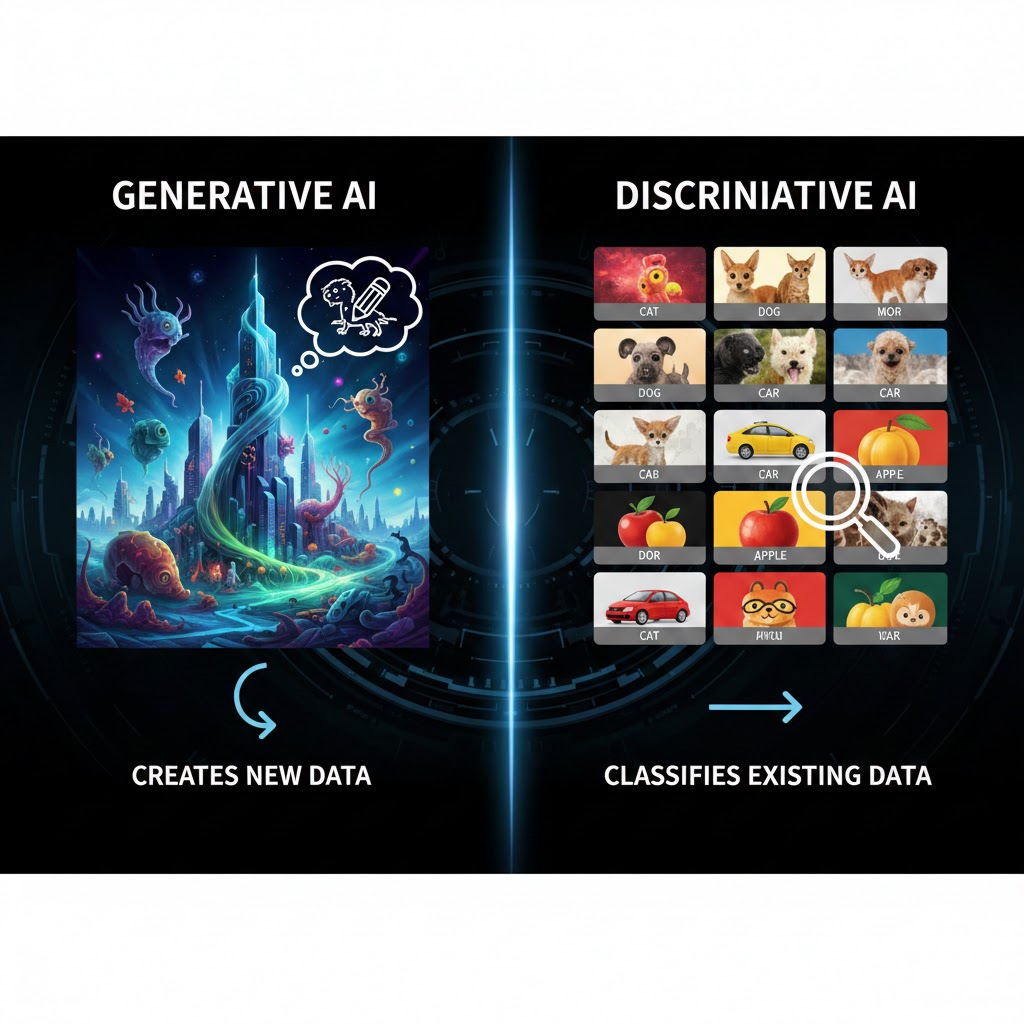
Generative vs Discriminative AI
Machine learning systems are often categorized as either discriminative or generative models. Discriminative models learn the decision boundary between classes and are optimized to predict labels from input data. Examples include logistic regression, support vector machines, and many deep-learning classifiers used for image recognition.
Generative models, by contrast, learn the probability distribution of the data itself. Instead of only classifying inputs, they can synthesize entirely new outputs consistent with the learned structure of the training data. Large language models fall into this category because they generate sequences of tokens based on learned statistical relationships.
In practice, generative systems often incorporate discriminative components such as ranking models, retrieval filters, or verification modules. Modern AI applications therefore blend both approaches to produce accurate, context-aware outputs.
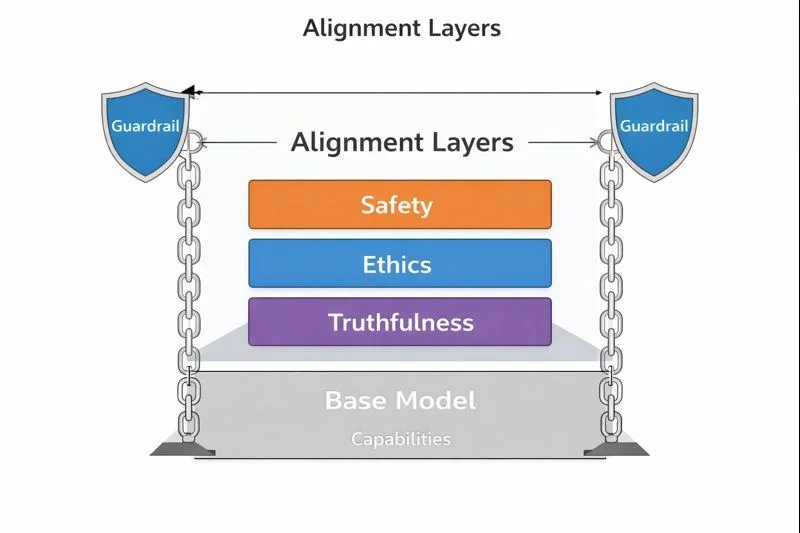
Alignment Layers and Guardrails
Base AI models are typically trained to optimize predictive accuracy, not necessarily safety, policy compliance, or domain-specific reliability. Alignment layers are therefore added on top of foundation models to guide system behavior and ensure outputs remain consistent with human intent and regulatory constraints.
Alignment mechanisms may include instruction tuning, reinforcement learning from human feedback (RLHF), rule-based policy filters, structured prompting, and runtime safety monitors. These layers shape the model’s responses, helping it avoid harmful content and maintain appropriate boundaries during interaction.
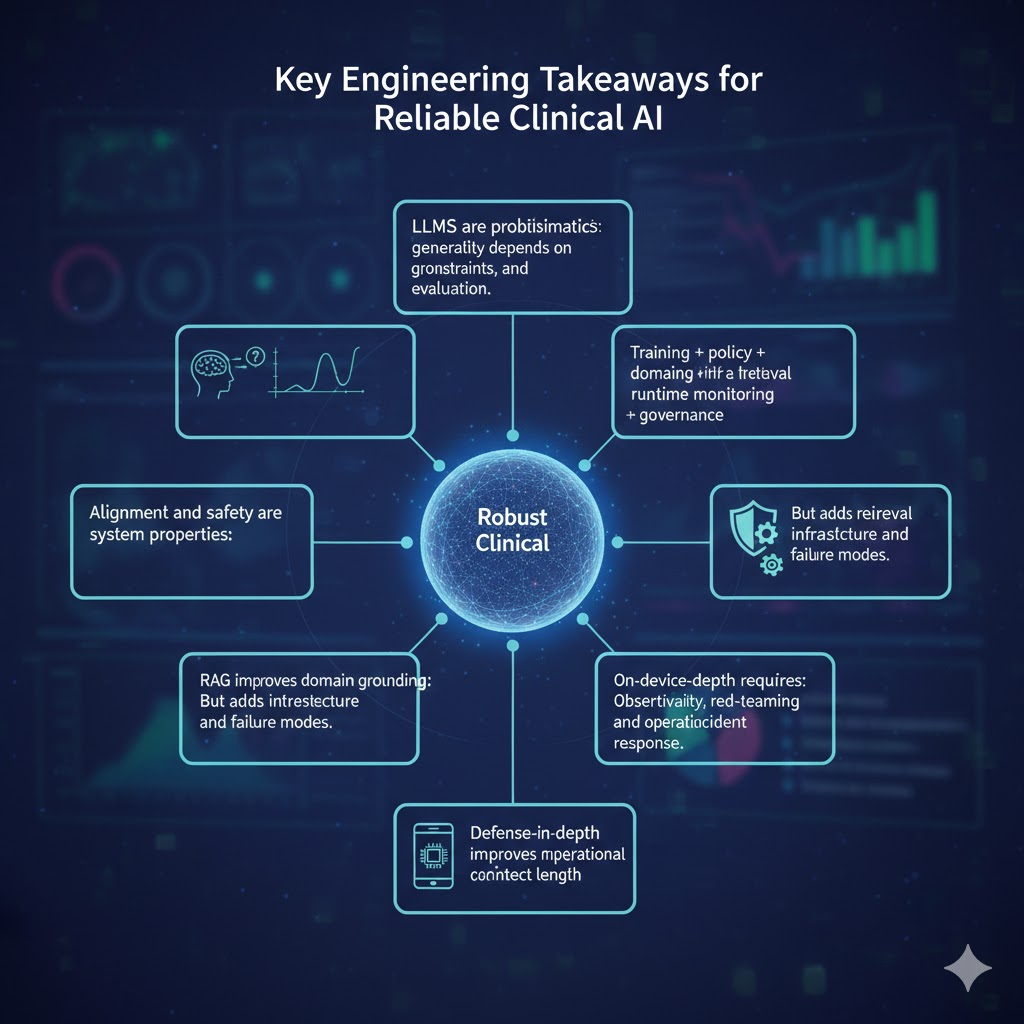
In enterprise or clinical environments, alignment is rarely a single model component. Instead it becomes a multi-layer architecture that integrates retrieval constraints, validation checks, audit logging, and human-in-the-loop review processes.
How Advanced Systems Improve Reliability
Earlier, we looked at how AI models generate responses and why they can sometimes produce confident but incorrect results.
In real-world applications — especially in business, healthcare, and engineering — this limitation is addressed by combining AI models with external data systems.
The concept below illustrates one of the most important techniques used to improve accuracy, traceability, and trust in modern AI deployments.
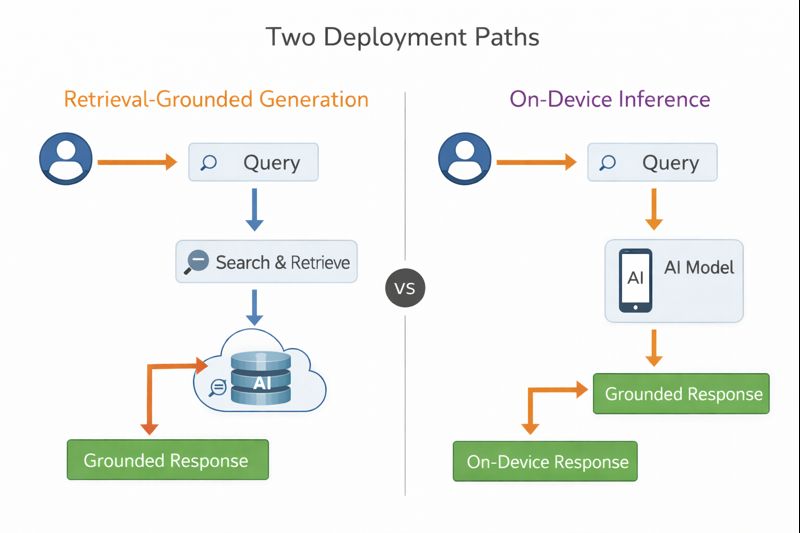
Two Deployment Paths for AI Systems
Organizations deploying modern AI typically follow one of two architectural paths: direct model deployment or augmented system deployment. The first path places a large language model directly behind an application interface, allowing the model to generate responses based solely on its pre-trained knowledge and prompt context.
While simple to implement, direct deployment often suffers from reliability limitations. Because the model cannot access external knowledge sources, responses may be incomplete or outdated. As a result, most production-grade systems move toward an augmented architecture in which the model is embedded within a broader AI pipeline.
In augmented deployments, the model is paired with retrieval systems, vector databases, safety filters, tool integrations, and monitoring layers. These additional components provide external knowledge, enforce governance policies, and allow the AI system to interact with real operational data.
This architectural distinction explains why successful enterprise AI implementations resemble distributed systems rather than single-model deployments. The model becomes only one component in a larger decision-support infrastructure.
AI System Architectures
Understanding AI requires more than knowing how models work. Real-world systems are built from layered architectures that combine models, data pipelines, retrieval systems, orchestration logic, and governance controls into scalable, production-ready solutions.
Retrieval-Augmented Generation (RAG) Architecture
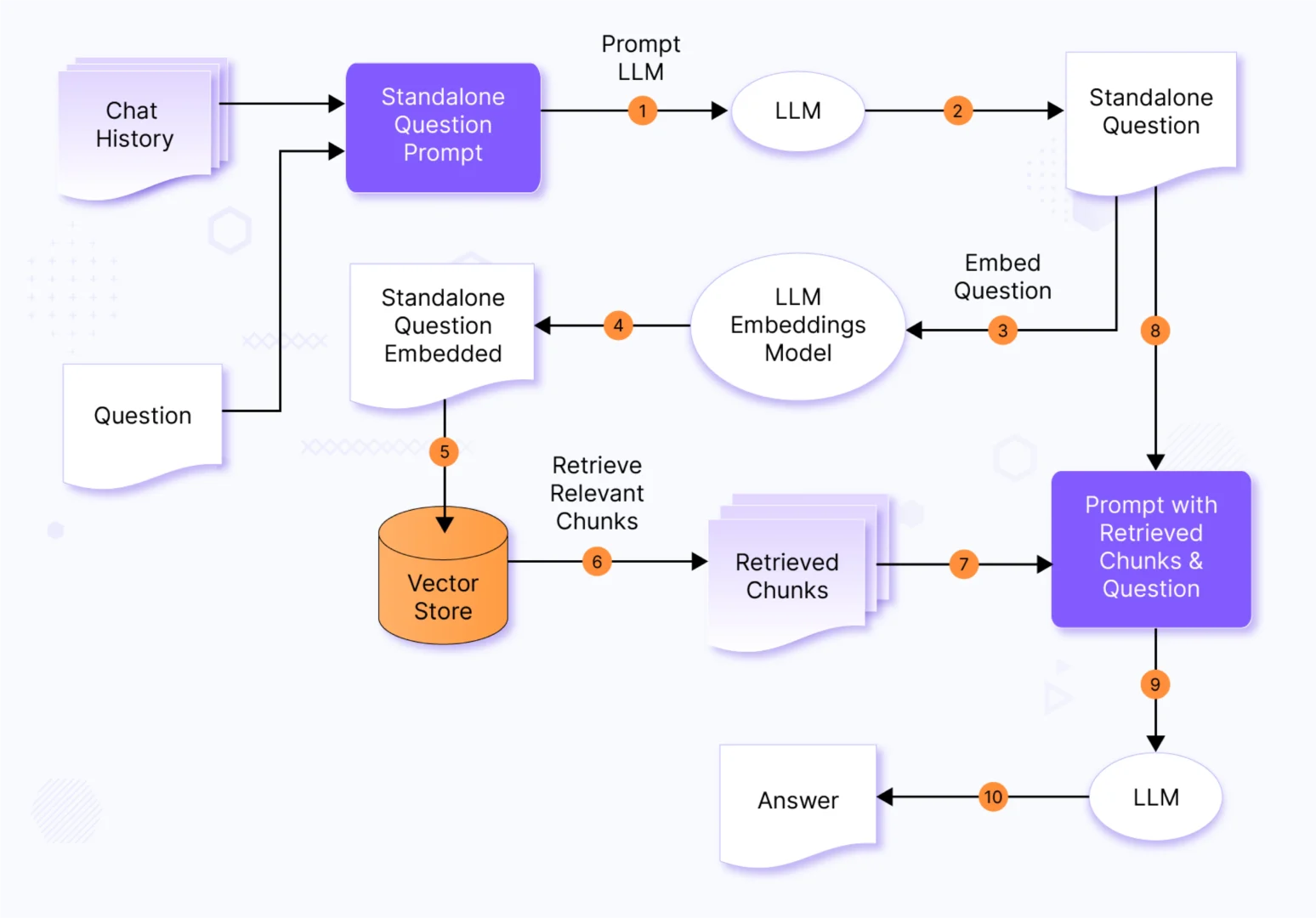
Retrieval-Augmented Generation (RAG) is a modern architectural pattern that enhances large language models by connecting them to external knowledge sources. Instead of relying solely on pre-trained parameters, the model retrieves relevant information at runtime and incorporates it into its response.
This approach addresses one of the core limitations of standalone models: the inability to access current or domain-specific data. By integrating vector databases, document stores, and retrieval pipelines, RAG systems provide grounded, verifiable outputs aligned with real-world information.
A typical RAG pipeline includes embedding generation, similarity search, context retrieval, and response synthesis. The model receives both the user query and retrieved context, allowing it to generate answers that are more accurate, explainable, and context-aware.
In enterprise environments, RAG architectures are often combined with guardrails, validation layers, and monitoring systems to ensure reliability and compliance across sensitive use cases.
Grounding and Retrieval-Augmented Generation
One of the fundamental challenges in generative AI systems is ensuring that responses remain accurate and grounded in reliable sources. Because large language models generate outputs based on learned statistical patterns, they can sometimes produce plausible but incorrect information. Grounding mechanisms address this limitation by integrating external knowledge sources directly into the inference process.
Retrieval-Augmented Generation (RAG) is a widely used approach for grounding. In a RAG architecture, a user query is converted into an embedding and used to retrieve relevant documents from a vector database or curated knowledge repository. These retrieved passages are then injected into the model’s context so that the generated response is based on verified information rather than solely on the model’s internal training data.
This approach dramatically improves reliability in enterprise and clinical environments because the model can reference updated documents, guidelines, or operational data without requiring retraining. The output can also include citations that allow human reviewers to verify the evidence used to construct the response.
How to Think About AI Moving Forward
AI is a powerful tool, but it is not magic. Its value depends on how thoughtfully it is designed, deployed, and governed within real-world environments.
The organizations that succeed with AI do not treat it as a shortcut or a replacement for expertise. Instead, they approach it with structure, discipline, and clear intent.
- A system to be managed: AI requires oversight, monitoring, and continuous refinement
- A tool to augment people: It should enhance human capability, not replace human judgment
- A responsibility: Its use carries ethical, operational, and strategic implications
When applied thoughtfully, AI can help people work more effectively, make better decisions, and improve both organizational performance and quality of life.
Key idea: AI delivers the most value when it is guided by human judgment, structured processes, and responsible oversight.
The sections below expand on each component of AI systems in greater depth.
Understand Artificial Intelligence Before Investing in Artificial Intelligence
Successful AI transformation requires more than selecting a model or deploying a chatbot. Enterprise AI success depends on workflow integration, governance architecture, operational alignment, measurable ROI, human oversight, and long-term deployment strategy. Athena Fusion Solutions helps executives and organizations understand how modern AI systems can be implemented responsibly, strategically, and effectively across healthcare, hospitality, enterprise operations, and digital transformation initiatives.
Explore the Artificial Intelligence Strategy & Architecture System
This page introduces the core concepts behind artificial intelligence, machine learning, generative AI, and enterprise AI systems. Continue through the strategic AI learning hub below to explore technical foundations, modern AI architectures, governance frameworks, retrieval-augmented generation (RAG), neuro-symbolic AI, and enterprise AI deployment strategy.
How Artificial Intelligence Works
Understand the foundational concepts behind artificial intelligence, machine learning, prediction systems, generative AI, and enterprise AI behavior.
Technical Foundations of Artificial Intelligence
Explore embeddings, neural networks, AI training systems, tokenization, inference, and the foundational components that power modern AI.
Mathematics & Architecture of Modern AI
Learn the mathematical principles, optimization systems, and architectural frameworks that govern modern AI model behavior.
RAG & Edge AI Architectures
Understand retrieval-augmented generation, contextual AI systems, enterprise retrieval pipelines, and real-time AI architectures.
AI Governance & Deployment
Learn how enterprise AI systems are governed, validated, monitored, secured, and deployed responsibly at scale.
Neuro-Symbolic Artificial Intelligence
Explore the future of AI systems combining structured reasoning, explainability, symbolic logic, and machine learning.
Why AI Projects Fail
Understand why many AI initiatives fail due to poor workflow integration, weak governance, disconnected systems, and lack of measurable ROI.
AI Investment Decision Framework
Evaluate AI initiatives through strategic alignment, operational readiness, governance maturity, implementation feasibility, and measurable business outcomes.
Frequently Asked Questions About Artificial Intelligence
Learn how modern artificial intelligence systems work, how machine learning and generative AI differ, where AI is used in business and healthcare, and why governance, workflow integration, and human oversight are essential for successful enterprise AI deployment.
What is artificial intelligence in simple terms?
Artificial intelligence (AI) refers to computer systems designed to perform tasks that normally require human intelligence, including reasoning, language understanding, prediction, pattern recognition, decision support, and automation. Modern AI systems are commonly used across healthcare, finance, hospitality, cybersecurity, manufacturing, and enterprise operations.
How does artificial intelligence work?
Artificial intelligence systems work by analyzing large amounts of data, identifying patterns, learning from examples, and using algorithms to make predictions or automate decisions. Modern enterprise AI systems often combine machine learning, large language models (LLMs), retrieval-augmented generation (RAG), workflow integration, and governance frameworks to support real-time operational intelligence.
What are examples of artificial intelligence?
Examples of artificial intelligence include ChatGPT and generative AI assistants, recommendation systems used by streaming platforms, fraud detection systems in banking, predictive healthcare analytics, AI-powered customer service platforms, cybersecurity monitoring, autonomous systems, wearable health monitoring, and enterprise workflow automation tools.
What is the difference between artificial intelligence and machine learning?
Artificial intelligence is the broader field focused on creating intelligent systems capable of reasoning, prediction, and automation. Machine learning is a subset of AI that enables systems to learn from data and improve performance over time without being explicitly programmed. Most modern AI applications rely heavily on machine learning models.
What is generative AI?
Generative AI refers to artificial intelligence systems capable of creating new content, including text, images, audio, video, software code, and business insights. Generative AI platforms often rely on large language models trained on massive datasets to generate human-like responses and assist with communication, research, and decision-making.
Why do many AI projects fail?
Many AI projects fail because organizations focus only on the AI model itself rather than the broader system architecture. Common causes include poor workflow integration, disconnected enterprise systems, weak governance, lack of quality data, unclear business objectives, insufficient human oversight, and failure to measure ROI.
What industries benefit most from artificial intelligence?
Artificial intelligence is transforming nearly every industry, including healthcare, hospitality, finance, manufacturing, logistics, cybersecurity, retail, defense, education, energy, and enterprise operations. AI is commonly used to improve operational efficiency, automate repetitive tasks, enhance customer experiences, support decision-making, and identify patterns within large datasets.
Can artificial intelligence replace human decision-making?
Artificial intelligence can support and augment human decision-making, but human oversight remains critical in most enterprise and healthcare environments. Human-centered AI systems combine automation with governance, validation, ethical safeguards, explainability, and operational accountability to ensure responsible deployment and trustworthy outcomes.
Artificial Intelligence References & Authoritative Resources
The following references support this guide to artificial intelligence, machine learning, generative AI, large language models, AI governance, enterprise AI systems, and responsible AI deployment. Internal resources provide additional Athena Fusion Solutions guidance on AI strategy, technical foundations, RAG architectures, and executive AI implementation.
Internal AI Strategy Resources
- Athena Fusion Solutions AI Strategic Hub — executive resources on artificial intelligence strategy, AI architecture, governance, deployment, and industry-specific AI transformation.
- Technical Foundations of Artificial Intelligence — foundational AI concepts including model training, embeddings, neural networks, inference, and data-driven prediction.
- RAG and Edge AI Architectures — how retrieval-augmented generation and edge AI improve AI accuracy, context, latency, and operational relevance.
- AI Governance and Deployment — governance, validation, oversight, safety, and deployment considerations for enterprise artificial intelligence systems.
- Why AI Projects Fail — strategic analysis of workflow integration, governance gaps, system architecture, and ROI discipline in enterprise AI initiatives.
- AI Investment Decision Framework — a practical framework for evaluating AI opportunities, business readiness, implementation risk, and measurable return on investment.
External Authoritative AI References
- Vaswani et al. (2017). Attention Is All You Need. arXiv — foundational transformer architecture paper behind many modern large language models.
- OpenAI. GPT-4 Technical Report. arXiv — technical report describing capabilities, limitations, and safety considerations of GPT-4.
- Anthropic. Constitutional AI: Harmlessness from AI Feedback. arXiv — research on AI alignment, harmlessness, and scalable feedback methods.
- Sutton & Barto. Reinforcement Learning: An Introduction. MIT Press — foundational reference on reinforcement learning and sequential decision-making.
- NIST. AI Risk Management Framework 1.0. NIST — U.S. framework for managing artificial intelligence risk, trustworthiness, and governance.
- FDA. Clinical Decision Support Software Guidance. FDA — regulatory guidance relevant to AI-enabled healthcare decision support systems.
Athena Fusion Solutions provides strategic advisory for organizations navigating AI adoption, including readiness assessment, system architecture, operating models, and implementation pathways. Engagements are designed to deliver measurable outcomes while preserving the human-centered experience that defines premium service environments.
Next Steps
This guide is provided freely as an independent educational resource to help leaders better understand modern AI.
No obligation • Conversations start with understanding your goals
Download: Technical Foundations of Modern AI
Get the complete PDF guide with expanded explanations, diagrams, and practical examples of how modern AI systems work — designed as a free educational resource for leaders and professionals.
Ready to move from understanding AI to applying it strategically?
An independent educational resource designed to help leaders and professionals understand the real capabilities, limitations, and practical applications of modern artificial intelligence.
Additional diagrams, glossaries, and practical examples are available throughout this guide. Download the full technical overview for offline reference.
Download Full PDF