AI Systems and Tools Compared: Models, Platforms, and Use Cases
A curated comparison of leading agentic AI platforms, orchestration frameworks, autonomous agent systems, and workflow automation engines. Evaluate strengths, enterprise readiness, governance considerations, and ideal deployment use cases.
Executive Summary — Key Decision Realities
- No single AI tool is sufficient — high-performing organizations deploy integrated stacks aligned to specific use cases.
- The market is converging into layered systems — models, automation, orchestration, and workflow applications now function as connected operating layers.
- Ease of use comes at the cost of control — simple tools accelerate adoption, while advanced systems require architecture and governance.
- Enterprise success is governed, not just built — security, compliance, review, and ownership determine whether AI scales safely.
- ROI is driven by integration — value comes from how systems connect to workflows, not from isolated tool selection alone.
Who This Guide Is For
This guide is designed for executives, operators, innovation leaders, and technical decision-makers who are already encountering AI through staff experimentation, vendor add-ons, or pressure to “do something with AI,” and need a practical way to evaluate options without being pulled into tool hype.
Rather than focusing on product trivia, this page focuses on business outcomes: where each resource type fits, what it does well, where limitations emerge, and when structured strategy becomes more valuable than continued experimentation.
For organizations in hospitality, wellness, healthcare-adjacent, and other high-trust service environments, the challenge is rarely access to tools. The real challenge is choosing the right operating model, governance posture, and investment sequence.
The Four Main Types of AI Resources
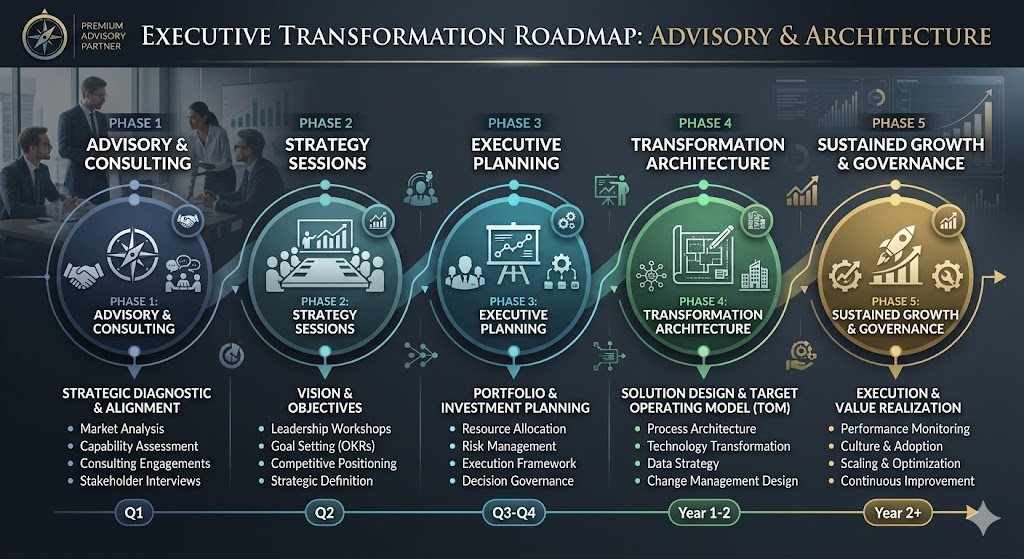
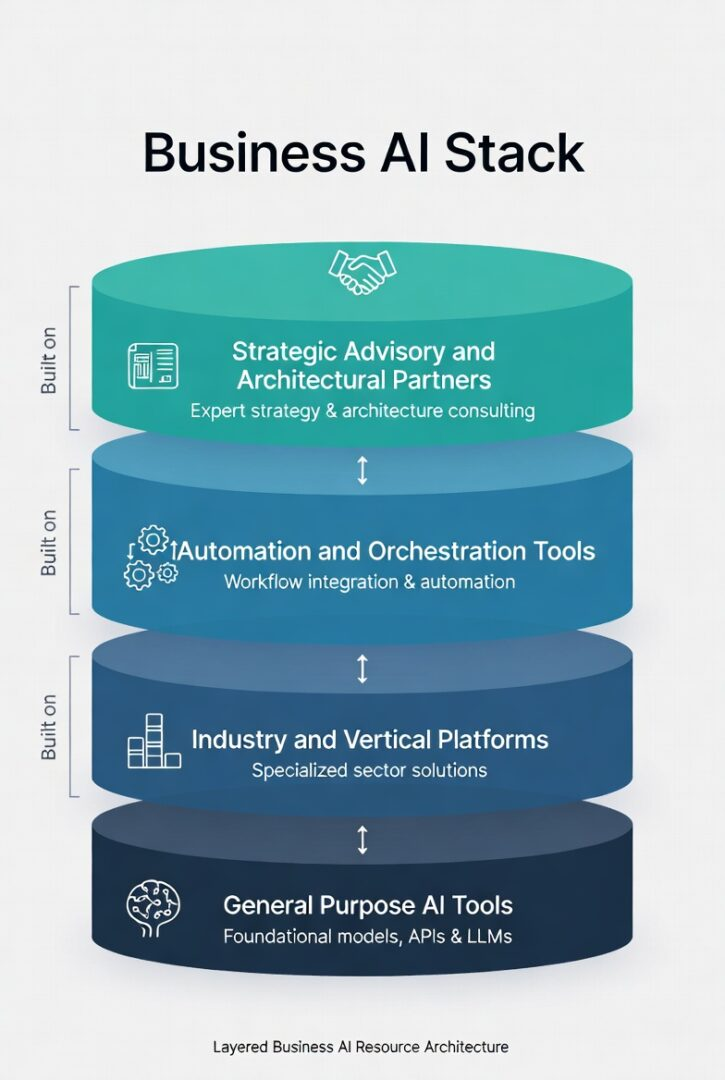
Most organizations encounter AI through four broad categories: general-purpose AI tools, industry platforms with embedded AI, automation and orchestration systems, and strategic advisory partners. Each has value, but each serves a different role in the maturity curve.
Problems arise when these categories are treated as substitutes. A chatbot is not a strategy. A vendor add-on is not governance. An automation workflow is not an architecture roadmap. High-performing organizations understand how these layers fit together.
1. General-Purpose AI Tools
Tools like ChatGPT, Claude, Gemini, and Copilot are flexible, accessible, and useful for early experimentation.
- Best for: Quick drafting, brainstorming, ideation, and first-pass analysis
- Strengths: Fast, inexpensive, highly flexible, easy to adopt
- Limits: Inconsistent outputs, no built-in governance, privacy and data risks if unmanaged
2. Industry & Vertical Platforms
PMS, CRM, EHR, and marketing suites increasingly include embedded AI features tied to specific workflows.
- Best for: Platform-defined use cases like messaging, forecasting, scheduling, and documentation
- Strengths: Lower friction, embedded adoption, vendor-managed enhancements
- Limits: Vendor lock-in, narrow feature sets, weak cross-system flexibility
3. Automation & Orchestration Systems
Zapier, Make, native workflow builders, integration layers, and agentic orchestration frameworks provide the connective tissue between models and business systems.
- Best for: Multi-step automations, system integration, repetitive task reduction, and cross-system workflows
- Strengths: Large efficiency gains, measurable time savings, repeatable workflows
- Limits: Can become brittle, undocumented, and risky if built ad hoc
4. Strategic Advisory & Architecture Partners
Strategic advisors help determine what to build, what to buy, where to pilot, and how to govern AI at the portfolio level.
- Best for: Roadmaps, prioritization, vendor evaluation, governance, ROI modeling
- Strengths: Vendor-agnostic perspective, policy design, executive alignment
- Limits: Guides decisions rather than replacing internal operations
Athena AI Tool Selection Framework™
AI tools should not be evaluated in isolation. This framework provides a structured method for comparing platforms based on operational impact, scalability, governance exposure, and integration reality.
Capability Depth
What it determines: Level of sophistication and flexibility.
Tradeoff: Higher capability usually increases complexity and cost.
Ease of Use
What it determines: Speed of adoption and accessibility.
Tradeoff: Simplicity often limits control and customization.
Integration Complexity
What it determines: Ability to connect with existing systems.
Impact: A primary driver of implementation success and ROI.
Scalability
What it determines: Suitability for enterprise deployment.
Constraint: Many tools perform well in pilots but break down at scale.
Governance Risk
What it determines: Security, compliance, and oversight exposure.
Priority: Critical in healthcare, finance, and other regulated environments.
ROI Potential
What it determines: Business impact relative to effort.
Reality: Value is realized through connected workflows, not tool selection alone.
AI Platform Evaluation Matrix
The following comparison applies the Athena AI Tool Selection Framework™ across representative tools and platforms.
| Tool / Platform | Category | Strength | Limitation | Best Use Case |
|---|---|---|---|---|
| ChatGPT / OpenAI | General-Purpose AI | Strong reasoning, broad ecosystem, flexible use | Requires governance and workflow design | General AI adoption, ideation, workflow augmentation |
| Claude / Anthropic | Reasoning & Safety-Oriented AI | High-quality reasoning, strong document handling | Smaller ecosystem | Research, writing, regulated environments |
| Gemini / Google | Multimodal & Productivity AI | Strong integration with Google ecosystem | Performance can vary by use case | Search-driven workflows, productivity augmentation |
| Copilot / Microsoft | Enterprise Productivity AI | Natural fit for Microsoft-centric organizations | Depends heavily on Microsoft stack maturity | Internal productivity, documentation |
| Runway | Video Generation | High creative control | Steeper learning curve | Marketing production, cinematic content |
| Synthesia | Avatar Video | Scalable script-to-video production | Limited realism | Training, onboarding, customer education |
| CapCut | Editing & Social Automation | Rapid editing and captions | Limited enterprise depth | Short-form content |
Core AI Platform Comparison
| Player | Primary Role in the Stack | Niche / Core Strength |
|---|---|---|
| OpenAI | General-purpose reasoning and agentic workflows | Benchmark for reasoning, versatility, and workflow extensibility |
| Multimodal platform tied to search and productivity | Strong reach across search, workspace, and multimodal AI | |
| Anthropic | Reasoning and safety-focused model platform | Structured output quality and long-context handling |
| Microsoft | Enterprise workflow and productivity layer | Deep organizational integration and compliance alignment |
| Perplexity | Research-first answer and browsing layer | Fast research workflows and citation-oriented output |
| Meta | Open-model ecosystem | Private deployment and customization leverage |
| Mistral AI | Efficiency and sovereignty-oriented platform | Privacy-conscious positioning and multilingual strength |
Workflow, Research, and Productivity Systems
| Category | Representative Platforms | Primary Value |
|---|---|---|
| Deep Research | Perplexity, OpenAI research workflows | Multi-source analysis and citation-backed output |
| Document Intelligence | NotebookLM and document-grounded assistants | Q&A grounded in uploaded internal materials |
| Workflow Automation | n8n, Zapier, native automation layers | Cross-system orchestration and operational efficiency |
| Meeting Intelligence | Granola, Fireflies.ai | Transcript capture and structured notes |
Specialized Development and Build Tools
| Category | Representative Platforms | Niche / Core Strength |
|---|---|---|
| AI Coding Editor | Cursor, Replit Agent | Codebase awareness, refactoring, assisted software development |
| Full-Stack App Generation | Lovable, v0-style builders | Prompt-driven generation of application scaffolding |
| Mini-App Builder | Opal and lightweight builders | Rapid internal tool creation |
| E-Commerce / Vertical Builder | Specialized storefront and vertical builders | Fast deployment for narrower commercial use cases |
Agentic AI Orchestration and Development Frameworks
LangChain
Flexible orchestration framework for tool use, memory, retrieval, and multi-step workflows.
Visit →Microsoft AutoGen
Framework for collaborative agent workflows and complex workflow experimentation.
Visit →OpenAI Developer Platform
Model access, tool integration, and structured developer capabilities for agent-like systems.
Visit →Semantic Kernel
Microsoft-oriented orchestration framework for AI planning and memory in business apps.
Visit →Representative AI Deployment Stacks
Core model layer → content generation tool → editing layer → publishing workflow
Designed for speed and scale.
Core model layer → avatar / presentation system → internal LMS or knowledge system
Optimized for consistency and policy alignment.
Core model layer → orchestration framework → internal systems / CRM / EHR / PMS
Focused on business-process automation and long-term ROI.
Side-by-Side Comparison of AI Resources
| Resource Type | Best For | Strengths | Risks / Limits | When to Engage Athena Fusion |
|---|---|---|---|---|
| General-purpose AI tools | Quick drafting and experiments | Fast to start, low cost | Inconsistent quality, privacy risk | When ad hoc wins begin touching critical workflows |
| Industry / vertical platforms | Enhancing workflows inside existing systems | Embedded adoption, easier use | Vendor roadmap constraints | When comparing vendor AI claims |
| Automation / orchestration tools | Connecting models and systems | Reduce manual work and improve consistency | Can become brittle without architecture | When automation touches core revenue or regulated data |
| Strategic advisory & architecture | Roadmaps, governance, vendor evaluation | Vendor-agnostic, executive-level, ROI-centered | Guides decisions rather than replacing ops | When AI is on the executive agenda |
When AI Resources Go Wrong
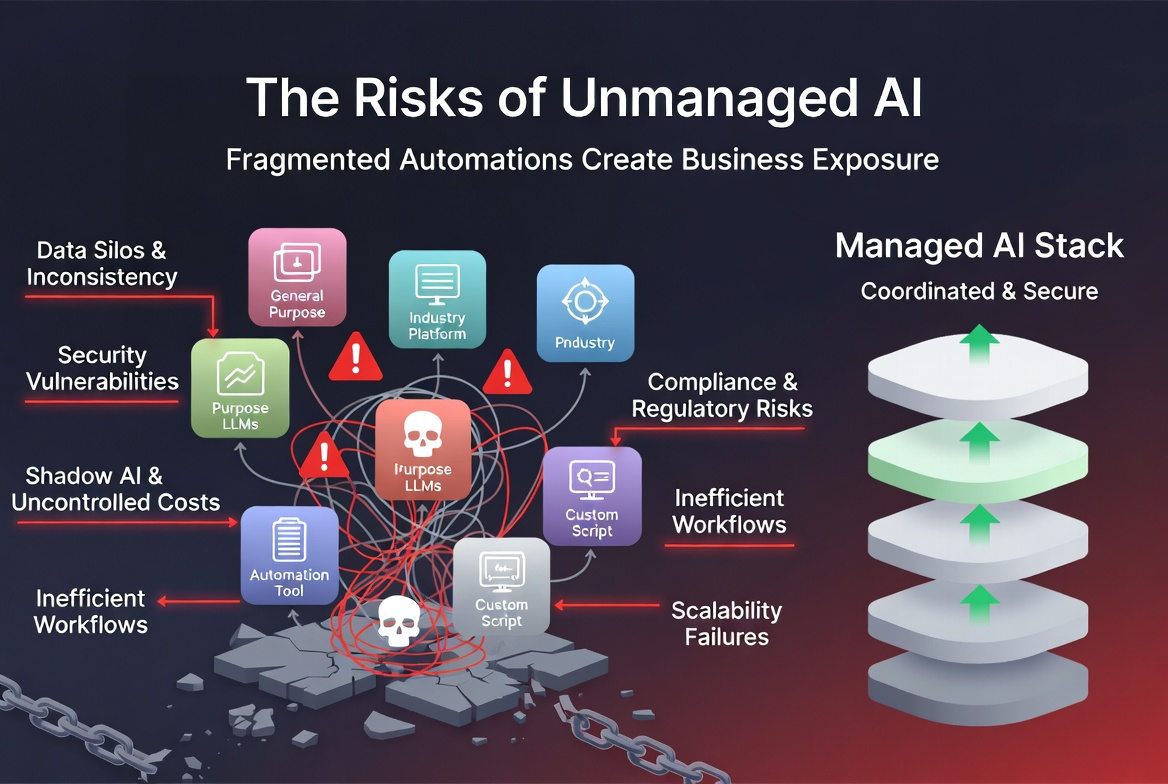
Many organizations first experience AI through scattered wins. These wins can be real—but unmanaged, they often create hidden fragility.
Common warning signs include inconsistent messaging, brittle automations, unclear workflow ownership, and no reliable way to measure ROI.
A structured 60–90 day pilot converts scattered activity into a focused, governed portfolio of initiatives with clear metrics, owners, and guardrails.
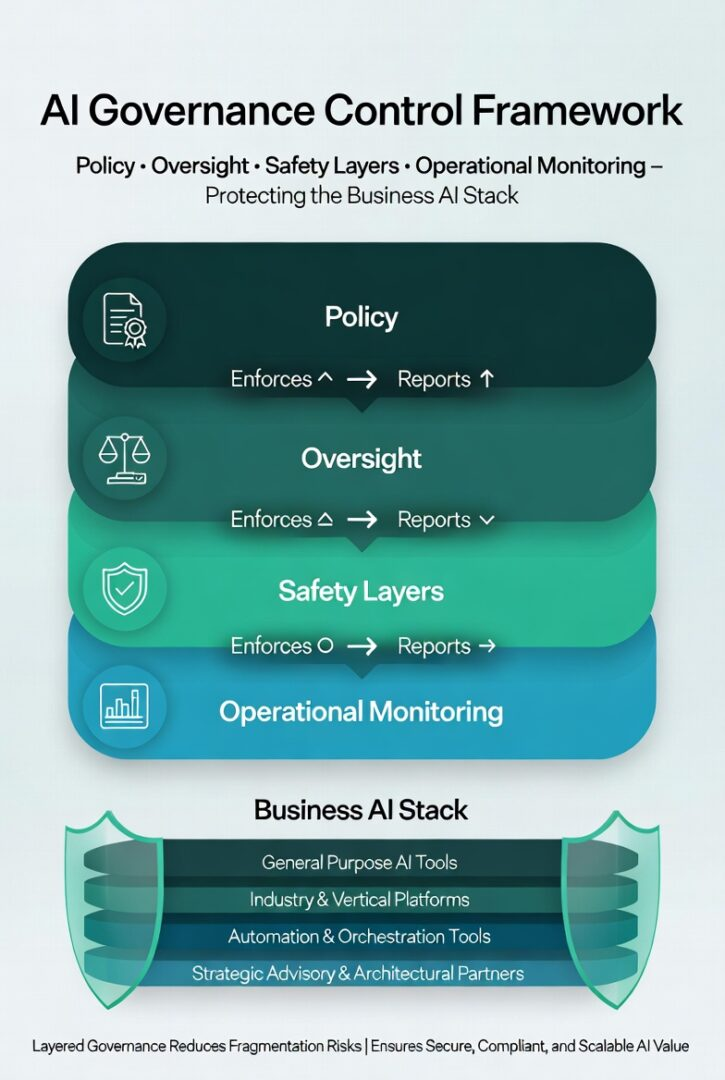
Governance, Safety, and Policy
As AI becomes embedded in operations, governance is no longer optional.
Privacy, brand voice, compliance, and risk controls must be part of the design from day one.
Governance is not a product feature. It is a design discipline spanning policy, architecture, workflow design, review processes, and leadership accountability.
How Athena Fusion Fits Into Your AI Resource Mix
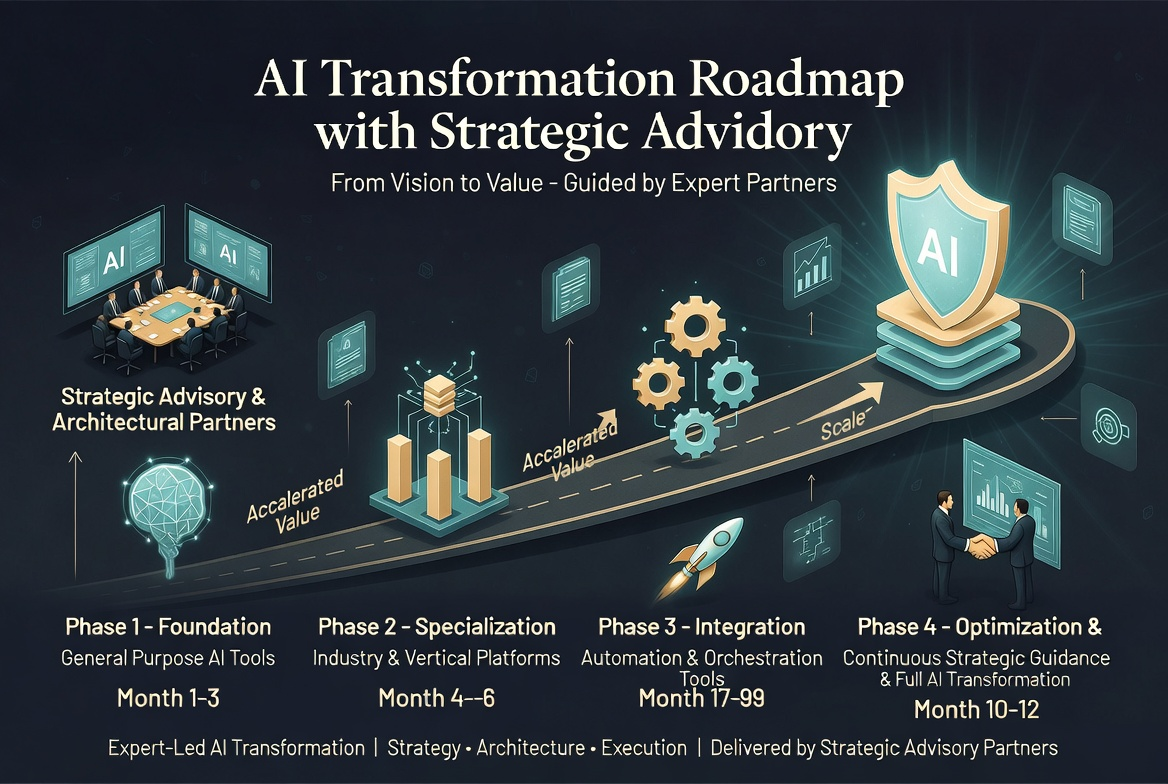
Athena Fusion provides human-centered AI strategy and architecture support for organizations that need structured decision-making, not random tool accumulation.
We help leaders identify high-value use cases, evaluate vendor claims, design automation pathways, and establish governance for sustainable adoption.
Our work often begins with AI readiness assessments and 60–90 day pilots designed to demonstrate measurable value while protecting brand, data, and organizational trust.
Next Steps: Move From Comparison to Action
If your team is already experimenting with AI—or vendors are actively pitching new AI features—this is the point to move from reactive decisions to deliberate strategy.