Advanced AI Architectures

Introduction to Neuro-Symbolic AI: From Neural Prediction to Explainable Reasoning Systems

Neuro-symbolic AI integrates neural networks, symbolic reasoning, knowledge representation, rules, and constraints to create AI systems that are more explainable, auditable, and suitable for complex enterprise decision environments.

This page is intended for experienced technologists, AI strategists, systems architects, and enterprise leaders evaluating how advanced AI architectures can support governed, high-trust decision intelligence.

Part of the AI Strategic & Education Hub — Athena Fusion Solutions flagship advisory framework.
Neuro-Symbolic AI • Hybrid Intelligence Systems • Enterprise Architecture

Introduction to Neuro-Symbolic AI: From Statistical Prediction to Explainable Reasoning Systems

Neuro-symbolic AI represents a fundamental shift in AI system architecture, combining neural networks with symbolic reasoning, structured knowledge, and constraint-based logic. These hybrid AI systems move beyond black-box prediction toward more explainable, auditable, and governable intelligence.

This page is designed for experienced technologists, AI strategists, and systems architects evaluating how neuro-symbolic architectures enable more reliable decision intelligence in complex, high-stakes environments.

Architectural Transition

From Statistical AI to Reasoning Systems

Modern artificial intelligence systems—particularly machine learning and deep learning—excel at identifying patterns in large datasets. However, these systems often lack the ability to apply structured reasoning, enforce constraints, or explain how decisions are derived.

Symbolic AI takes a fundamentally different approach, using rules, logic, and knowledge representation to enable traceable and interpretable reasoning. While highly explainable, symbolic systems alone lack the adaptability and learning capacity of neural network-based models.

Neuro-symbolic AI integrates these approaches into a unified architecture, combining neural pattern recognition with symbolic reasoning and constraint-based logic. This enables AI systems to move beyond prediction toward structured, explainable decision-making.

Neuro-Symbolic AI Architecture

Core Architecture of Neuro-Symbolic AI Systems

A neuro-symbolic AI architecture integrates neural networks with symbolic reasoning to create hybrid AI systems capable of both learning from data and applying structured logic. This approach enables AI systems to move beyond prediction toward explainable, constraint-aware decision-making.

Neural Layer: Handles perception, embeddings, feature extraction, and pattern recognition across large and unstructured datasets using machine learning and deep learning models.

Symbolic Layer: Applies rules, ontologies, knowledge graphs, and domain-specific logic to enforce constraints, represent expert knowledge, and support interpretable reasoning.

Integration Layer: Connects learned representations to symbolic structures, enabling translation between statistical outputs and structured reasoning frameworks.

Decision & Validation Layer: Evaluates outputs against rules, policies, and contextual constraints, ensuring that AI-generated recommendations align with domain requirements, governance standards, and real-world conditions.
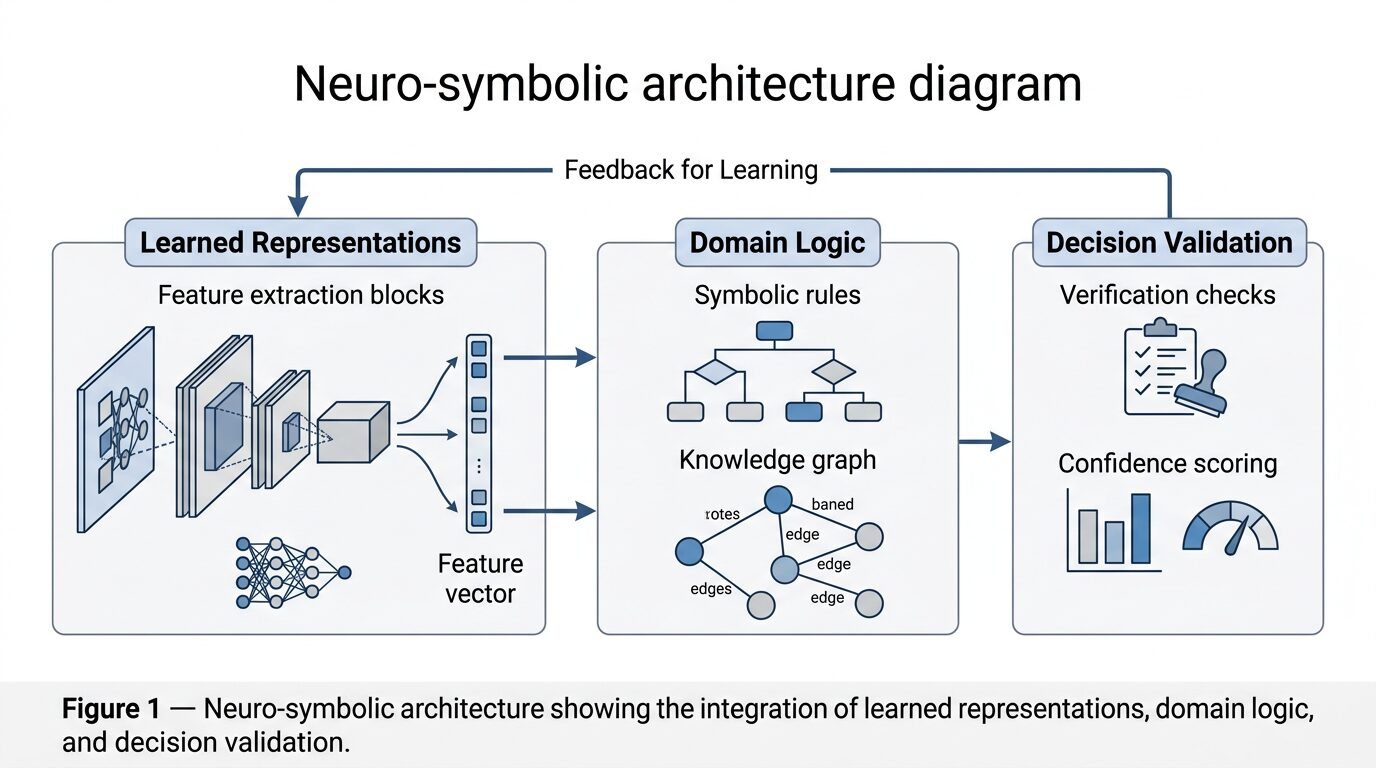
Neuro-symbolic AI architecture showing neural layer, symbolic reasoning layer, integration layer, decision validation, and feedback loop
Figure 1 — Neuro-symbolic AI architecture showing the integration of neural representations, symbolic reasoning, knowledge graphs, decision validation, and feedback-based learning.
Applied Enterprise Value

Where Neuro-Symbolic AI Creates Enterprise Impact

Once the architecture is understood, the strategic question becomes where neuro-symbolic AI creates measurable value. The strongest use cases occur where AI systems must combine adaptive learning with rules, expert knowledge, compliance logic, and human oversight.
Neuro-symbolic
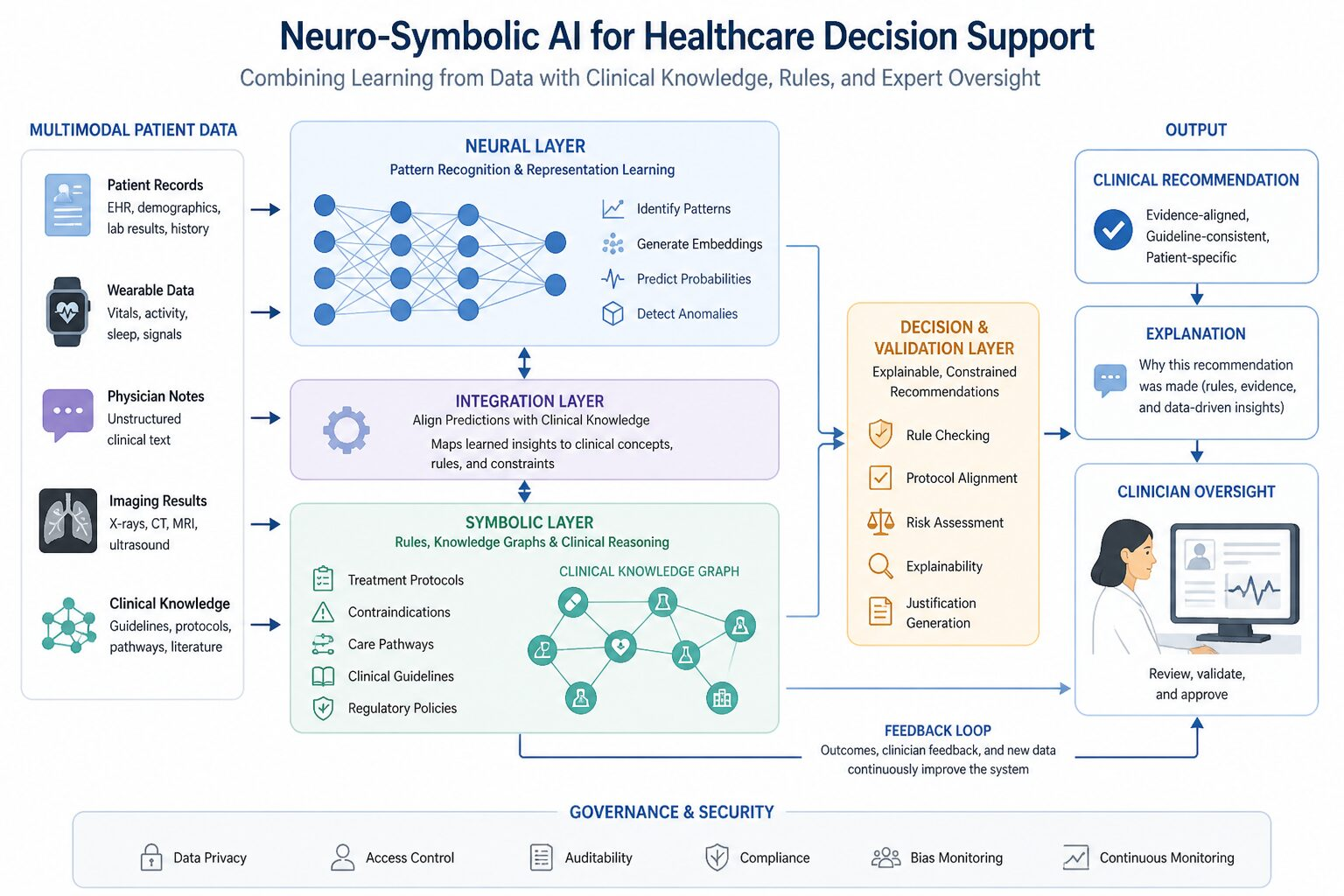
Figure 2 — Neuro-symbolic AI architecture for healthcare decision support, illustrating how multimodal patient data (EHR, wearables, imaging, and clinical notes) is processed through neural and symbolic layers, validated against clinical rules and protocols, and delivered as explainable, auditable recommendations with clinician oversight and continuous feedback.

Healthcare and Clinical Decision Support

In healthcare, neuro-symbolic AI can integrate patient records, wearable data, physician notes, imaging results, and clinical knowledge graphs. Neural models identify emerging patterns, while symbolic reasoning helps ensure recommendations align with treatment protocols, contraindications, care pathways, and clinician oversight.

AI Governance, Compliance, and Risk Control

Neuro-symbolic AI can embed regulatory logic, enterprise policies, ethical constraints, and risk thresholds directly into AI decision systems. This helps ensure outputs are auditable, compliant, and aligned with organizational standards—especially in healthcare, finance, defense, and other regulated industries.
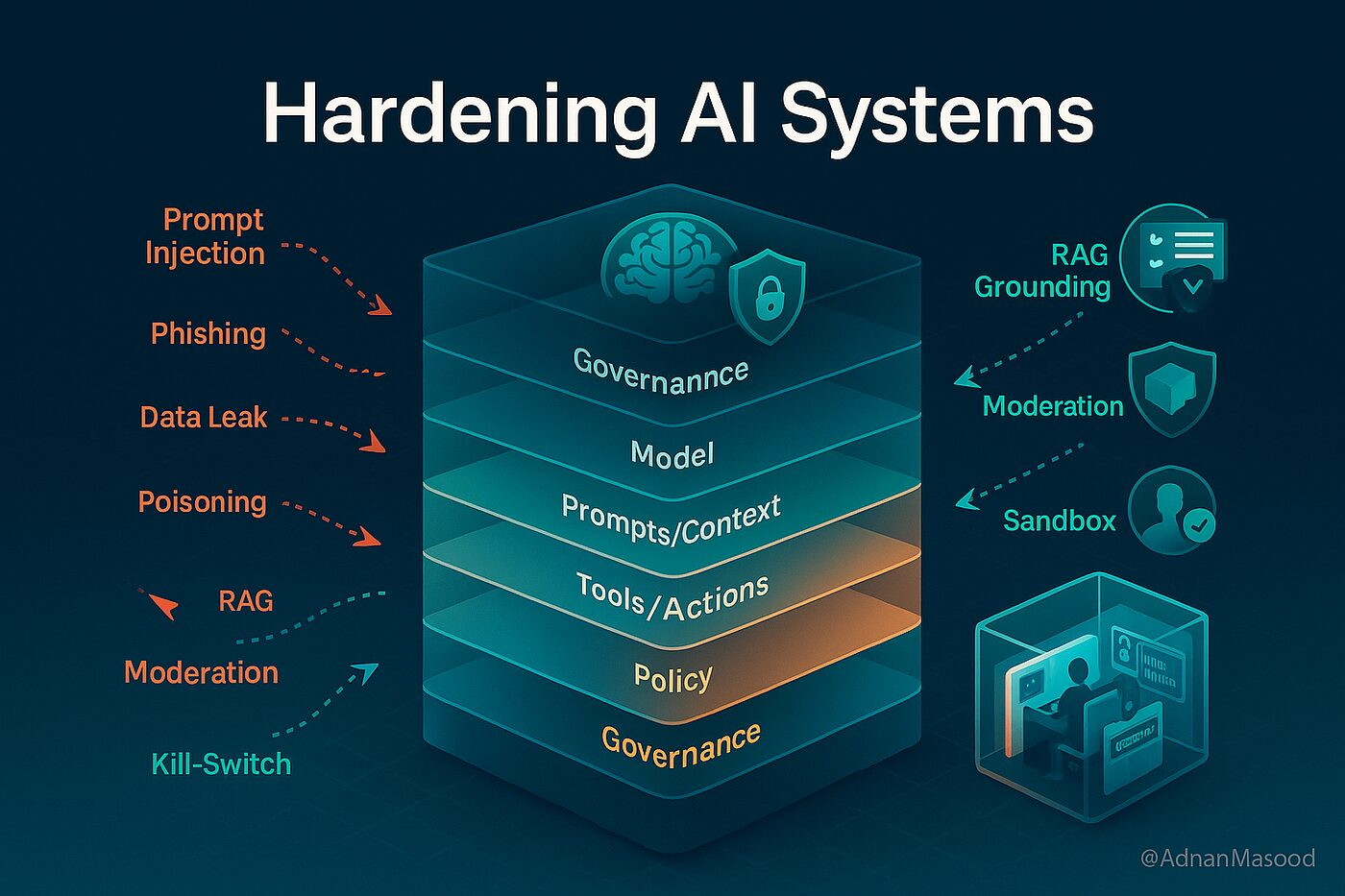
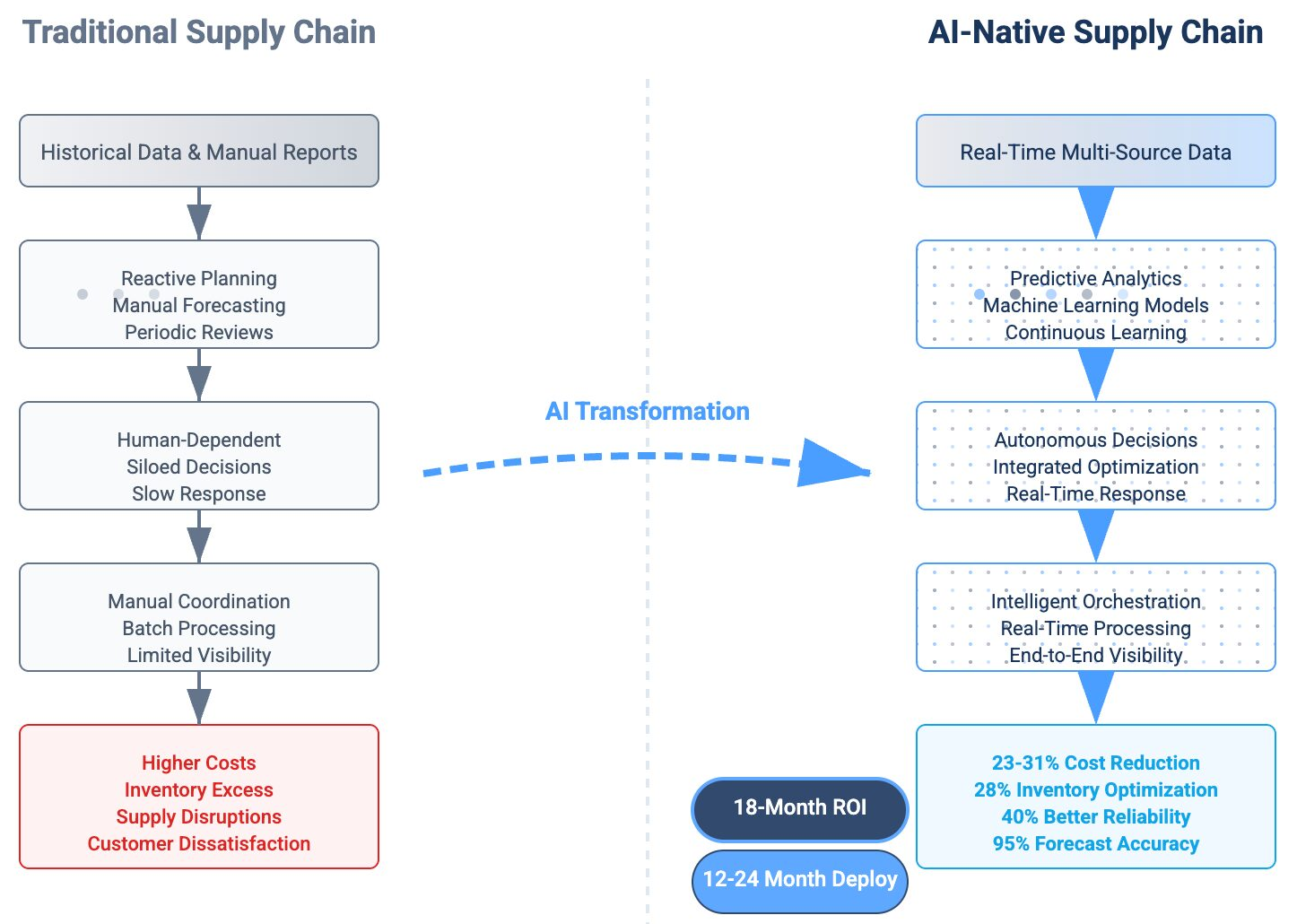
AI governance framework diagram showing policy alignment, compliance controls, risk management, auditability, and responsible enterprise AI deployment
Figure 3 — AI governance framework illustrating how policy alignment, compliance controls, risk management, auditability, and responsible deployment support trustworthy enterprise AI systems.
AI-native systems compared with traditional software showing continuous learning, adaptive intelligence, real-time optimization, and static rule-based workflows
Figure 4 — Comparison of AI-native systems and traditional software, highlighting continuous learning, adaptive intelligence, real-time optimization, and limitations of static rule-based workflows.

AI-Native Systems Compared with Traditional Software

AI-native systems are designed with intelligence, learning, and adaptive decision support embedded at the core. Traditional systems often rely on static rules and manual updates, limiting their ability to respond dynamically to complex data, changing conditions, and evolving enterprise workflows.

Strategic Implications

Why Neuro-Symbolic AI Matters for Enterprise Systems

Neuro-symbolic AI extends beyond predictive performance by enabling systems that are explainable, governed, and aligned with real-world constraints. This shift is essential for enterprise environments where accuracy alone is insufficient without transparency, control, and accountability.

Explainable Decision Systems

AI outputs can be traced to structured logic, rules, and knowledge frameworks, improving interpretability and supporting auditability.

Embedded Governance

Policies and constraints can be integrated directly into system logic, enabling compliance and controlled decision-making at scale.

Operational Trust

Transparent reasoning improves confidence among technical and operational stakeholders, supporting broader adoption across enterprise workflows.

Resilience in High-Stakes Systems

Validation against domain rules reduces errors, hallucinations, and failure modes in critical applications.

System Design

Detailed Components of Neuro-Symbolic AI Systems

While neuro-symbolic AI is often described conceptually, real-world implementation depends on a coordinated set of system components. These components determine how data is processed, how reasoning is applied, and how decisions are validated in operational environments.

1. Neural Layer (Machine Learning and Deep Learning)

Processes high-dimensional data such as text, images, and sensor streams. Generates embeddings, detects patterns, and produces probabilistic outputs using machine learning models.

2. Symbolic Layer (Rules and Knowledge Representation)

Encodes structured knowledge using rules, ontologies, and domain logic. Enables interpretable reasoning and constraint-aware decision-making.

3. Integration Layer (System Orchestration)

Connects neural outputs to symbolic reasoning systems, allowing statistical predictions to be evaluated within structured logic and operational constraints.

4. Decision and Validation Layer

Evaluates outputs against rules, policies, and contextual constraints. Supports explainability, auditability, and controlled decision pathways.

5. Knowledge Assets (Graphs and Ontologies)

Provides reusable structured knowledge through knowledge graphs, ontologies, and expert-defined rules, improving consistency and scalability across systems.

6. Human Oversight (Human-in-the-Loop)

Incorporates expert review, exception handling, and escalation pathways to ensure that human judgment remains part of decision-making in complex or high-risk scenarios.

Enterprise Architecture View

Neuro-Symbolic AI Architecture for Enterprise Decision Systems
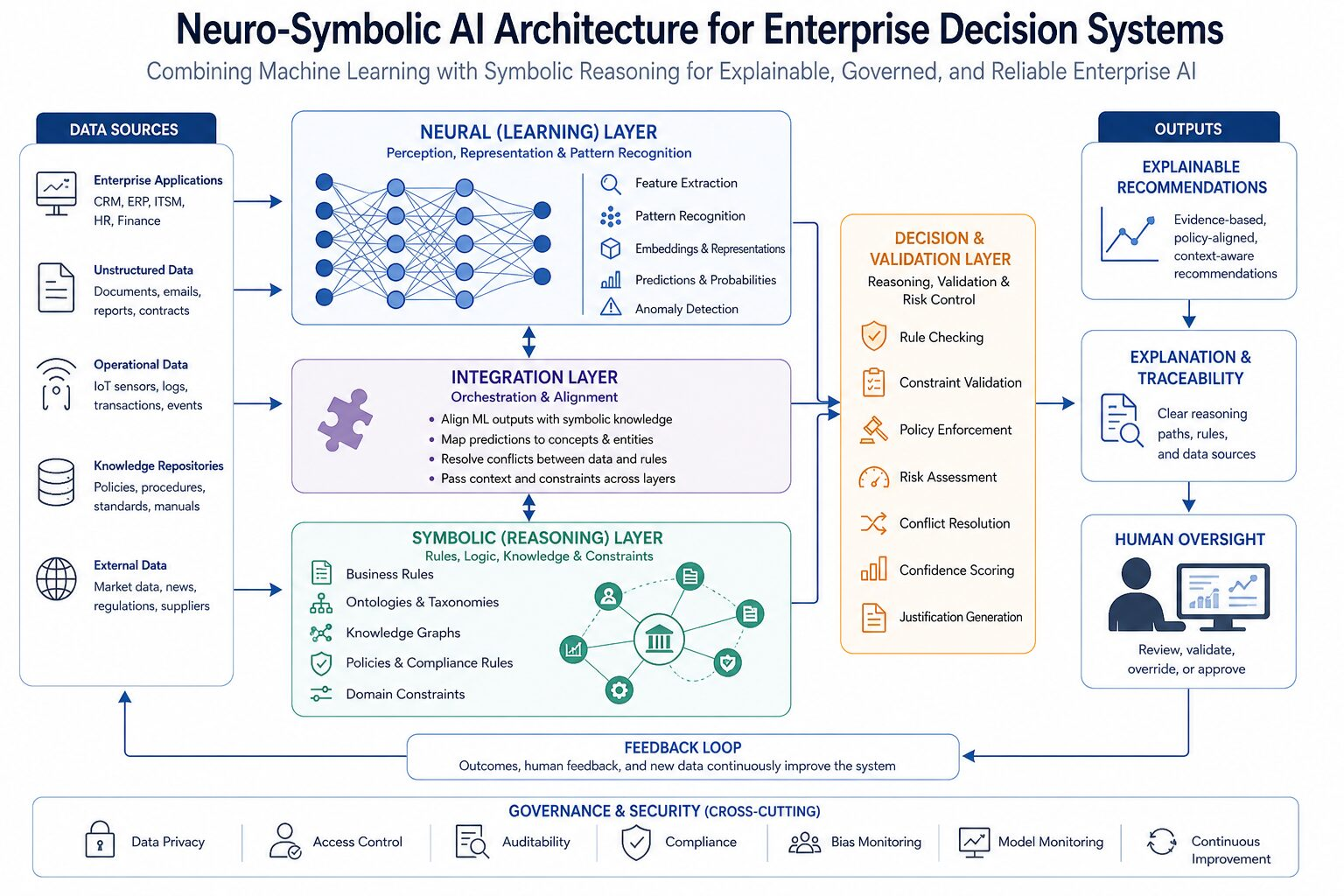
Neuro-symbolic AI architecture for enterprise data systems showing data sources, neural learning layer, symbolic reasoning layer, integration, decision validation, explainable outputs, human oversight, and governance controls
Figure 5 — Neuro-symbolic AI architecture for enterprise data systems illustrating how enterprise data sources are processed through neural learning models and symbolic reasoning layers, validated against policies and constraints, and delivered as explainable, auditable outputs with human oversight and governance controls.
Applied Enterprise Value

Where Neuro-Symbolic AI Creates Real Enterprise Impact

Neuro-symbolic AI systems are increasingly relevant in enterprise environments where artificial intelligence must be accurate, explainable, auditable, and aligned with domain-specific rules. By combining machine learning with symbolic reasoning, organizations can build AI systems that support decision-making, governance, compliance, and operational performance in high-stakes settings.
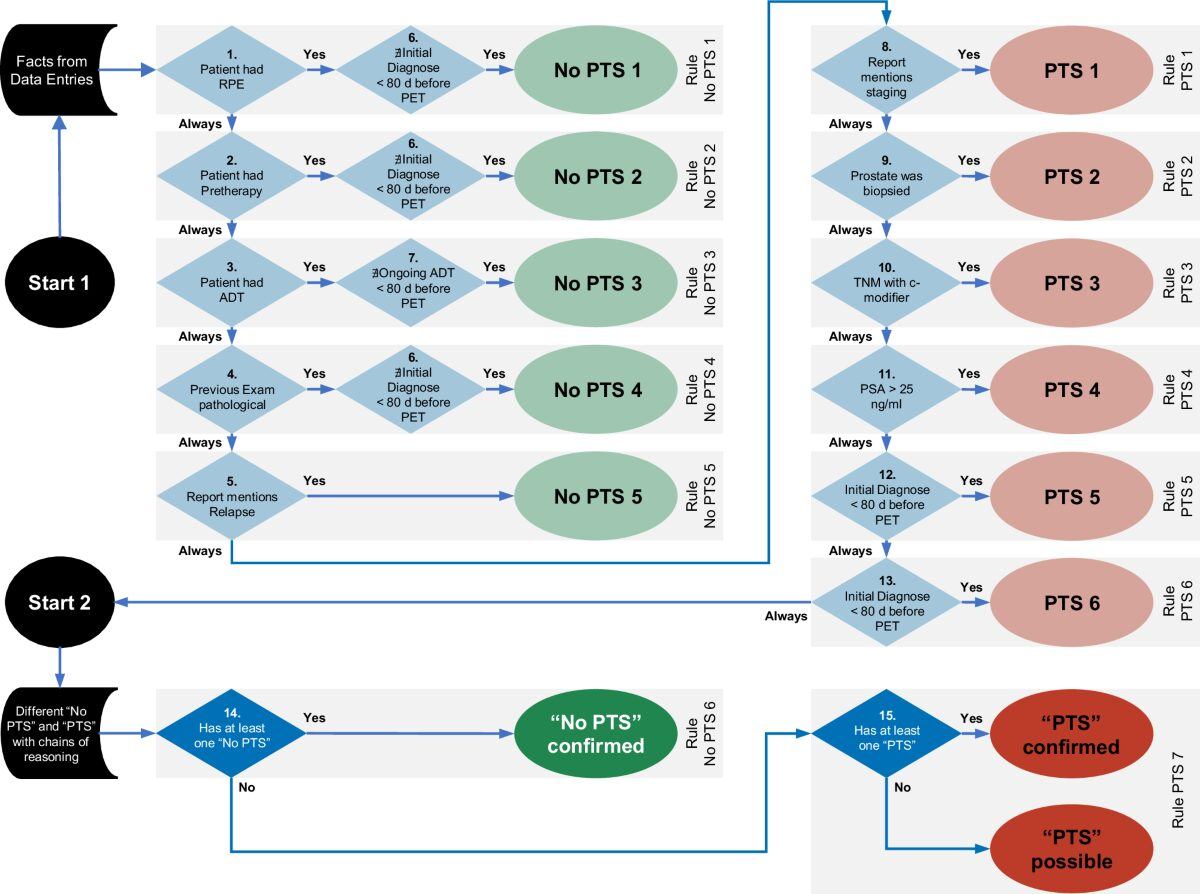
Neuro-symbolic AI clinical operations diagram showing patient data, wearable signals, physician notes, and clinical knowledge graphs supporting explainable healthcare decision support
Figure 6 — Neuro-symbolic AI for clinical operations, showing how patient data, wearable signals, physician notes, and clinical knowledge graphs can support explainable healthcare decision support.

Healthcare and Clinical Decision Support

In healthcare, neuro-symbolic AI can integrate patient records, wearable data, physician notes, imaging results, and clinical knowledge graphs. Neural models identify emerging patterns, while symbolic reasoning helps ensure recommendations align with treatment protocols, contraindications, care pathways, and clinician oversight.

Neuro-Symbolic AI Architecture in Practice

Neuro-symbolic architectures combine neural perception with symbolic reasoning layers to create decision frameworks that are both adaptive and constrained. This enables organizations to move beyond black-box probabilistic outputs toward structured, explainable, and policy-aligned enterprise intelligence.
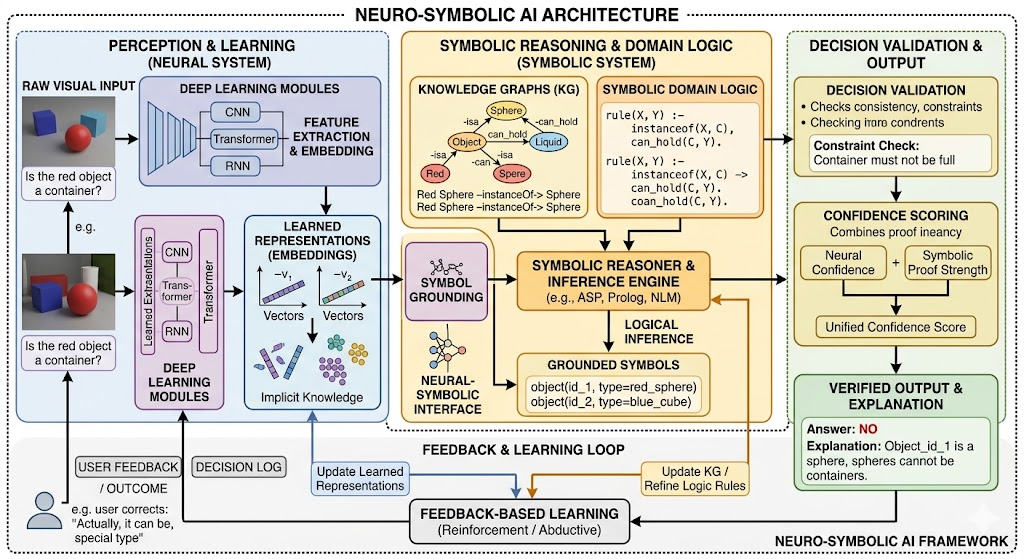
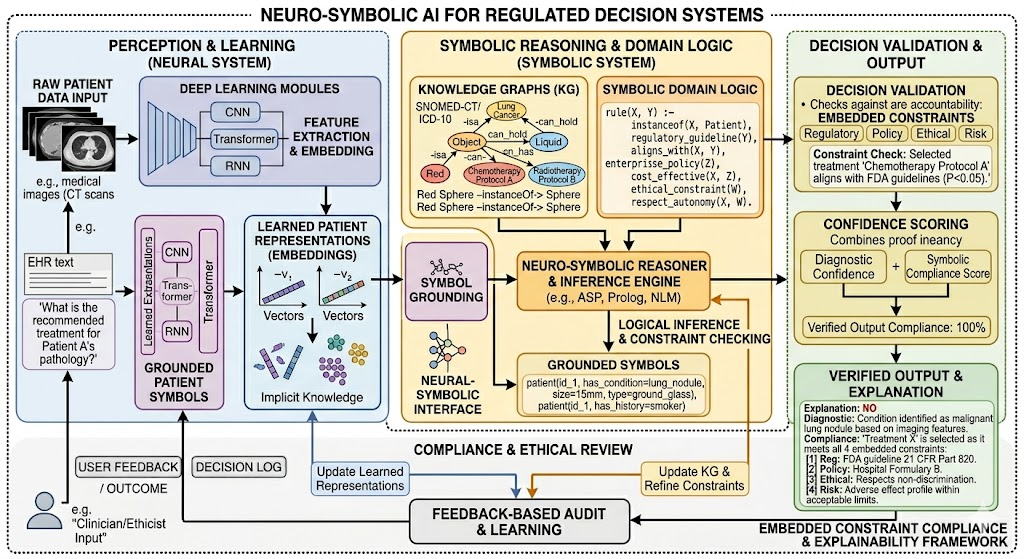
Neuro-symbolic AI architecture diagram showing neural network feature extraction, symbolic domain logic with rules and knowledge graphs, decision validation, confidence scoring, and feedback learning
Figure 7 — This detailed architecture diagram illustrates a state-of-the-art Neuro-Symbolic AI framework, blending the perception and learning capabilities of deep neural networks with the explainable logic and reasoning of symbolic systems. The neural system processes raw visual inputs into learned embeddings, which are then grounded into symbols. A symbolic reasoning engine, powered by knowledge graphs and logical rules, processes these grounded symbols to generate verified outputs, complete with explicit explanations and unified confidence scores. The entire lifecycle is supported by a continuous feedback and learning loop, ensuring both statistical and logical refinement.
AI governance framework diagram showing policy alignment, compliance controls, risk management, auditability, and responsible enterprise AI deployment
Figure 8 —This holistic Neuro-Symbolic AI architecture demonstrates how deep learning perception can be integrated with explicit symbolic reasoning to create trustworthy, explainable, and compliant AI systems for highly regulated fields like healthcare. By combining neural networks for pattern recognition with knowledge graphs and logic-based rule sets, this framework enables a verifiable decision validation process. The "Decision Validation & Output" stage specifically ensures that AI outputs adhere to strict regulatory guidelines (e.g., FDA), enterprise policies, and ethical standards, providing a unified confidence score and human-readable explanations. The system continuously improves via a feedback loop that updates both the neural learned representations and the symbolic logic rules.

AI Governance, Compliance, and Risk Control

Neuro-symbolic AI can embed regulatory logic, enterprise policies, ethical constraints, and risk thresholds directly into AI decision systems. This helps ensure outputs are auditable, compliant, and aligned with organizational standards—especially in healthcare, finance, defense, and other regulated industries.

AI-Native Systems Compared with Traditional Software

AI-native systems are designed with intelligence, learning, and adaptive decision support embedded at the core. Traditional systems often rely on static rules and manual updates, limiting their ability to respond dynamically to complex data, changing conditions, and evolving enterprise workflows.
Comparison diagram of AI-native systems versus traditional software showing continuous learning, adaptive intelligence, real-time optimization, and static rule-based workflows
Figure 9 — Comparison of AI-native systems and traditional software, highlighting continuous learning, adaptive intelligence, real-time optimization, and the limitations of static rule-based workflows.
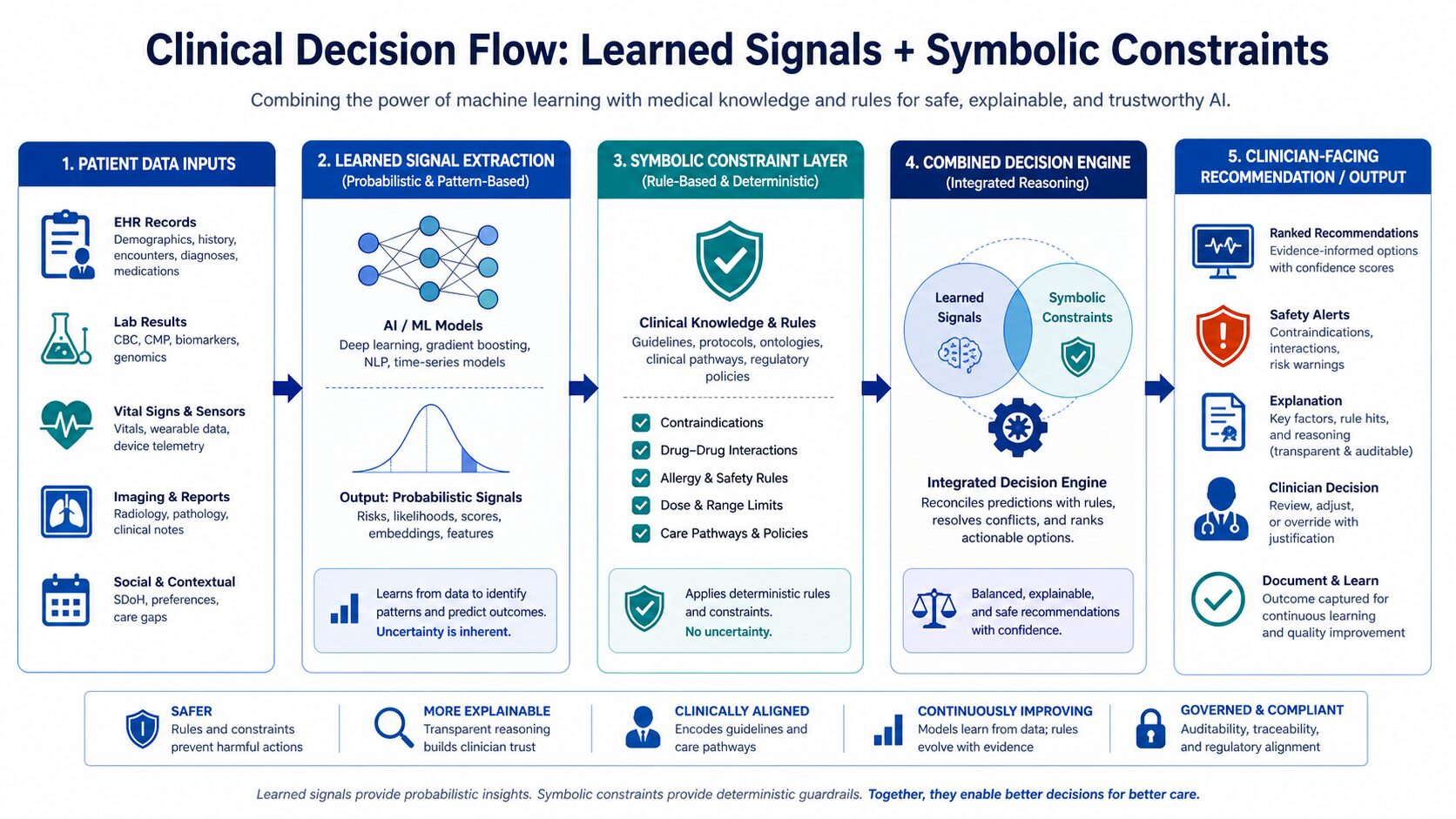
Neuro-symbolic AI clinical decision workflow showing patient data, machine learning signal extraction, symbolic clinical rules, decision validation, and clinician-facing recommendations
Figure 10 — Neuro-symbolic AI clinical decision workflow showing how patient data, machine learning signals, symbolic clinical constraints, and clinician oversight combine to produce explainable healthcare recommendations.
Healthcare Use Case

Neuro-Symbolic AI for Clinical Decision Intelligence

Neuro-symbolic AI can support clinical decision intelligence by combining patient data, machine learning signals, symbolic clinical rules, and clinician review within a governed decision workflow.

In healthcare settings, wearable recovery data, symptom reports, medication records, lab results, imaging findings, and treatment protocols can be integrated into a unified clinical decision support system.

Neural models identify probabilistic signals such as fatigue risk, declining resilience, or emerging clinical patterns. A symbolic reasoning layer evaluates those signals against contraindications, medication interactions, escalation thresholds, and clinical guidelines.

The result is not a generic prediction, but an explainable recommendation pathway that clinicians can review, validate, justify, and audit over time.

AI Investment & Enterprise Value

The ROI of Neuro-Symbolic AI: Reliability, Explainability, and Governance

The ROI of neuro-symbolic AI comes from more than automation. In enterprise environments, value is often created through reduced decision risk, stronger explainability, better governance, improved auditability, and higher confidence in AI-assisted decisions.

By combining machine learning with symbolic reasoning, neuro-symbolic architectures can support more reliable and production-ready AI systems in regulated, knowledge-intensive, and safety-sensitive workflows.

10–25%

Potential reduction in decision errors where validation rules, constraints, and expert logic are critical.

15–30%

Potential efficiency gains in complex workflows involving knowledge retrieval, review, validation, and exception handling.

5–10 mo.

Potential payback window for high-value use cases where governance, reliability, and expert productivity drive measurable value.

High Trust

Improved adoption potential when users can inspect reasoning paths, constraints, and justification logic.

From an executive perspective, enterprise AI ROI increasingly depends on whether systems can be trusted in production—not simply whether they can generate outputs quickly. Explainability, governance, and reliability determine whether AI moves from pilot experimentation to operational value.

Neuro-symbolic AI is especially relevant where incorrect or unexplainable outputs carry meaningful cost: clinical decision support, compliance workflows, financial risk analysis, defense systems, and enterprise operations.

The strongest business case for neuro-symbolic AI is found where decision quality, auditability, policy alignment, and human oversight are central to operational performance.

Learn more about the underlying architecture in Mathematical & Architectural Foundations of AI and how it connects to real-world systems in RAG & Edge AI Architectures .

Neuro-symbolic AI ROI analysis chart showing reliability, explainability, governance impact, and enterprise value realization
Figure 5 — Neuro-symbolic AI ROI model showing how reliability, explainability, governance, and decision quality can accelerate enterprise value realization.
Leadership Implications

Strategic Questions for Executives Evaluating Neuro-Symbolic AI

As organizations move toward enterprise AI systems, leaders must evaluate where explainable AI, governance, and structured reasoning are required—not optional. The following questions help identify where neuro-symbolic AI architectures can deliver the greatest strategic value.

  • Where is explainability required for compliance, safety, or operational trust?
  • Which workflows depend on expert logic that should be encoded into AI systems?
  • What knowledge assets (rules, guidelines, ontologies) can strengthen AI reasoning?
  • Which decisions require auditability, traceability, and policy alignment?
  • Where are we over-relying on black-box AI models in high-stakes environments?
  • What AI governance model should sit above predictive and generative systems?
  • Where can hybrid AI systems create trust-based competitive advantage?
  • How do we transition from AI experimentation to production-grade enterprise architecture?

Neuro-symbolic AI should be evaluated as a core enterprise AI architecture strategy, not a niche technical capability. Organizations that prioritize explainability, governance, and structured reasoning will be better positioned to deploy AI systems that are credible, scalable, and aligned with real-world complexity.

Enterprise AI Architecture

From Neuro-Symbolic AI to Scalable Enterprise AI Systems

Neuro-symbolic AI is not a standalone capability. In production environments, it operates within a broader enterprise AI architecture that integrates retrieval systems, real-time data pipelines, distributed intelligence, and governance frameworks.

Modern AI system architectures combine neuro-symbolic reasoning with Retrieval-Augmented Generation (RAG), edge computing, and orchestration layers to support scalable, explainable, and policy-aligned decision systems.

Understanding how these components work together is essential for organizations moving from isolated AI use cases toward production-grade, enterprise-scale AI systems.

Key Takeaway for Enterprise AI Strategy

Neuro-symbolic AI enables a shift from black-box prediction to explainable, governed, and constraint-aware decision systems. This is essential in environments where AI outputs must be justified, audited, and aligned with real-world rules and policies.

  • Explainable decision pathways grounded in logic and data
  • Integration of domain expertise into AI reasoning systems
  • Reduced risk in high-stakes and regulated environments
  • More reliable performance through constrained, policy-aligned logic

Neuro-Symbolic Architecture at a Glance

Neuro-symbolic AI systems combine learning and reasoning within a unified, explainable decision framework:

  • Neural Layer: Pattern recognition and representation learning
  • Symbolic Layer: Rules, logic, and structured domain knowledge
  • Integration Layer: Alignment between learned outputs and reasoning systems
  • Decision Layer: Validation, constraints, and explainable outcomes
Leadership Implications

Neuro-Symbolic AI as an Enterprise Architecture Strategy

Neuro-symbolic AI should not be evaluated as a feature or isolated capability. It represents a shift in enterprise AI architecture—from probabilistic outputs toward explainable, governed, and constraint-aware decision systems.

This shift requires leaders to move beyond model selection and consider how learning systems, symbolic reasoning, and policy enforcement are integrated across enterprise workflows, data systems, and decision processes.

Organizations that treat neuro-symbolic AI as a core architectural strategy—not an add-on—will be better positioned to deploy AI systems that are scalable, auditable, and aligned with real-world operational and regulatory requirements.

Enterprise Implications

From AI Models to Governed Decision Systems

In enterprise environments, AI systems must do more than generate accurate predictions. They must operate within constraints, support explainability, and align with governance, policy, and real-world decision frameworks.

Neuro-symbolic AI enables this transition by integrating learning with reasoning, allowing organizations to move from experimental AI models toward governed, production-grade decision systems.

Access the Full Technical Architecture

A detailed implementation framework—including system design, data pipelines, and integration patterns—is available under NDA.

Request Access
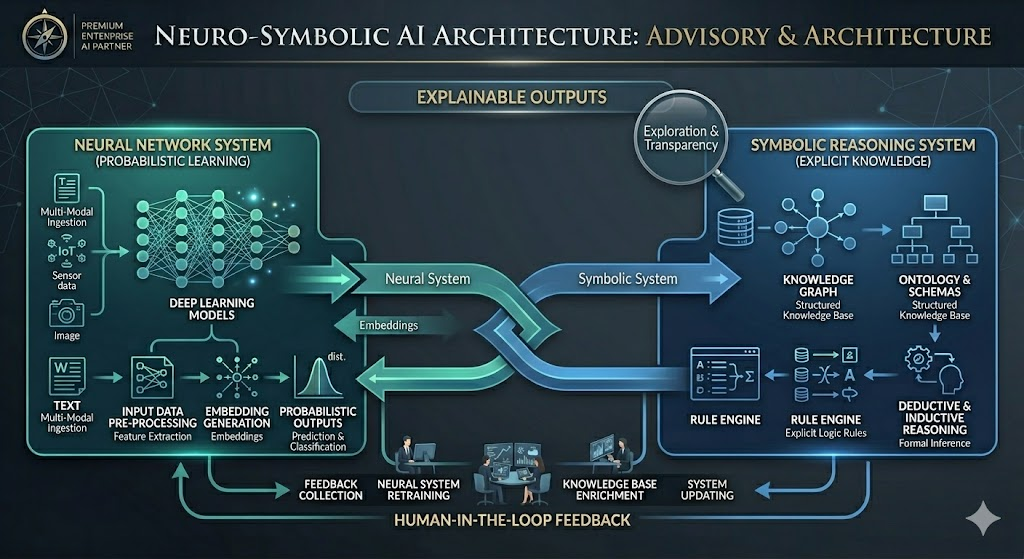
Figure 11 — Neuro-Symbolic AI Architecture: A dual-engine system integrating neural probabilistic learning with symbolic reasoning through a deeply coupled, bidirectional integration layer.

Neuro-Symbolic AI: Architectural Integration of Learning and Reasoning

A neuro-symbolic AI architecture represents a fundamental evolution beyond traditional AI systems. Rather than relying on a single modeling paradigm, it combines two complementary engines: neural networks for data-driven learning and symbolic systems for structured reasoning.

The defining innovation is deep bidirectional integration—not simply chaining outputs, but continuously aligning statistical predictions with explicit logic and domain knowledge.

1. Neural System — Probabilistic Learning

The neural layer processes unstructured, high-volume data and extracts patterns using machine learning techniques.

  • Multi-modal ingestion: text (NLP), sensor data, images
  • Feature extraction: preprocessing and transformation
  • Embeddings: high-dimensional semantic representations
  • Deep learning models: generate probabilistic predictions

This system excels at perception and scalability, but produces outputs based on probability rather than explicit reasoning.

2. Symbolic System — Explicit Knowledge & Logic

The symbolic layer operates on structured knowledge and deterministic reasoning.

  • Knowledge graphs: entities and relationships
  • Ontologies: domain structure and definitions
  • Rule engines: enforce logic and constraints
  • Inference: deductive and inductive reasoning

Unlike neural systems, this layer produces interpretable and traceable outputs.

3. Integration Layer — The Architectural Breakthrough

The integration layer connects both systems into a unified intelligence framework.

  • Neural → Symbolic: predictions are grounded in logic
  • Symbolic → Neural: rules guide and constrain learning

This bidirectional coupling ensures outputs are not only accurate, but also consistent with domain knowledge and operational constraints.

4. Decision Layer — Explainable Intelligence

The final output is a validated, explainable decision rather than a raw prediction.

  • Traceable reasoning paths
  • Policy and rule validation
  • Human-interpretable recommendations

5. Human-in-the-Loop Feedback

Continuous improvement is achieved through expert oversight:

  • Refining rules and ontologies
  • Retraining models
  • Expanding knowledge bases

Architectural Contrast

Feature Traditional AI Neuro-Symbolic AI
Core Method Probabilistic pattern recognition Hybrid learning + reasoning
Data Handling Unstructured only Unstructured + structured knowledge
Output Predictions Validated, explainable decisions
Explainability Limited (black box) Built-in via reasoning
Integration Minimal Deep bidirectional coupling
Frequently Asked Questions

Neuro-Symbolic AI: Key Questions and Answers

What is neuro-symbolic AI?

Neuro-symbolic AI is a hybrid artificial intelligence approach that combines neural networks (machine learning and deep learning) with symbolic reasoning (rules, logic, and knowledge representation). This enables AI systems to both learn from data and apply structured reasoning for more explainable and reliable decisions.

How is neuro-symbolic AI different from traditional machine learning?

Traditional machine learning focuses on pattern recognition and prediction based on data, often without explainability. Neuro-symbolic AI adds reasoning, constraints, and domain knowledge, allowing systems to produce decisions that are more transparent, auditable, and aligned with real-world rules.

Why is explainability important in enterprise AI systems?

Explainability is critical in environments where decisions must be justified, audited, or regulated. In healthcare, finance, and defense, organizations need to understand how AI reaches conclusions, not just what those conclusions are.

What industries benefit most from neuro-symbolic AI?

Neuro-symbolic AI is particularly valuable in regulated and high-stakes industries such as healthcare, financial services, defense, insurance, and enterprise operations where accuracy, governance, and decision transparency are essential.

How does neuro-symbolic AI support AI governance?

Neuro-symbolic AI enables governance by embedding rules, policies, and constraints directly into AI systems. This allows organizations to enforce compliance, ensure auditability, and align AI decisions with regulatory and operational requirements.

Is neuro-symbolic AI ready for enterprise deployment?

Yes, neuro-symbolic AI is increasingly being used in enterprise environments, particularly where explainability and reliability are required. While not every use case requires it, it is highly relevant for complex, decision-intensive workflows.

References & Research Foundations

These references support the transition from purely statistical AI systems to hybrid architectures integrating reasoning and learning.
Technical Deep Dive

Mathematical Foundations of Neuro-Symbolic AI

For engineers, architects, and advanced practitioners, neuro-symbolic AI is grounded in formal mathematical frameworks including predicate logic, probabilistic reasoning, knowledge graph embeddings, and constraint-based inference.

These foundations define how hybrid AI systems integrate learning, reasoning, and validation into coherent, explainable decision architectures.

Cross-Platform AI Applications

Where This AI Architecture Applies

The technical foundations of AI — including retrieval-augmented generation, edge AI, neuro-symbolic reasoning, governance, and deployment architecture — are not limited to one industry. They become most valuable when translated into real operating systems across healthcare, hospitality, finance, wellness, and workflow automation.

Healthcare AI Systems

Clinical AI, EHR integration, longitudinal patient monitoring, disease-specific intelligence, and governance models for safe healthcare deployment.

Explore Healthcare AI →

Luxury Hospitality AI

AI strategy for luxury resorts, guest personalization, operational efficiency, wellness ecosystems, and measurable ROI in hospitality environments.

Explore Hospitality AI →

Workflow Automation

Cross-platform automation systems that reduce manual friction, improve operational throughput, and convert fragmented workflows into measurable productivity gains.

View Workflow Automation Guide →

Why AI Projects Fail

A cross-industry framework explaining why AI pilots stall, why architecture matters, and how organizations move from isolated experiments to deployed systems.

Read the Failure Framework →

AI Platform Landscape

A practical comparison of AI tools, platforms, and resource categories for executives, operators, technologists, and small business leaders.

Compare AI Platforms →

Prompt Engineering

Core principles for using generative AI more effectively across business workflows, executive strategy, content development, and operational decision support.

View Prompt Engineering Principles →

AI Investment Framework

A decision framework for evaluating where AI investment creates measurable value, where risk is highest, and where controlled pilots should begin.

Coming Soon

Lifestyle Monitoring AI & Insurance

A future-facing crossover model connecting wellness retreats, wearable monitoring, high-sensitivity populations, and incentive-based insurance structures.

Coming Soon

Every Patient Becomes an Athlete in Recovery

A healthcare and wellness framework that applies athletic recovery principles to longitudinal patient monitoring, rehabilitation, and quality-of-life improvement.

Coming Soon

The Evolution of AI to Neuro-Symbolic AI

Understand how artificial intelligence has evolved from statistical models to hybrid systems that combine learning, reasoning, and structured knowledge.

Explore how modern AI is evolving from prediction to reasoning—and where it fits within a complete system architecture

Continue Exploring AI Strategy & Technical Foundations