
The 7 Core Principles of
Prompt Engineering
Every Small Business Should Know
Turn AI from a creative experiment into a repeatable operational asset — improving speed, consistency, and quality across marketing, sales, support, and operations.

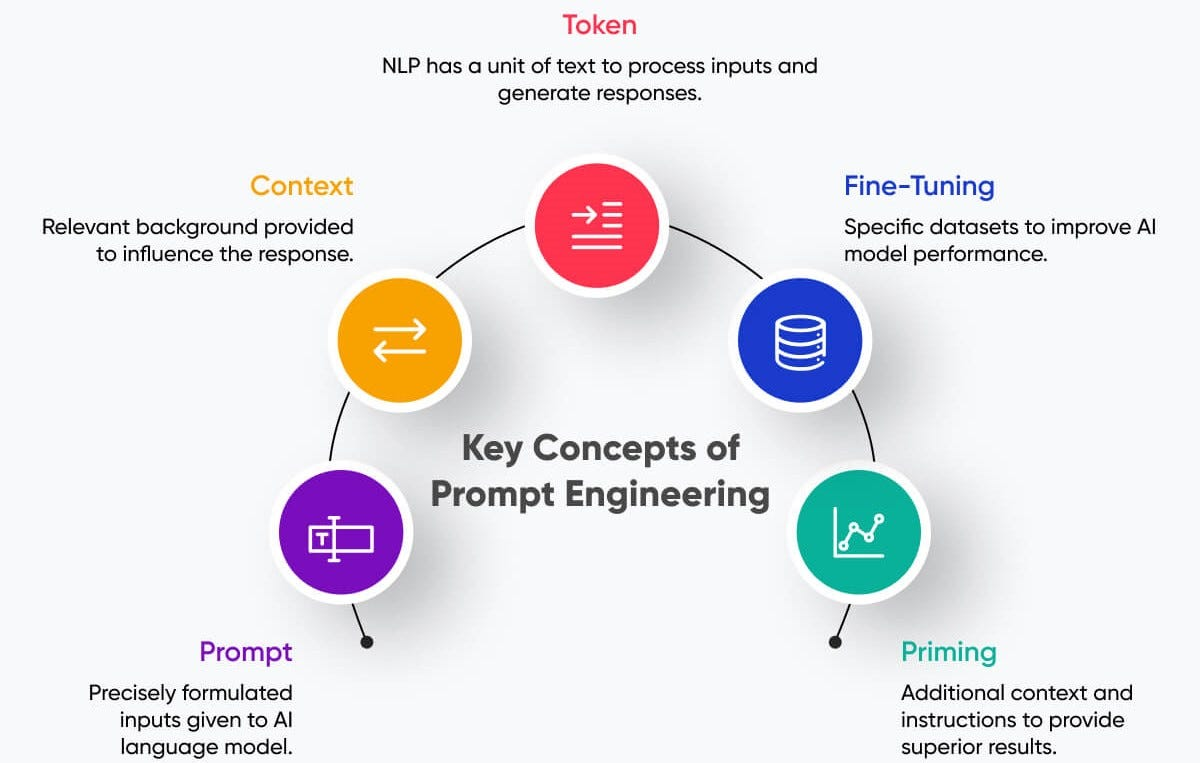
Executive Summary: The Strategic Value of Prompt Engineering
Prompt engineering transforms AI from a creative experiment into a repeatable operational asset across marketing, sales, and operations.
Clear instructions, structured prompts, and reusable templates dramatically reduce time spent drafting business content. In the rapidly evolving landscape of generative AI, the bottleneck to organizational transformation is no longer the technology itself, but the precision of the orchestration. For the small business owner, the luxury hospitality leader, and the healthcare innovator, "Prompt Engineering" is the critical interface where human expertise meets machine scale. It is the practice of codifying institutional knowledge into a high-reliability digital support system. At Athena Fusion Solutions, our approach is rooted in a human-centered, Nordic-inspired framework. We believe that AI should not function as a black box, but as a transparent extension of the professional’s intent. This guide moves beyond basic "chatting" to explore the development of Digital Support Systems (DSS)—architectures that combine rigorous data analysis with deep contextual reasoning. By mastering these seven core principles, organizations can transition from fragmented AI experiments to a unified Technical Compendium of proprietary logic. This allows a solo principal or a small leadership team to manage population-scale challenges—such as patient recovery trajectories or resort RevPAR optimization—without sacrificing the "human touch" that defines their brand. The goal of this strategic framework is to ensure that every AI-driven interaction is: Contextually Grounded: Rooted in your specific business data and heritage. Operationally Reliable: Consistent across 100,000 participants or 1,000 guest interactions. Proprietary: Building a long-term asset that belongs to your organization, not the model provider. Ultimately, we are not just engineering prompts; we are engineering operational resilience for the modern era.
Quantifying the Strategic ROI
In a principal-led organization, the true ROI of prompt engineering extends beyond mere "speed." It is measured by the reliability of outcomes and the ability to scale expert-level reasoning across an entire ecosystem without increasing headcount or compromising the human touch.
By shifting from ad-hoc chatting to a governed Technical Compendium of prompt assets, organizations move from experimentation to measurable operational resilience. This transformation manifests in three critical areas:
- Compressed Decision Latency: Reducing the time between data collection (from wearables, sensors, or financial logs) and actionable strategic insight.
- Institutional Consistency: Ensuring that high-value workflows—such as clinical recovery analysis or resort guest journey mapping—remain identical across 100,000+ interactions.
- Margin Optimization: While content productivity gains often reach 50-70%, the higher-order value lies in RevPAR growth and reduced clinical "hallucinations" through grounded contextual reasoning.
Effective prompt engineering transforms AI from a cost-center experiment into a proprietary asset that compounds in value over time.

Principle 1: Clarity
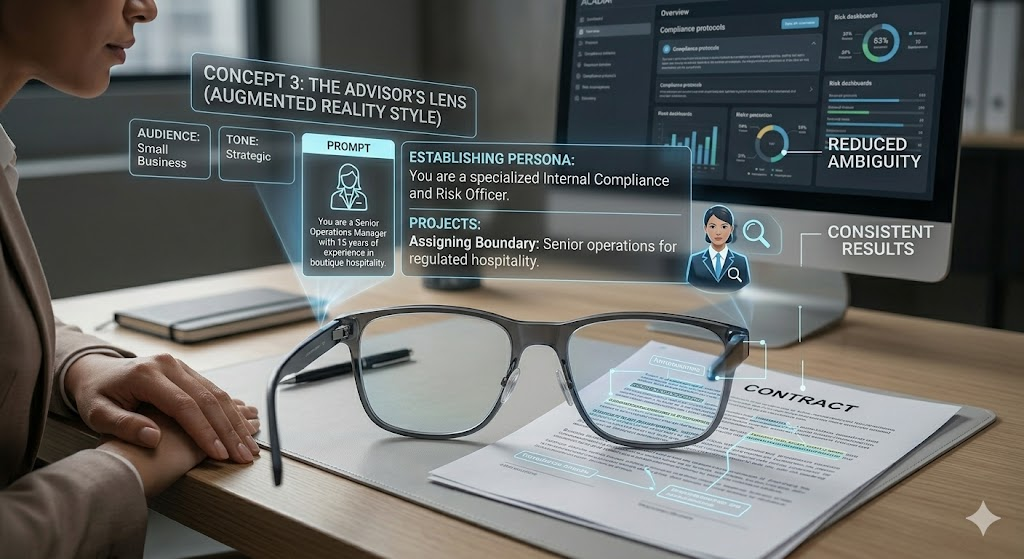
Clear prompts reduce ambiguity and improve the reliability of AI outputs.
Defining audience, tone, format, and objective leads to consistent results across tasks. Don't just ask the AI to "write an email." Assign it a specific professional identity and boundary. In a principal-led advisory model, the AI should act as a specialized extension of your expertise. The Content: Start every prompt by establishing a Persona. For a small business, this means telling the AI: "You are a Senior Operations Manager with 15 years of experience in boutique hospitality." This forces the model to draw from a specific professional vocabulary and tone. Small Business Benefit: It ensures the output isn't generic "robot-speak" but aligns with the sophisticated voice of your brand.
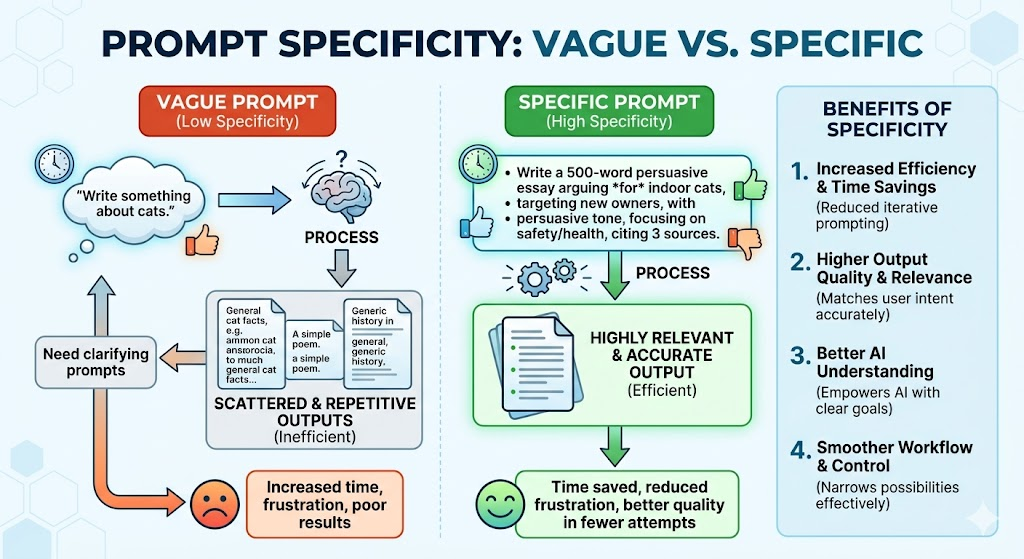
Principle 2: Specificity
Detailed prompts guide the AI toward precise outcomes by defining length, tone, and structure.
Specificity dramatically reduces editing time and improves content quality. In a Nordic-inspired framework, AI should support human roles, not replace the human touch. Use prompts to define exactly where the AI ends and the human begins. The Content: Explicitly state what the AI should not do. For example: "Analyze these guest feedback trends, but do not draft the final response. Highlight the three most sensitive emotional cues that require a personal touch from the General Manager." Small Business Benefit: This protects your most valuable asset—your personal relationship with clients—while using AI to handle the heavy lifting of data synthesis.
Principle 4: Structure
Structured prompts guide reasoning and help teams standardize output formats.
This approach is especially useful for SOP creation and documentation workflows. For complex decisions—like resort RevPAR growth or healthcare AI integration—the process of getting the answer is as important as the answer itself. The Content: Use the directive "Think step-by-step." Ask the AI to first outline its reasoning, identify potential risks, and then provide the recommendation. This allows you to audit the AI's "logic" before you act on its advice. Small Business Benefit: This turns the AI into a "sparring partner" for strategic thinking. It helps a solo principal catch blind spots in a project plan or technical architecture before they become costly errors.
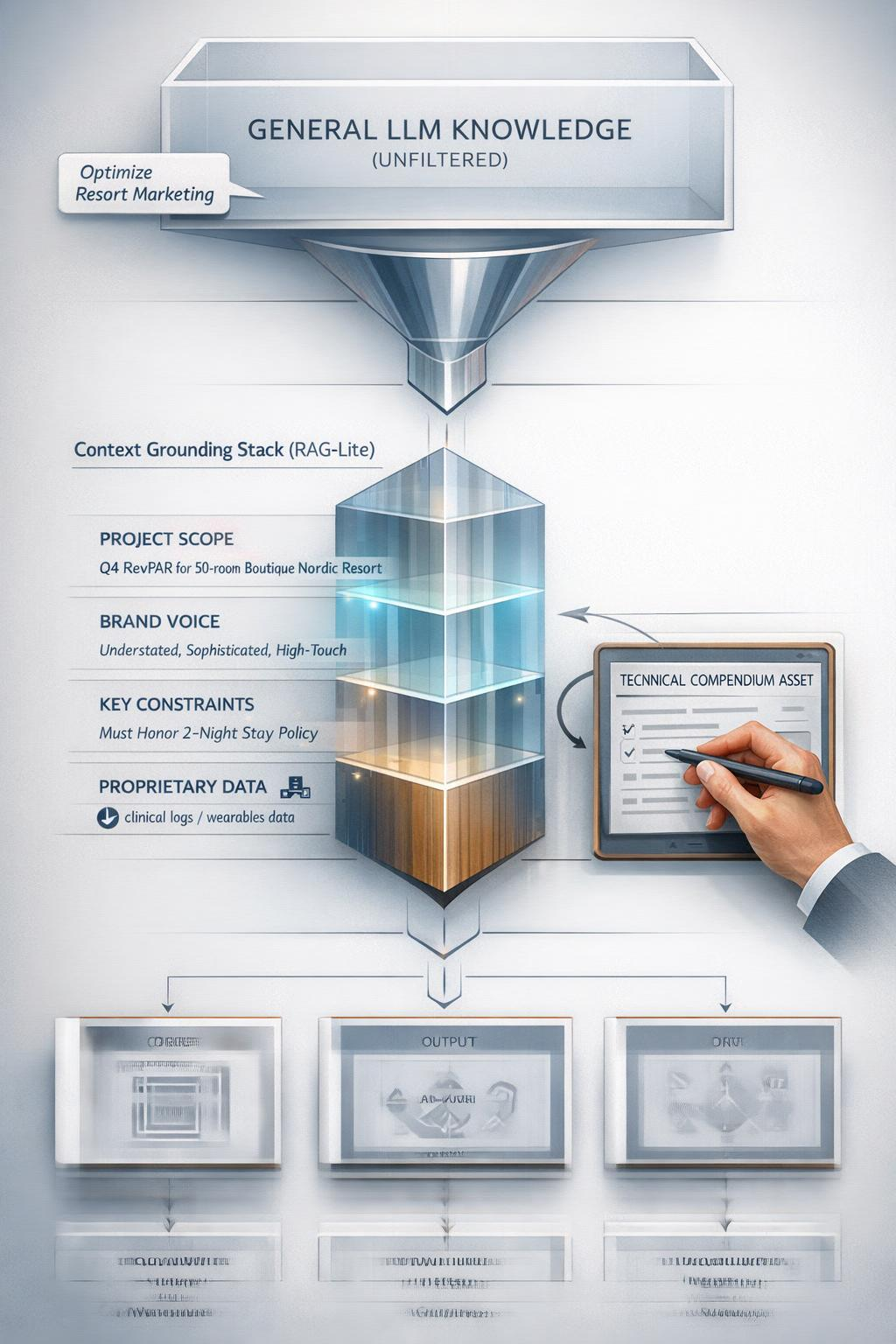
Principle 3: Context
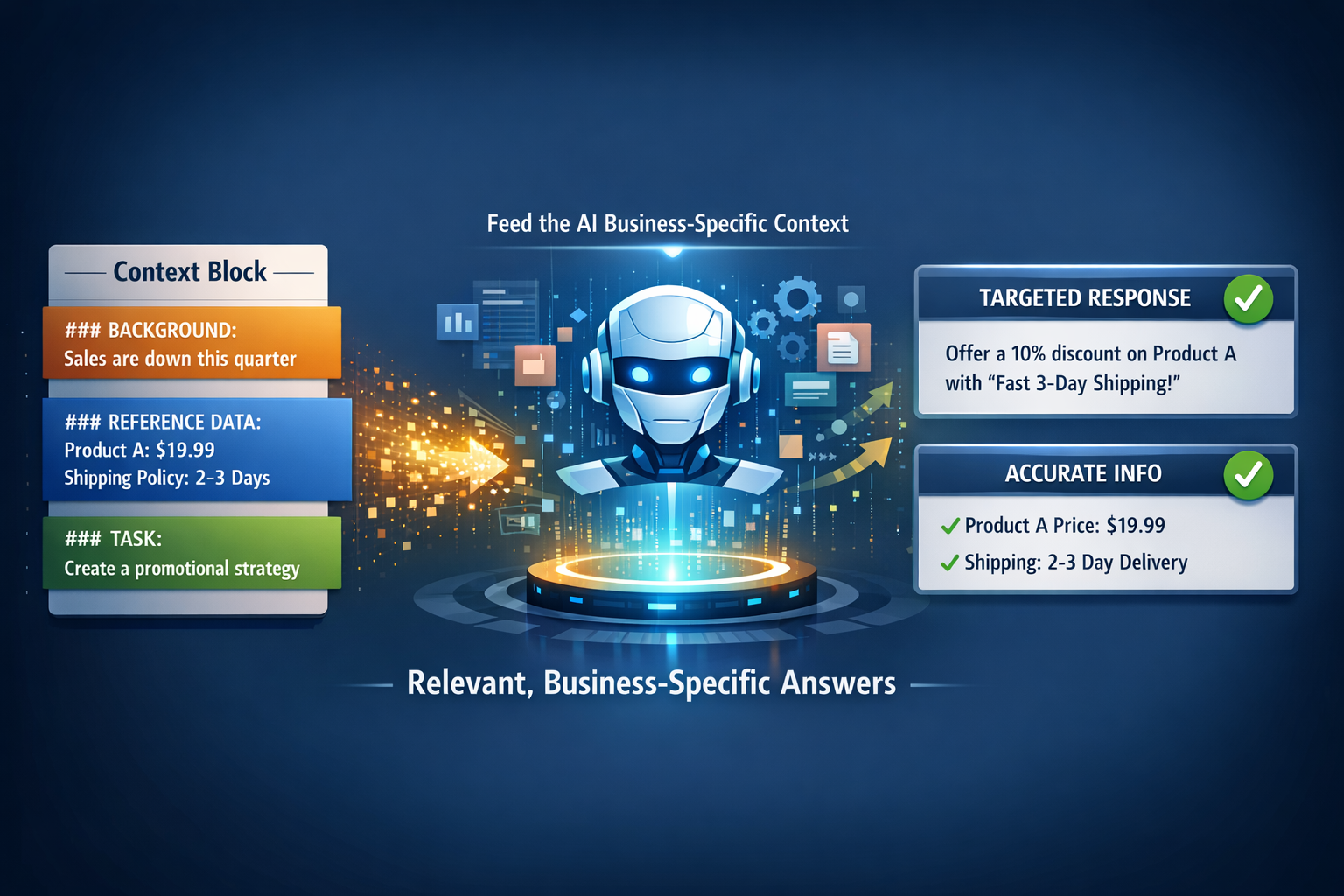
Providing contextual information enables AI to tailor responses to specific business environments.
This improves relevance and reduces generic or inaccurate responses. Small businesses often lack massive datasets, but they have deep institutional knowledge. Feed the AI the "Technical Compendium" of your specific business rules to ensure accuracy. The Content: Instead of vague requests, use a structured "Context Block." Use the format: ### BACKGROUND: [Insert current challenge] ### REFERENCE DATA: [Insert specific pricing or policy] ### TASK: [Define the goal]. This mimics a Retrieval-Augmented Generation (RAG) architecture on a manual level. Small Business Benefit: This eliminates "hallucinations" where the AI makes up facts about your services or pricing, ensuring the output is operationally ready for use.

Context and Structure Turn AI Into a Team Asset
3. Context — Give Relevant Background
Provide your industry, audience, brand voice, constraints, and desired outcome. Think of it as onboarding a new contractor.
4. Structure — Use Organized Formats
Use a repeatable pattern: Role, Context, Task, Output Format, Constraints.
-
1Role — assign expertise
-
2Context — define your business reality
-
Principles 5–7
Iteration, Examples, and Constraints Create Reliable Output
5. Iteration — Refine Through Feedback
Do not stop at the first draft. Iterate, improve, save the best version, and reuse it.
6. Examples — Show What Good Looks Like
Few-shot prompting is one of the fastest ways to transfer tone, structure, and expectations.
7. Constraints — Define Boundaries and Limits
Constraints keep output safe, usable, and on-brand — especially for external-facing content.
Figure 5. Prompt engineering becomes operationally valuable when prompts are refined, versioned, and reused across similar workflows. 
Figure 8. Integrating Contextual Reasoning: Moving from raw data analysis to intelligent decision support. Digital Support Systems: Data Meets Context
Modern enterprise AI must transcend simple pattern matching. True Digital Support Systems (DSS) function by synthesizing large-scale data analysis with deep contextual reasoning—the ability to understand the nuances of a specific business environment, guest preference, or clinical protocol.
By iterating on your prompt architecture, we build systems that don't just "calculate"; they "interpret." This allows the AI to provide strategic recommendations that are technically accurate and operationally relevant to your unique heritage and standards.
The Convergence of Logic and Insight: A robust DSS utilizes Retrieval-Augmented Generation (RAG) to ground AI outputs in your organization's proprietary data. This ensures that every insight is backed by evidence while maintaining the flexibility to reason through complex, non-linear challenges—such as fluctuating RevPAR trends or patient recovery trajectories.
- Data Synthesis: Processing high-volume inputs from wearables, sensors, and financial logs.
- Contextual Layering: Applying your specific "Nordic" service frameworks to filter raw data.
- Reasoned Output: Delivering actionable intelligence that supports, rather than replaces, the human expert.
The result is a high-reliability ecosystem where AI acts as a sophisticated digital twin of your strategic intent, capable of population-scale analysis with principal-led precision.
Figure 6. As AI use expands, governance, reasoning patterns, and prompt libraries help teams standardize quality and reduce risk. Advanced + Governance + LibraryScale Prompting with Reasoning, Guardrails, and Reuse
Advanced Techniques
Once the 7 principles are in place, add persona prompting, structured reasoning, and multimodal review for more complex work.
Governance
Every external-facing prompt should include a safety line and defined human review triggers.
Prompt Library
A shared library with owners, versions, use cases, and metrics turns isolated prompts into an organizational asset.
FAQ + Tools + Next StepsPut the 7 Principles Into Practice
🤖ChatGPT
Rapid drafting and iteration
🧠Claude
Long-form documents and reasoning
🔍Gemini
Google Workspace workflows
📎Copilot
Microsoft 365 integration
Your Next StepsChoose one recurring workflow, apply the 5-part prompting structure, iterate three rounds, save the winning version, and begin tracking measurable time savings next week.

Figure 9. AI-powered workflow automation helping small businesses improve productivity, streamline operations, and drive measurable business growth through intelligent tools, operational efficiency, and AI-assisted decision support.

