
AI Readiness Gap in Financial Operations
Financial operations are one of the highest-value opportunities for enterprise AI, automation, and decision intelligence — yet most organizations are constrained not by the technology itself, but by fragmented workflows, disconnected data, weak governance, and limited operational readiness.
What This AI Readiness Guide Covers
This enterprise AI strategy guide explores the operational, governance, workflow, and organizational factors that determine whether financial operations are ready for artificial intelligence, workflow automation, predictive analytics, and scalable enterprise AI deployment.
The AI Opportunity in Financial Operations Is Real — But Many Finance Functions Are Not Ready to Capture It
Finance teams are under increasing pressure to accelerate month-end close, improve forecasting accuracy, detect financial risk earlier, reduce manual reconciliation, strengthen auditability, and provide leadership with more timely operational insights. Enterprise AI, workflow automation, and decision intelligence can support all of these objectives, but only when the finance operating foundation is ready.
The AI readiness gap appears when leadership wants AI-enabled financial operations, but the organization lacks the data quality, process discipline, system integration, governance policies, internal controls, and change-management structure required to deploy artificial intelligence effectively.
What Is the AI Readiness Gap in Financial Operations?
The AI readiness gap is the distance between what an organization wants artificial intelligence to accomplish in finance and what its current data, systems, workflows, controls, and workforce capabilities can realistically support.
Financial Operations Are One of the Highest-Value Enterprise AI Opportunities Because Small Improvements Compound Quickly
Unlike speculative AI initiatives, financial operations provide measurable operational and financial metrics where artificial intelligence, workflow automation, and decision intelligence can generate clear business value. Organizations can track improvements across financial close cycles, forecasting accuracy, error reduction, cash-flow visibility, invoice processing, exception handling, audit preparation, compliance monitoring, and executive reporting.
Faster Financial Close Cycles
AI systems can help identify anomalies, flag missing entries, accelerate reconciliation workflows, automate repetitive financial tasks, and support variance analysis across complex operational environments.
Improved Forecasting and Cash Visibility
AI-assisted forecasting can improve scenario planning, cash-flow visibility, operational planning, predictive analytics, and early detection of financial performance shifts or operational risk patterns.
Stronger Governance, Compliance, and Controls
Properly governed AI can support fraud detection, compliance monitoring, audit readiness, documentation management, risk analysis, and operational transparency across enterprise financial systems.
The Most Common Barriers to AI Adoption in Financial Operations Are Operational, Not Technical
Many organizations assume the first step in enterprise AI adoption is selecting an AI platform or automation tool. In reality, the first step is determining whether the finance function is operationally prepared to use artificial intelligence safely, accurately, compliantly, and productively within real-world financial workflows.
- Financial and operational data is often fragmented across disconnected accounting systems, ERP platforms, CRM environments, payroll systems, banking applications, spreadsheets, and manually maintained reports.
- Finance workflows frequently depend on manual review processes, institutional knowledge, undocumented workarounds, and inconsistent operational procedures that limit scalable automation.
- Reporting logic, forecasting assumptions, and performance metrics are often inconsistent across departments, business units, leadership dashboards, and operational reporting structures.
- Governance frameworks, internal controls, approval chains, audit requirements, compliance policies, and accountability structures have often not been mapped for AI-assisted financial workflows.
- Finance teams are frequently not trained to evaluate AI-generated outputs, operational risks, governance limitations, model reliability, workflow implications, or appropriate enterprise AI use cases.
Strategic and Operational Risk
When artificial intelligence is deployed before operational readiness is addressed, organizations can unintentionally increase operational risk instead of reducing it. Poor data quality, weak governance, fragmented workflows, inconsistent reporting logic, and unclear accountability structures can produce misleading outputs, compliance exposure, audit complications, operational inefficiencies, and resistance from finance teams.
Four Dimensions Determine Whether Financial Operations Are Ready for Enterprise AI and Workflow Automation
Successful AI adoption in financial operations depends on more than selecting the right AI platform. Organizations must evaluate operational readiness across data architecture, workflow maturity, governance controls, and workforce capability to support scalable, secure, and reliable AI-assisted financial processes.
Are the organization’s financial records, transaction data, vendor data, operational metrics, revenue data, and reporting definitions structured, accessible, accurate, governed, and consistent enough to support enterprise AI analysis, automation, and decision intelligence?
Are finance processes documented, repeatable, measurable, standardized, and operationally mature enough to support workflow automation and AI-assisted financial operations without increasing risk or inconsistency?
Are there clearly defined policies for privacy, access control, auditability, approval authority, regulatory compliance, human oversight, operational accountability, and acceptable enterprise AI usage across financial workflows?
Are finance leaders, analysts, controllers, and operational teams prepared to interpret AI-generated outputs, evaluate model limitations, challenge assumptions, manage operational risk, and use artificial intelligence as a decision-support capability rather than a replacement for professional judgment?
Enterprise AI in Financial Operations Should Begin Where the Business Case Is Measurable and Operational Risk Is Controllable
The strongest early opportunities for artificial intelligence in financial operations are usually not broad enterprise automation initiatives. They are targeted AI pilots where operational value can be measured, governance frameworks can be validated, workflow integration can be tested, and finance team confidence can be built incrementally.
- AI-assisted invoice processing, exception detection, and reconciliation workflows
- Accounts payable and accounts receivable workflow analysis and automation
- Cash-flow forecasting, predictive analytics, and scenario modeling
- Expense anomaly detection and operational risk identification
- Revenue leakage analysis and financial performance monitoring
- Budget variance explanation and AI-assisted financial analysis
- Management reporting, executive dashboard support, and operational visibility
- Audit preparation, compliance documentation review, and governance support
Close the AI Readiness Gap in Financial Operations Before Scaling Enterprise AI
A practical enterprise AI strategy for financial operations should begin with an operational readiness assessment rather than an immediate software purchase. The goal is to identify where artificial intelligence can create measurable business value, where operational or governance gaps still exist, and which controlled pilot can be launched with appropriate oversight, accountability, and implementation discipline.
Step 1: Assess Operational Readiness
Review current financial data sources, ERP integrations, reporting workflows, operational bottlenecks, governance controls, compliance requirements, process maturity, and executive priorities to determine enterprise AI readiness.
Step 2: Prioritize High-Value Use Cases
Select enterprise AI use cases based on measurable business value, workflow impact, implementation complexity, operational readiness, governance requirements, and controllable risk exposure.
Step 3: Launch Controlled AI Pilots
Deploy controlled AI pilots with human oversight, defined success metrics, governance policies, operational safeguards, workflow integration, and clearly assigned accountability before broader enterprise scaling.
Prioritizing Enterprise AI Use Cases in Financial Operations by Business Impact and Organizational Readiness
Not every enterprise AI opportunity in financial operations should be pursued immediately. The most effective artificial intelligence strategy compares each finance use case against two critical dimensions: expected business impact and organizational readiness. This framework helps finance leaders prioritize controlled AI pilots, operational automation initiatives, and long-term transformation opportunities more strategically.
AI use cases located in the upper-right quadrant should generally be prioritized first because they combine measurable financial value with stronger operational readiness, governance maturity, and workflow stability. Opportunities in the upper-left quadrant may offer significant strategic value, but they often require foundational improvements in data quality, process maturity, enterprise integration, governance controls, and workforce readiness before scalable deployment becomes realistic.
High Business Impact / High Organizational Readiness
These are often the strongest starting points for controlled enterprise AI pilots. Examples include invoice automation, fraud monitoring, financial close support, reconciliation workflows, and management reporting. These initiatives usually provide measurable process metrics, stronger operational controls, and clearer business cases.
High Business Impact / Low Organizational Readiness
These opportunities may be strategically important, but they should not be rushed into deployment. Enterprise-wide forecasting, autonomous finance operations, predictive financial modeling, and advanced scenario simulation often require stronger data governance, enterprise integration, workflow standardization, and workforce readiness before scaling.
Lower Business Impact / High Organizational Readiness
These use cases can provide useful operational quick wins, especially for productivity enhancement, compliance support, and workflow efficiency improvements. They can help build organizational confidence and governance maturity without introducing excessive operational complexity.
Lower Business Impact / Lower Organizational Readiness
These initiatives should generally be deprioritized until the organization improves its operational foundation, governance controls, workflow maturity, or strategic business case for enterprise AI adoption.
Six High-Value Enterprise AI Use Cases in Financial Operations
The strongest early opportunities in financial operations are targeted enterprise AI use cases where business value can be measured, operational risk can be controlled, and readiness gaps can be identified before broader deployment. These AI applications align directly with measurable finance outcomes including processing cost reduction, faster cycle times, improved forecast accuracy, fraud detection, compliance efficiency, and executive reporting speed.
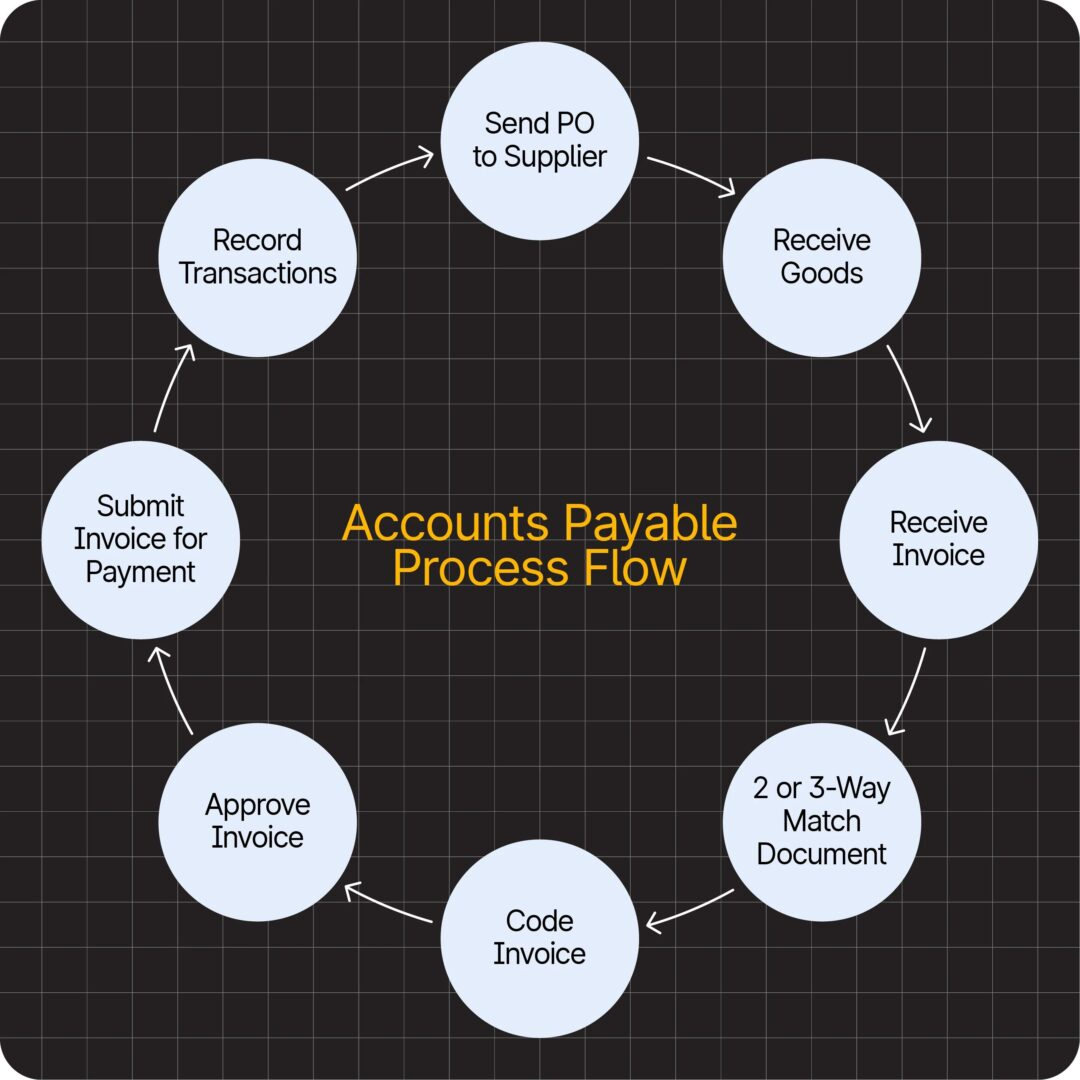
1. Invoice Processing & Accounts Payable Automation
Enterprise AI can extract invoice data, match purchase orders, detect processing exceptions, route approvals, and reduce manual accounts payable effort across financial operations workflows.
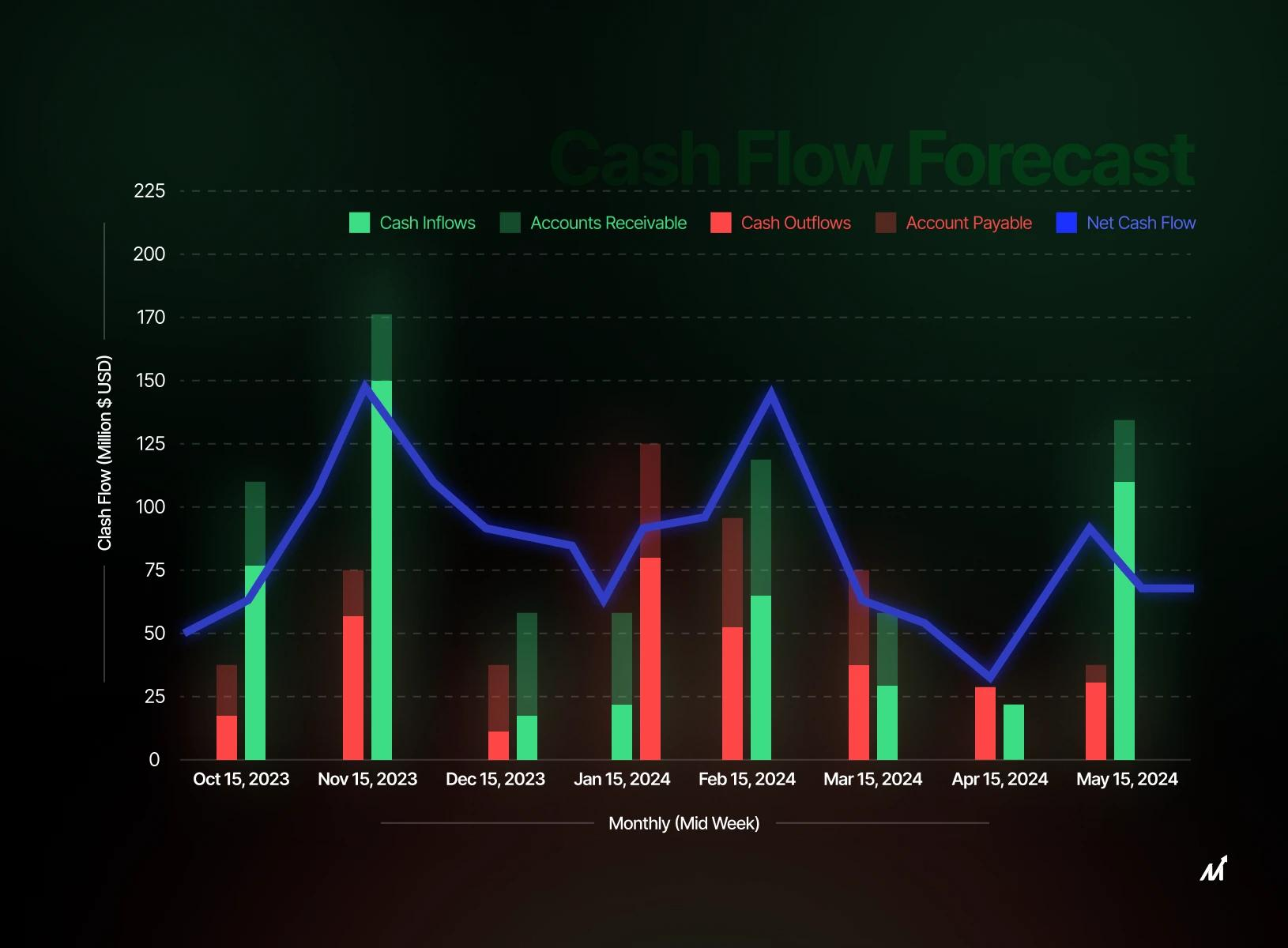
2. Financial Forecasting & Scenario Planning
AI-assisted forecasting can support cash-flow visibility, revenue modeling, variance explanation, predictive analytics, scenario analysis, and operational planning assumptions.
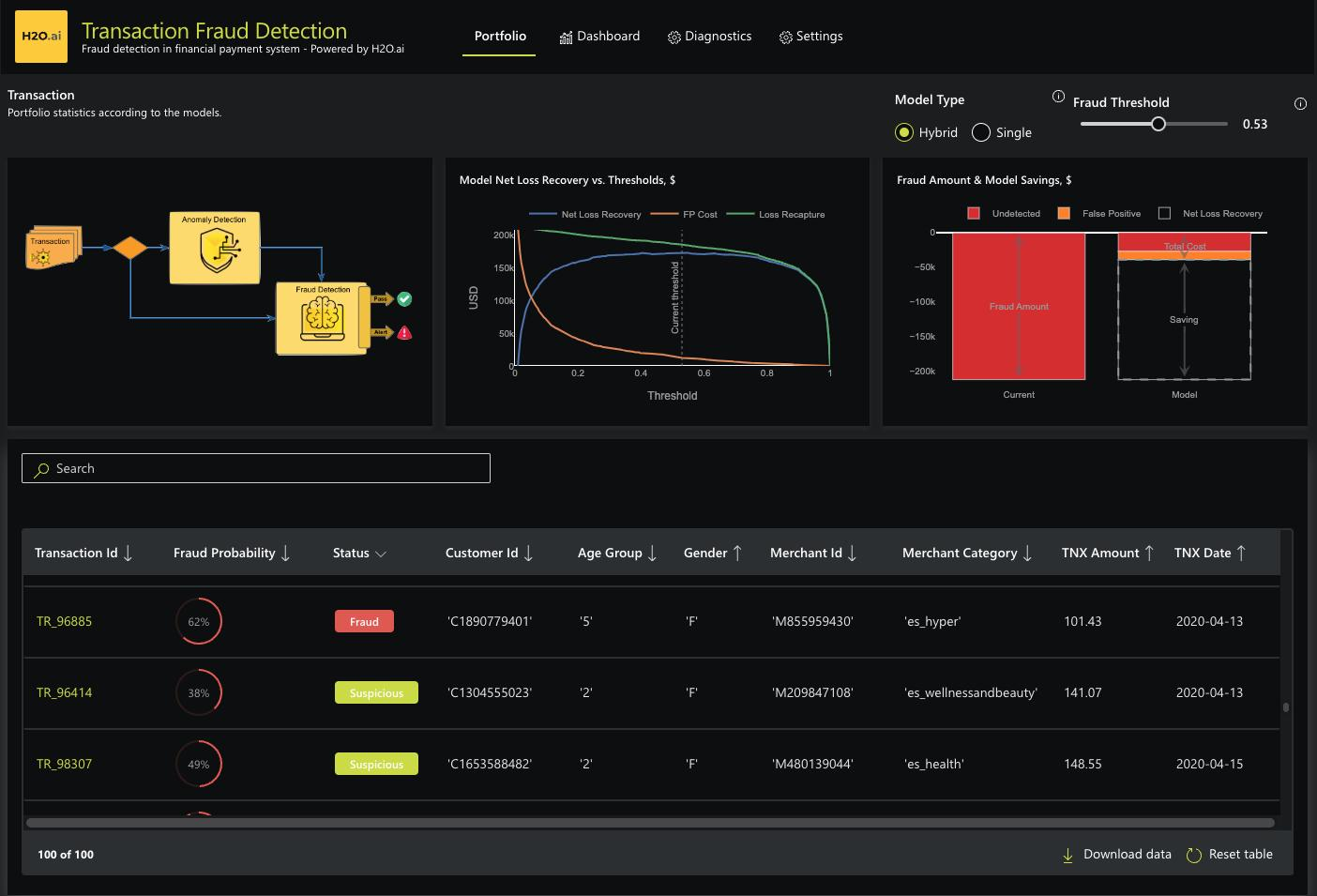
3. Fraud Detection & Risk Monitoring
Enterprise AI and financial analytics can monitor transactions, detect anomalies, identify operational red flags, and support earlier fraud investigation workflows.

4. Financial Close & Reconciliation
AI-assisted reconciliation can identify unmatched transactions, surface unusual entries, explain financial variances, and improve close-cycle visibility across enterprise finance operations.
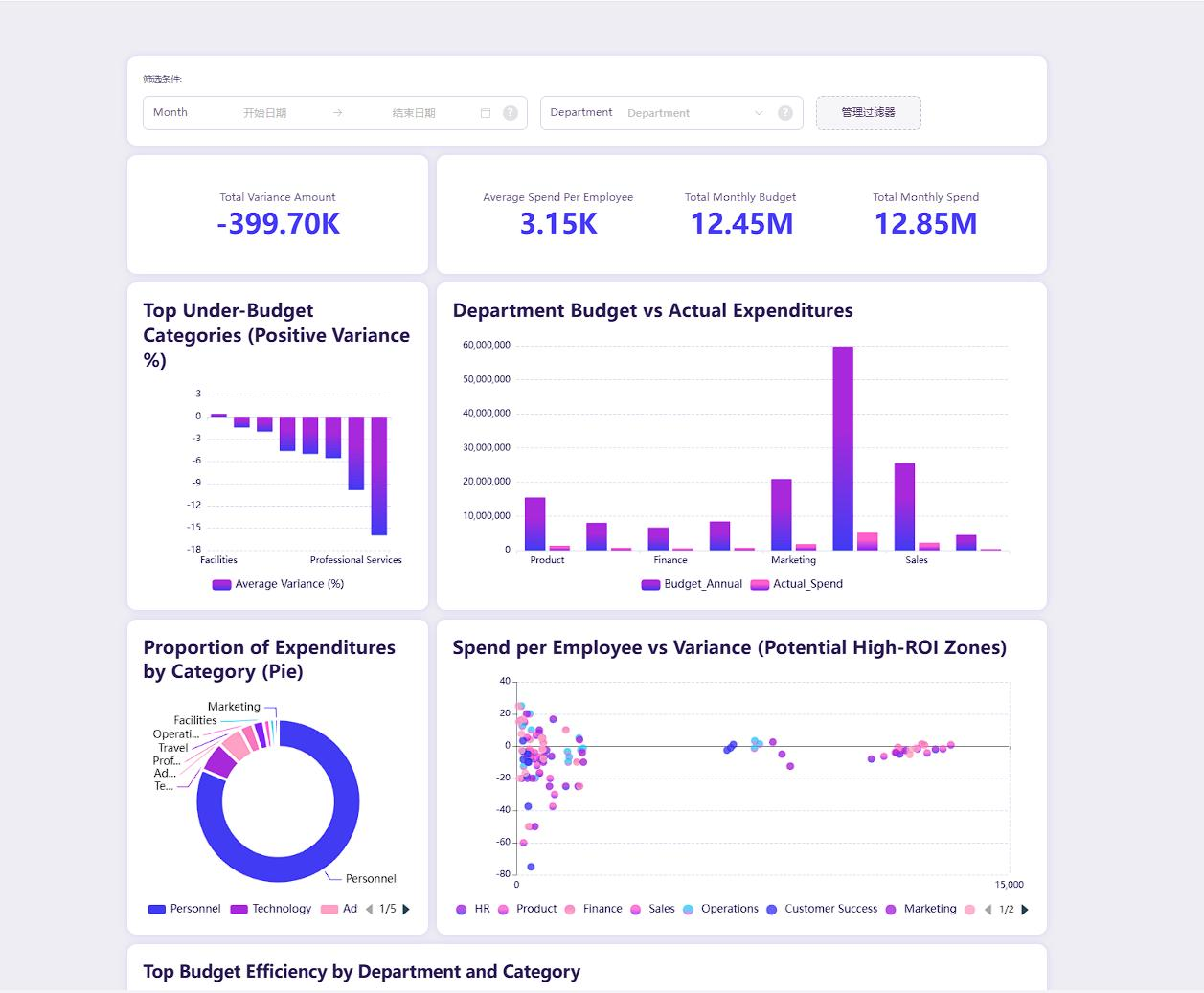
5. Expense Management & Anomaly Detection
Enterprise AI can analyze employee expenses, vendor payments, reimbursement activity, and financial transaction patterns to flag outliers, policy exceptions, and potential misuse.

6. Management Reporting & Decision Support
Enterprise AI can help prepare executive summaries, draft variance narratives, identify operational trends, and convert financial data into clearer management insight and strategic reporting.
Prioritizing Enterprise AI Use Cases in Financial Operations by ROI and Organizational Readiness
Not every enterprise AI opportunity in financial operations should be pursued simultaneously. Finance leaders need a structured framework for separating near-term AI pilots from longer-term operational transformation initiatives. The Enterprise AI Finance Impact Matrix compares each use case across two critical dimensions: expected business impact and organizational readiness.
This framework helps leadership avoid the common mistake of selecting AI projects based only on technical excitement. A stronger strategy prioritizes use cases where financial value is measurable, operational risk is manageable, and the organization has sufficient data quality, workflow maturity, governance controls, system integration, and workforce readiness to execute successfully.
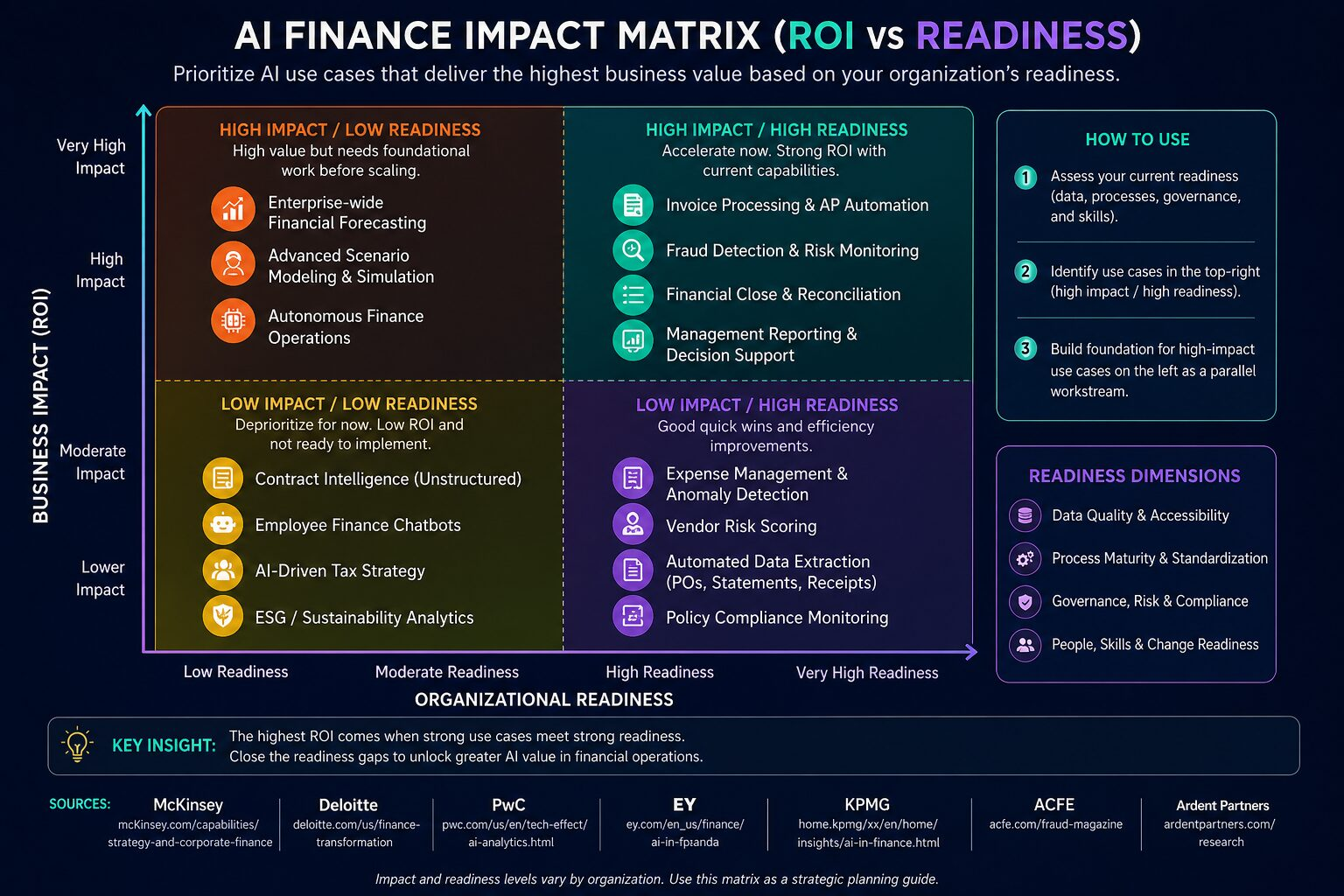
High ROI / High Organizational Readiness
These are often the strongest candidates for early enterprise AI pilots. Examples include invoice automation, fraud monitoring, financial reporting assistance, reconciliation workflows, and management reporting where data accessibility and workflow maturity already exist.
High ROI / Low Organizational Readiness
These opportunities may offer significant strategic value, but they require operational preparation before deployment. Examples include advanced forecasting, enterprise-wide scenario modeling, predictive analytics, and autonomous finance workflows that depend on stronger integration, governance, and process standardization.
Lower ROI / High Organizational Readiness
These can serve as useful operational quick wins for training, adoption, and workforce confidence-building. However, they should not consume resources that would be better directed toward higher-value enterprise finance transformation priorities.
Lower ROI / Lower Organizational Readiness
These initiatives should generally be deferred until the organization improves workflow maturity, governance capability, operational integration, or the overall business case for enterprise AI adoption becomes stronger.
Executive Takeaway: AI readiness is not simply a technical checklist. It is an operational business condition. The strongest enterprise AI strategy for financial operations begins with targeted pilots in the high-impact, high-readiness zone while using readiness gaps identified in other quadrants to guide future governance, integration, workflow, and workforce investments.
External Research Supporting Enterprise AI Readiness in Financial Operations
These industry references strengthen the business case for enterprise AI in financial operations while reinforcing a critical point: measurable AI value depends on operational readiness, workflow maturity, governance controls, data quality, workforce capability, and implementation discipline — not simply access to AI tools.
Research on how finance organizations are deploying enterprise AI, predictive analytics, and operational automation to improve financial planning, reporting, and decision support.
Finance Teams Putting AI to WorkEnterprise finance AI analysis covering AI agents, workflow automation, governance considerations, operational transformation, and emerging finance use cases.
AI Agents for FinanceAnalysis of how artificial intelligence is transforming financial planning and analysis through forecasting, scenario modeling, and operational insight generation.
AI in Financial Planning & AnalysisResearch demonstrating how stronger monitoring, controls, analytics, and oversight can materially reduce fraud losses and operational exposure.
Controls That Reduce Fraud LossesBenchmark analysis covering accounts payable automation, invoice processing efficiency, workflow maturity, and finance operational performance metrics.
State of ePayables 2024Financial operations benchmark data supporting process evaluation, workflow efficiency analysis, operational performance measurement, and continuous improvement initiatives.
Accounts Payable Key BenchmarksFrequently Asked Questions About Enterprise AI Readiness in Financial Operations
What is AI readiness in financial operations?
AI readiness in financial operations refers to an organization’s ability to safely and effectively deploy enterprise AI across workflows, reporting systems, governance structures, operational processes, and decision-support environments. Readiness includes data quality, workflow maturity, governance controls, workforce capability, and system integration.
Why do many finance AI initiatives fail?
Many finance AI projects fail because organizations focus on AI tools before addressing operational readiness. Common issues include fragmented financial data, inconsistent workflows, weak governance controls, unclear accountability, limited integration between systems, and insufficient workforce training.
What are the best early AI use cases in financial operations?
High-value early AI use cases often include invoice processing automation, fraud detection, financial forecasting, reconciliation support, expense anomaly detection, executive reporting assistance, audit preparation, and accounts payable workflow optimization.
How does governance affect enterprise AI in finance?
Governance is critical because financial operations involve compliance requirements, approval controls, auditability, privacy protection, operational accountability, and regulatory oversight. Strong governance frameworks help reduce operational risk while improving trust in AI-assisted financial workflows.
Should organizations fully automate financial decision-making with AI?
In most enterprise finance environments, AI should function as a decision-support capability rather than a replacement for professional judgment. Human oversight remains essential for governance, compliance, auditability, operational accountability, and strategic financial decision-making.
What is the best way to begin AI adoption in finance?
The strongest approach usually begins with a structured AI readiness assessment followed by targeted pilot projects where business value can be measured, governance can be tested, operational risk can be controlled, and finance teams can gradually build confidence and adoption maturity.
Is Your Finance Function Operationally Ready for Enterprise AI?
Athena Fusion Solutions helps organizations evaluate enterprise AI readiness across financial operations, workflow automation, governance frameworks, data maturity, operational integration, and executive decision support. Identify high-value AI use cases, readiness gaps, and practical pilot opportunities before scaling enterprise AI initiatives.
Request an AI Readiness BriefingWhere This AI Architecture Applies
The technical foundations of AI — including retrieval-augmented generation, edge AI, neuro-symbolic reasoning, governance, and deployment architecture — are not limited to one industry. They become most valuable when translated into real operating systems across healthcare, hospitality, finance, wellness, and workflow automation.
Healthcare AI Systems
Clinical AI, EHR integration, longitudinal patient monitoring, disease-specific intelligence, and governance models for safe healthcare deployment.
Explore Healthcare AI →Luxury Hospitality AI
AI strategy for luxury resorts, guest personalization, operational efficiency, wellness ecosystems, and measurable ROI in hospitality environments.
Explore Hospitality AI →Workflow Automation
Cross-platform automation systems that reduce manual friction, improve operational throughput, and convert fragmented workflows into measurable productivity gains.
View Workflow Automation Guide →Why AI Projects Fail
A cross-industry framework explaining why AI pilots stall, why architecture matters, and how organizations move from isolated experiments to deployed systems.
Read the Failure Framework →AI Platform Landscape
A practical comparison of AI tools, platforms, and resource categories for executives, operators, technologists, and small business leaders.
Compare AI Platforms →Prompt Engineering
Core principles for using generative AI more effectively across business workflows, executive strategy, content development, and operational decision support.
View Prompt Engineering Principles →AI Investment Framework
A decision framework for evaluating where AI investment creates measurable value, where risk is highest, and where controlled pilots should begin.
Coming SoonLifestyle Monitoring AI & Insurance
A future-facing crossover model connecting wellness retreats, wearable monitoring, high-sensitivity populations, and incentive-based insurance structures.
Coming SoonEvery Patient Becomes an Athlete in Recovery
A healthcare and wellness framework that applies athletic recovery principles to longitudinal patient monitoring, rehabilitation, and quality-of-life improvement.
Coming SoonThese cross-platform applications show how the same AI architecture can support clinical systems, resort operations, financial decision-making, workflow automation, and wellness intelligence.
Explore Crossover IntelligenceDownload the AI Readiness Gap in Financial Operations PDF
Access the complete enterprise AI finance readiness guide covering financial workflow automation, AI governance frameworks, operational readiness, forecasting, reconciliation, fraud detection, executive decision support, finance transformation, and practical AI implementation planning.
Download PDFThis enterprise AI resource explores the AI readiness gap in financial operations and provides a structured framework for evaluating operational readiness, workflow maturity, governance capability, financial AI use cases, operational risk management, data quality, and scalable enterprise AI deployment strategy.
Continue Exploring Enterprise AI Strategy and Financial Transformation
Explore additional enterprise AI resources covering operational readiness, workflow automation, governance frameworks, AI systems architecture, finance transformation, healthcare AI integration, hospitality AI strategy, and scalable implementation planning.