
Athena Fusion Solutions logo
AI Strategic Advisory Hub
Popular Agentic AI Resources

The Real ROI of AI in Wellness & Hospitality 2025–2030

A data-driven executive guide to measurable AI ROI — including revenue uplift, labor efficiency, guest experience gains, and a practical micro-pilot roadmap for premium wellness and hospitality operators.

Executive Overview

AI in wellness and hospitality should not be evaluated only as a technology expense. It should be evaluated as an operating lever that can improve revenue capture, reduce service friction, strengthen personalization, and create a more consistent premium guest experience.

Executive Navigation Overview

What This Executive AI ROI Guide Covers

This guide explores how AI is transforming luxury hospitality, wellness tourism, operational intelligence, guest personalization, staffing efficiency, and measurable ROI across modern resort and hospitality operations.

Section 1

Interactive ROI Calculator

Executive framework for evaluating operational efficiency, guest experience impact, and revenue potential from AI deployment.

Section 2

The Global Wellness Economy

Analysis of the wellness tourism market and why AI investment opportunities are accelerating in premium hospitality.

Section 3

Core AI ROI Drivers

Revenue optimization, labor productivity, workflow orchestration, and premium guest experience enhancement.

Section 4

Hospitality Event Operations

How AI can transform conferences, weddings, executive retreats, wellness events, and luxury hospitality coordination.

Section 5

Market Signals & Validation

Real-world operational indicators, hospitality AI adoption trends, and measurable ROI validation examples.

Section 6

Deployment & Strategic Advantage

ROI-first AI deployment frameworks, operational integration strategies, and future competitive positioning.

Interactive ROI Calculator

Estimate the Potential ROI of AI in Luxury Hospitality

This simplified model estimates how AI can improve revenue, reduce labor friction, and create operational savings when applied to guest experience and resort workflows.

Inputs

Annual Guest Revenue:
$5,000,000

Annual Labor Cost:
$2,000,000

Estimated Revenue Lift:
10%

Estimated Labor Efficiency Gain:
12%

Implementation Cost:
$350,000

Estimated Results

Revenue Gain
$500,000
Labor Savings
$240,000
Total Annual Benefit
$840,000
Net Benefit
$490,000
ROI
140.0%
Estimated Payback
5.0 mo

Strategic Interpretation

This scenario suggests credible potential for positive ROI, but execution quality, staff adoption, workflow integration, and measurement discipline determine whether projected value is realized.

Note: This calculator is intentionally simplified. Actual results depend on implementation quality, workflow design, guest mix, staff adoption, and how effectively AI is integrated into service delivery, personalization, and operating systems.

Strategic Insight

Why AI ROI Is Often Underestimated

Organizations frequently underestimate AI ROI because traditional financial models fail to capture the full spectrum of value creation. Most dashboards isolate metrics, while real impact emerges when revenue, efficiency, and guest experience are measured together.

Revenue Is Undercounted

Personalization and conversion gains drive revenue growth but are often excluded from ROI models.

Lifetime Value Is Ignored

Repeat visits, loyalty, referrals, and premium positioning are rarely modeled accurately.

Operational Friction Is Invisible

Efficiency gains from reduced delays, coordination effort, and rework are often missed in financial reporting.

Compounding Gains Are Missed

AI systems improve over time, creating accelerating returns that static ROI models overlook.

AI ROI Visibility Framework

Measuring the Real ROI of AI in Luxury Hospitality and Wellness Operations

Most hospitality organizations struggle to measure AI success because operational systems, guest engagement platforms, staffing data, and revenue analytics remain disconnected. AI ROI becomes measurable when these systems are unified into a single operational intelligence framework capable of monitoring revenue performance, labor efficiency, and guest satisfaction simultaneously.
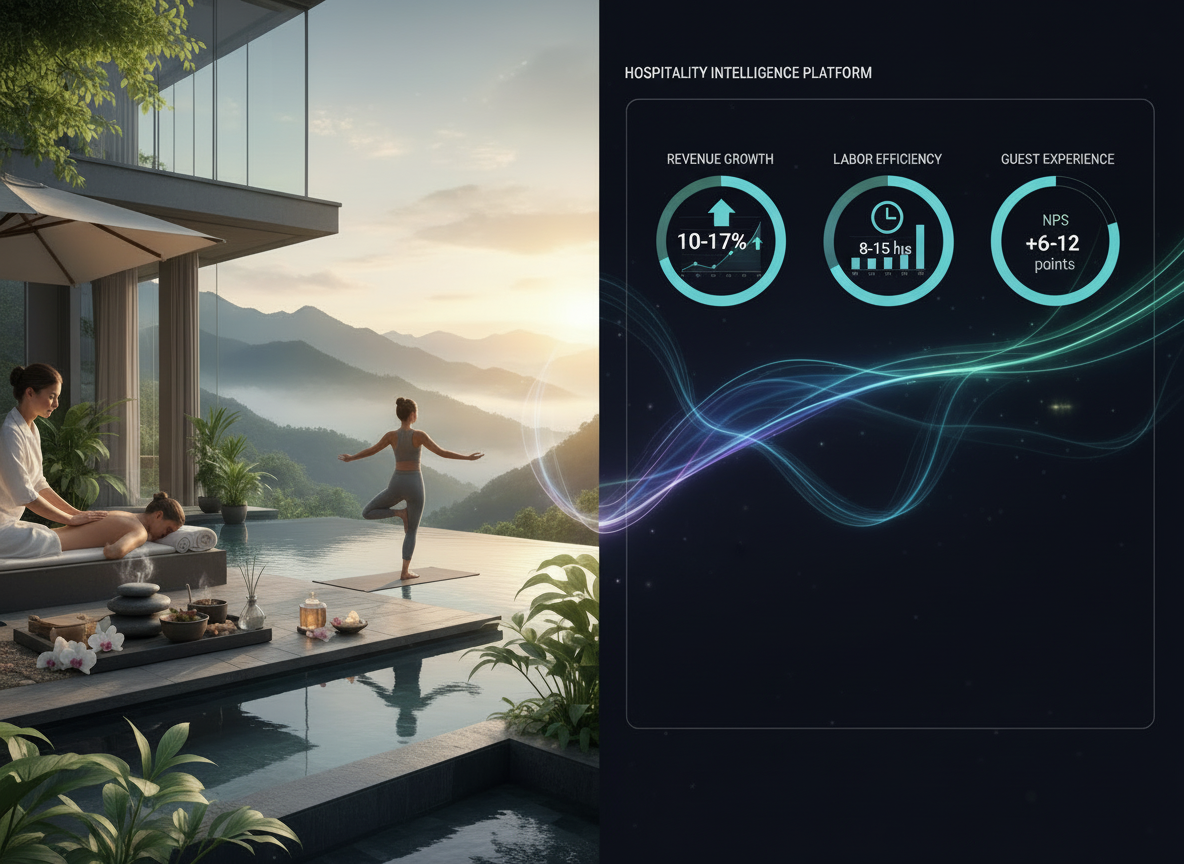
AI ROI dashboard showing revenue growth, operational efficiency, and guest experience metrics in a luxury wellness resort setting
Figure 1 — AI-driven operational intelligence dashboard illustrating the three core ROI pillars for luxury hospitality organizations: revenue growth, operational efficiency, and guest experience optimization.
Revenue Growth

AI systems can identify hidden revenue opportunities through intelligent pricing models, personalized guest offers, predictive booking analysis, wellness package optimization, and operational forecasting.

Operational Efficiency

Integrated AI architectures reduce workflow fragmentation across housekeeping, front desk operations, maintenance, staffing coordination, scheduling, and guest services.

Guest Experience

AI-enhanced hospitality systems improve personalization, reduce service friction, accelerate response times, and enable staff to focus more attention on meaningful guest interactions.

The Strategic Shift: From Fragmented Metrics to Unified Operational Intelligence

The future of AI in luxury hospitality is not centered on isolated automation tools. It is driven by integrated operational ecosystems capable of connecting workforce management, guest experience analytics, wellness engagement, revenue systems, and real-time operational monitoring into a unified intelligence architecture.
Section 1

The Global Wellness Economy Is on a Rocket Trajectory

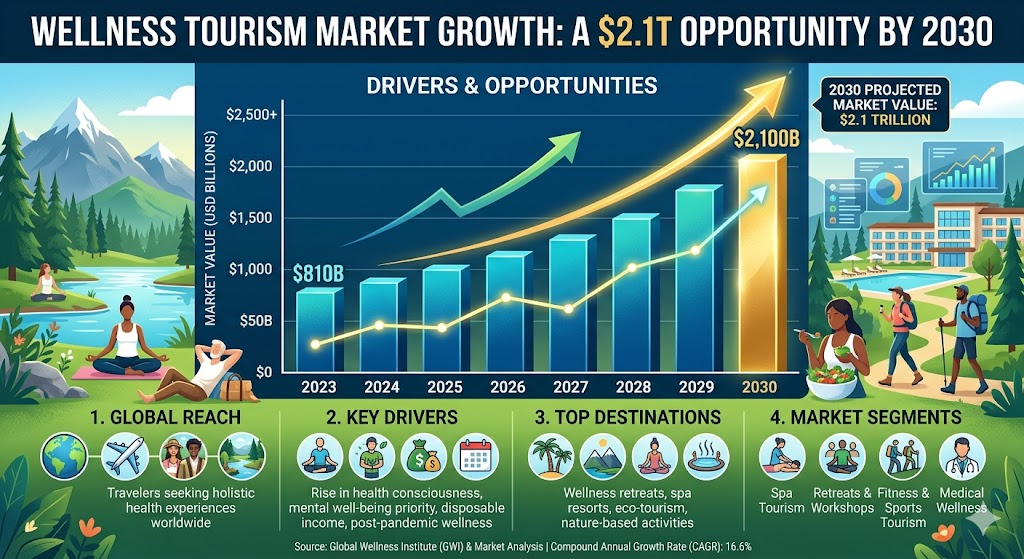
Wellness tourism has surpassed the trillion-dollar threshold and continues accelerating. This tailwind makes AI investments more defensible because the upside compounds through higher participation, higher willingness to pay, and higher lifetime guest value.

What Modern Wellness Travelers Seek

  • Personalized health optimization with measurable outcomes
  • Sleep and stress recovery supported by data
  • Longevity-focused retreats with evidence-backed programming
  • Authentic nature and culture-based immersion
Wellness market growth infographic showing expansion of the global wellness economy and opportunity for luxury hospitality organizations
Figure 2 — Rapid expansion of the global wellness economy is creating significant opportunities for AI-driven personalization, operational optimization, and premium wellness hospitality experiences.
AI ROI Framework

AI Delivers Measurable ROI in Three Financially Important Areas

In hospitality and wellness settings, AI creates value most reliably in three places: revenue expansion, labor productivity, and service consistency. These gains typically appear first at the workflow level before becoming enterprise-wide transformation.

High-performing hospitality organizations increasingly use AI not as a standalone automation tool, but as an operational intelligence layer that improves coordination, personalization, staffing efficiency, and real-time decision making across the guest experience ecosystem.

Three pillar AI ROI visualization showing revenue growth labor efficiency and guest experience optimization in hospitality
Figure 3 — Three-pillar AI ROI framework illustrating how revenue growth, labor efficiency, and guest experience optimization combine to create measurable business value in luxury hospitality and wellness operations.
01

Revenue Expansion

AI improves pricing precision, upsell conversion, and personalization. This turns guest data into direct top-line revenue through dynamic packaging, targeted offers, and higher-value experiences.

02

Labor Productivity

Automation of guest messaging, scheduling, and coordination reduces operational friction and allows staff to focus on high-value guest interaction rather than administrative work.

03

Experience Consistency

Faster response times, better personalization, and fewer service gaps improve satisfaction, retention, and premium brand positioning.
Hospitality Event Operations

How AI Can Transform Conferences, Weddings, and Luxury Hospitality Events

Luxury hospitality events are operationally complex, highly personalized, labor intensive, and experience sensitive. AI creates value by reducing orchestration friction, improving operational visibility, strengthening personalization, and helping hospitality teams coordinate premium guest experiences at scale.

Operational Orchestration

AI Event Coordination Systems

AI can coordinate room blocks, catering timing, transportation, staffing allocation, housekeeping priorities, AV support, vendor workflows, and schedule changes in real time. This improves operational responsiveness while reducing communication friction between departments.

Guest Experience

Personalized Guest Journeys

AI can personalize itineraries, wellness recommendations, networking suggestions, dining preferences, room experiences, and guest communication flows across conferences, weddings, executive retreats, and wellness hospitality environments.

Revenue Optimization

AI-Driven Revenue Expansion

Luxury hospitality organizations can use AI to optimize upsells, premium package offers, spa utilization, wellness experiences, event upgrades, and personalized guest recommendations designed to increase ancillary revenue and guest lifetime value.

Workforce Coordination

Staffing & Labor Optimization

AI operational intelligence systems can predict staffing demand, identify operational bottlenecks, coordinate housekeeping timing, anticipate check-in surges, and improve workforce allocation during high-volume event operations.

Strategic Insight

Luxury Hospitality AI Is Evolving Toward Experience Orchestration

The most valuable hospitality AI systems are not focused exclusively on task automation. They combine operational intelligence, guest personalization, staffing coordination, service recovery, workflow orchestration, and executive visibility into integrated systems designed to improve both operational performance and premium guest experience delivery.

Section 3

Four Market Signals That Strengthen the ROI Case

The case for AI in wellness and hospitality is strengthened by broader market signals: the scale of the wellness economy, operational efficiency gains already being reported, labor productivity pressure facing hospitality leaders, and measurable revenue improvements from AI-enabled personalization.

$6.8T

The Wellness Economy Is Already Large Enough

The global wellness economy creates a large and growing demand environment for strategic AI investment.

85%

Hospitality Leaders Report Efficiency Gains

AI adoption is already associated with operational productivity benefits, especially in service-heavy environments.

81%

Productivity Pressure Is Strategic

Labor leverage, operational consistency, and service continuity are now strategic priorities for hospitality operators.

+20%

Personalization Can Drive Revenue

AI-enabled recommendations, offers, upgrades, and itinerary relevance can translate into measurable top-line gains.

Section 5

Why AI ROI Is Systematically Underestimated

Most organizations evaluate AI primarily as a cost-reduction tool. While efficiency gains are real, this narrow lens significantly understates the true economic impact. The largest returns from AI in hospitality and wellness increasingly come from revenue expansion, personalization, and long-term guest value creation.

1. Over-Focus on Cost Savings

Many organizations treat AI as automation only. This misses value created through pricing, upsell optimization, service recovery, and experience design.

2. Revenue Impact Is Harder to Measure

Increases in guest spend, conversion rates, and repeat bookings are distributed across touchpoints and often misattributed to general business performance.

3. Guest Lifetime Value Is Overlooked

AI improves personalization and consistency, which directly influences loyalty, repeat visits, reviews, and referral behavior.

4. First-Wave vs. Second-Wave Value

The first wave of AI delivers operational efficiency. The second wave delivers revenue transformation.

AI should not be evaluated solely as a cost-control mechanism. It is a revenue and experience optimization system.

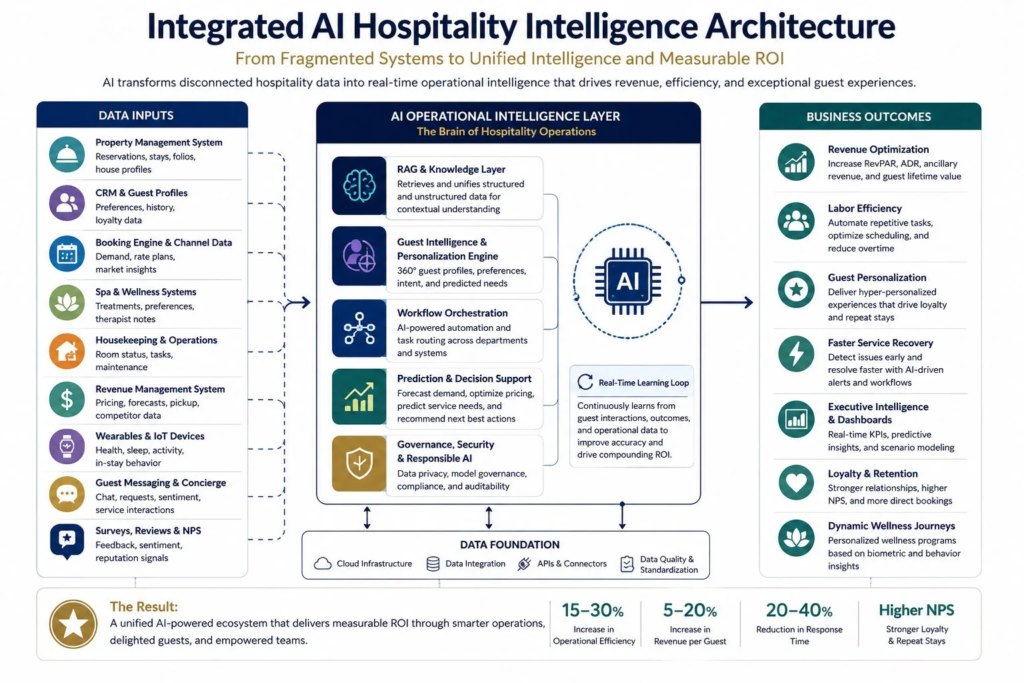
Integrated AI hospitality intelligence architecture showing how PMS, CRM, booking systems, wellness platforms, housekeeping operations, revenue management, guest messaging, and wearable data connect to AI operational intelligence for revenue optimization, labor efficiency, guest personalization, and measurable ROI in luxury hospitality.
Figure 4 — Integrated AI hospitality intelligence architecture illustrating how luxury resorts and wellness hospitality organizations can unify operational systems, guest data, workflow automation, personalization engines, and operational intelligence dashboards to improve revenue optimization, labor efficiency, guest experience consistency, and measurable AI ROI.
Validation Layer

Why AI ROI Is Not Theory Anymore

Accountability changed the game: baselines, dashboards, and integrations are enabling provable ROI and faster iteration cycles. What was once speculative is now tracked, reported, and replicated.

The conversation has shifted from “Can AI create value?” to “Which use cases create value fastest — and how do we scale them?”

Section 9

ROI-First Deployment Framework

A six-step approach that turns AI potential into measurable property performance.

Step 1

Define baselines: current revenue mix, labor allocation, NPS, and response times.

Step 2

Map desired outcomes: hard ROI and soft ROI including brand, loyalty, and repeat stays.

Step 3

Align tools with KPIs to avoid tool-first adoption.

Step 4

Implement micro-pilots: one workflow, one team, one dashboard.

Step 5

Measure over 3–12 months; focus on trendlines, not anecdotes.

Step 6

Scale winners and sunset underperformers.

Demand Shift

Consumer Behavior Is Moving Toward AI-Assisted Travel Planning

The guest side of the market is also changing. AI is becoming part of the discovery and decision environment — not just the back office.

For premium hospitality and wellness operators, that creates both pressure and opportunity. Brands that can connect AI-assisted discovery with personalized offers, clear value propositions, and smoother booking paths will be better positioned to capture digitally influenced demand.

AI is no longer only an operational advantage — it is becoming a demand-capture channel.

Section 11

Example ROI Model for a Premium Wellness Hospitality Brand

The exact economics will vary by property, but the logic below shows how operators should evaluate AI financially: as a combination of revenue lift, labor productivity, and reduced service friction.

Operational Variable Financial Interpretation
Annual room, wellness, and ancillary revenue baseline $18M–$30M
AI-assisted upsell / personalization impact Incremental top-line lift through better packaging, upgrades, and itinerary relevance
Guest messaging, coordination, and scheduling automation Reduced labor friction with more staff time redirected to guest-facing service
Service consistency gains Higher repeat intent, improved reviews, and stronger premium positioning
Board-level interpretation AI should be evaluated as a measurable operating lever embedded in revenue, labor, and experience systems.
Executive Conclusion

AI ROI in Wellness and Hospitality Is Becoming Easier to Defend

The strongest case for AI in wellness and hospitality is no longer theoretical. The market is large, guest expectations are shifting, labor productivity pressure is intensifying, and current deployments are already showing measurable gains in efficiency and revenue-supporting personalization.

The organizations most likely to benefit are not those that pursue AI as branding theater. They are the ones that treat it as an operating discipline: define the KPI, choose the workflow, run the pilot, measure the outcome, and scale only when the economics are clear.

The strategic question is no longer whether AI belongs in the operating model. It is whether the organization will capture early measurable gains — or wait until competitors have already turned those gains into structural advantage.

Frequently Asked Questions

AI ROI in Wellness & Hospitality

Practical answers for luxury resorts, wellness destinations, and hospitality leaders evaluating AI investments.

How should a luxury resort measure AI ROI?

AI ROI should be measured across revenue lift, labor productivity, service consistency, guest satisfaction, and repeat-booking behavior. The strongest approach is to define baseline metrics before implementation, run a controlled micro-pilot, and compare results over 3–12 months.

Why is AI ROI often underestimated in hospitality?

Many organizations evaluate AI only as a labor-saving tool. That misses larger value sources such as personalization, upsell conversion, faster service recovery, improved reviews, loyalty, and higher guest lifetime value.

What AI use cases produce measurable ROI fastest?

The fastest ROI usually comes from guest messaging automation, itinerary personalization, upsell recommendations, housekeeping coordination, labor scheduling, service recovery workflows, and revenue-management support.

Should resorts start with a full AI transformation or a micro-pilot?

Resorts should start with a focused micro-pilot: one workflow, one team, one dashboard, and clearly defined KPIs. This reduces risk, builds internal confidence, and creates evidence before scaling AI across the property.

What KPIs should be tracked in an AI hospitality pilot?

Useful KPIs include response time, upsell conversion rate, revenue per guest, staff time saved, guest satisfaction, review sentiment, complaint resolution time, housekeeping turnaround, repeat-booking intent, and Net Promoter Score.

Does AI replace hospitality staff?

The strongest hospitality AI strategy does not replace the human touch. It removes low-value administrative friction so staff can spend more time on personal service, guest recovery, relationship building, and premium experience delivery.

Where should this FAQ section go on the page?

Place this FAQ section near the bottom of the page, after the Executive Conclusion and before the final call-to-action. This improves SEO, reinforces decision confidence, and answers objections before the reader reaches the briefing request.

Appendix: Key Resources & References

References & Data Sources — External

  • Global Wellness Institute — Wellness Economy Statistics & Facts
  • McKinsey & Company — The State of AI
  • Deloitte — Future of Hospitality / AI-Driven Industry Trends
  • PwC — AI at the Heart of Tourism and Hospitality
  • PwC — US Hospitality Directions
  • Skift Research — Travel and Hospitality Trends

Note: ROI ranges and projections should be validated against current public benchmarks and property-specific operating data.

AI Strategy for Luxury Resorts — Athena Fusion Solutions
Athena Fusion Solutions — Hospitality & Wellness

AI Strategy for
Luxury Resorts

Executive frameworks, operational playbooks, ROI models, and experience design systems built specifically for luxury hospitality leaders navigating AI adoption.

5
Articles live
5
Subsets
7
Coming soon
Start here by role
👥
HR / people leader
Workforce & culture transformation
Live →
Why Most AI Projects Fail & How to Fix Them Live
The Future of Golf with Generative AI Live
Crossover articles — where hospitality meets healthcare & finance
These articles apply across verticals and link back to this hub.
Lifestyle Monitoring AI & Insurance soon Every Patient Becomes an Athlete in Recovery soon Wearable Data as Revenue soon AI ROI Unified Framework soon
Want ROI You Can Defend to the Board?

Move from AI Interest to Measurable Hospitality Performance

Athena Fusion Solutions helps wellness resorts and hospitality leaders implement human-centered AI through micro-pilots that prove measurable value before full-scale deployment.

Request a Strategic AI Briefing →
AI ROI in Luxury Hospitality | Revenue Growth, Labor Efficiency & Guest Experience
AI ROI & Transformation Resource

Download The Real ROI of AI Guide

Explore how organizations can measure the operational, financial, and strategic impact of artificial intelligence through workflow automation, operational AI systems, predictive analytics, intelligent decision support, customer experience optimization, and scalable enterprise AI deployment. This guide examines measurable ROI frameworks across healthcare, hospitality, wellness, and business operations.

AI ROI · Artificial Intelligence ROI · Workflow Automation · Operational AI Systems · Enterprise AI Deployment · Intelligent Automation · Predictive Analytics · Hospitality AI · Healthcare AI · Wellness Technology · AI Business Transformation · AI Operational Efficiency · AI Strategy Consulting · Measurable AI Outcomes · Digital Transformation Strategy

Leave a Comment