AI HR Transformation in Hospitality: Longitudinal Workforce Intelligence for Luxury Resort AI Strategy
AI is reshaping hospitality operations, guest experience, workforce planning, and service delivery. The critical question is no longer whether luxury resorts should adopt AI, but how HR leaders, operations executives, and hospitality teams can guide responsible AI transformation through longitudinal workforce intelligence, human-centered AI governance, and integrated operational systems.
Focus areas: hospitality AI transformation, HR AI strategy, longitudinal operational intelligence, workforce analytics, luxury resort AI, predictive staffing, AI governance, guest experience intelligence, and human-centered hospitality automation.
Table of Contents
This page explores how longitudinal operational intelligence, workforce analytics, hospitality AI architecture, AI governance, and human-centered operational systems are reshaping luxury hospitality organizations and workforce transformation strategies.
- • Why HR Must Lead AI Transformation
- • Human-Centered Hospitality AI
- • Workforce Transformation Challenges
- • AI Readiness in Hospitality Organizations
- • Strategic Hospitality AI Adoption
- • Longitudinal Operational Intelligence
- • Longitudinal Workforce Intelligence
- • Predictive Staffing Intelligence
- • Workforce Analytics & Operational Visibility
- • AI-Assisted Operational Decision Systems
- • Hospitality AI Architecture
- • AI Workflow Integration
- • Interoperable Hospitality Systems
- • Operational AI Orchestration
- • Guest Experience Intelligence Systems
- • Hospitality AI Governance Framework
- • Explainable AI & Workforce Trust
- • AI Governance & Compliance
- • Strategic AI Deployment Roadmaps
- • Future of Hospitality AI Systems
What Research Shows: HR’s Strategic Role in Hospitality AI Transformation
Research on AI in hospitality HR shows a critical pattern: employee perception often determines whether AI adoption improves engagement, workforce productivity, and operational efficiency — or creates resistance, distrust, and implementation failure.
When hospitality employees view AI as supportive, transparent, and human-centered, adoption is more likely to succeed. When AI feels like surveillance, replacement, or top-down control, even well-designed technology can fail. This makes HR central to hospitality AI governance, workforce trust, change management, and longitudinal workforce intelligence.
The World Economic Forum’s 2025 Future of Jobs Report projects major workforce shifts through 2030. For luxury resorts and hospitality organizations, HR’s role expands beyond hiring and compliance into AI readiness, workforce analytics, human-centered automation, AI skills development, and responsible operational transformation.
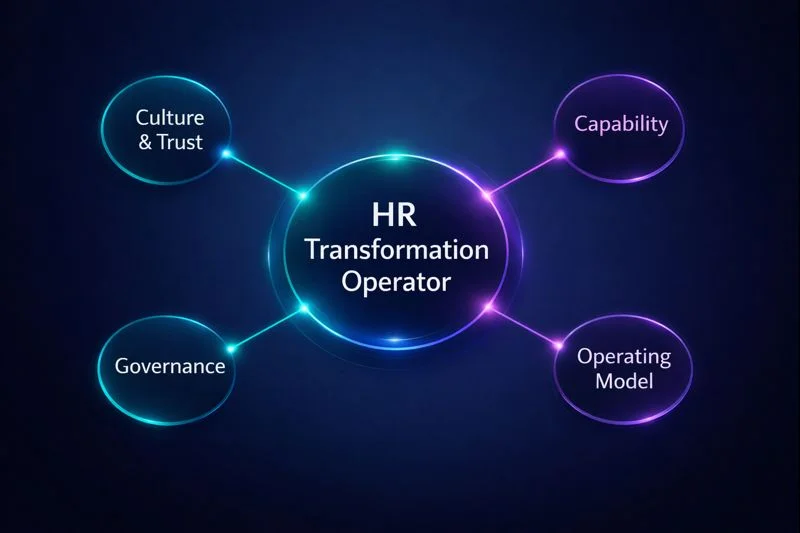
- Culture guardian: Protecting service warmth, employee trust, and human-centered guest experience
- Capability architect: Building AI-era skills, digital fluency, and hospitality workforce intelligence
- Governance leader: Ensuring fairness, transparency, explainability, and responsible AI adoption
- Change operator: Redesigning hospitality roles around human strengths, AI support, and operational intelligence
Where to Start: 5 Low-Risk AI Pilots for Hospitality HR Transformation
The most successful hospitality AI transformation programs begin with pilots that support employees rather than surveille them. These low-risk AI pilots help luxury resorts improve workforce intelligence, operational efficiency, employee experience, and guest service quality while building the organizational trust required for larger AI workflow integration.
HR Concierge Chatbot
A hospitality HR chatbot gives employees 24/7 access to benefits, policies, onboarding answers, scheduling guidance, and internal support resources. This reduces repetitive HR workload while improving employee experience and workforce communication.
Automated Recruiting & Scheduling
AI-assisted candidate scheduling reduces coordination friction, accelerates hiring workflows, and supports hospitality workforce planning. For luxury resorts with seasonal staffing pressure, this improves time-to-hire and reduces administrative burden.
Multilingual Onboarding Assistant
Multilingual AI onboarding improves training access, compliance communication, service standards, and early employee engagement. This supports human-centered hospitality AI by helping employees understand workflows in the language and format most useful to them.
Predictive Shift Coverage
Predictive staffing intelligence can identify call-out risk, coverage gaps, demand patterns, and scheduling pressure before they disrupt operations. This helps hospitality managers improve workforce resilience, service continuity, and operational visibility.
Manager Coaching Toolkit
Generative AI coaching templates can help hospitality managers improve feedback quality, employee development conversations, service recovery coaching, and leadership consistency across departments without replacing human judgment.
These hospitality AI pilots are designed to prove value quickly while building the workforce trust, AI governance discipline, and longitudinal operational intelligence required for more advanced hospitality AI orchestration.
AI Transformation in Hospitality Is Primarily a Workforce and Human Experience Challenge
Most discussions around AI in hospitality focus on automation, personalization, predictive analytics, and operational efficiency. While these capabilities are important, this framing often ignores a deeper operational reality: hospitality is fundamentally a people-driven experience business.
Luxury hospitality organizations depend on emotional intelligence, workforce coordination, service consistency, guest trust, and human-centered service delivery. As AI systems become more integrated into hospitality operations, the central challenge shifts from technology deployment alone to longitudinal workforce intelligence, operational alignment, employee trust, and responsible AI governance.
The greatest risk of hospitality AI transformation is not technical failure, but a fundamental misalignment between autonomous operational systems and human-centered guest experience delivery. This is why the stewardship of AI transformation increasingly shifts toward Human Resources, workforce intelligence, AI governance, and operational leadership.
The Strategic Role of HR in Hospitality AI Transformation
Luxury resorts and hospitality organizations are entering a period of accelerated AI transformation driven by workforce shortages, operational complexity, guest experience expectations, and the emergence of longitudinal operational intelligence systems. Chronic staffing challenges—including extended hiring cycles, high workforce turnover, scheduling instability, and operational burnout— are increasingly colliding with advanced AI capabilities.
Yet many hospitality organizations approach AI incorrectly. They treat AI adoption as a technology deployment project rather than a people transformation initiative. In reality, successful hospitality AI strategy depends on workforce trust, operational alignment, AI governance, human-centered service delivery, and longitudinal workforce intelligence—all areas where HR leadership becomes central.
As AI systems become integrated into workforce planning, staffing intelligence, onboarding, operational workflows, guest experience orchestration, and service recovery, HR increasingly becomes the organizational bridge between AI systems, operational leadership, employee experience, and hospitality culture.
This model highlights a critical point: while AI generates insights, value is realized through how staff interpret and deliver those insights. That responsibility sits within HR, not technology.
AI in Hospitality: From Guest Data to Human-Centered Service Delivery
A successful hospitality AI operating model connects guest data, longitudinal operational intelligence, AI workflow integration, HR leadership, workforce alignment, and human-centered service delivery into one coordinated system.
Workforce signals
Service history
Predictive analytics
Operational insights
Service triggers
Process coordination
Culture
AI governance
Consistent
Human-centered
The Luxury Hospitality Paradox: AI Efficiency vs Human-Centered Guest Experience
In luxury hospitality, people are the product. Every guest interaction—from concierge engagement and personalized service to service recovery and emotional connection—depends on human judgment, empathy, operational awareness, and hospitality culture. While AI in hospitality can optimize scheduling, workforce coordination, onboarding, predictive staffing, and operational efficiency, it cannot replace the human warmth that defines premium guest experience.
This is why HR leadership becomes central to successful hospitality AI transformation. As AI systems increasingly influence hiring, workforce analytics, scheduling, performance management, and operational workflows, the greatest risks are often human rather than technical: workforce distrust, perceived bias, culture dilution, employee disengagement, and the erosion of human-centered service delivery.
The future of human-centered hospitality AI depends on creating longitudinal workforce intelligence systems that reduce operational friction while preserving emotional intelligence, workforce trust, guest satisfaction, and luxury hospitality culture.
Real-World Success: AI Transformation in Action
A luxury hospitality operator moved from reactive HR administration to a more strategic, trust-centered operating model by introducing AI in stages, keeping people, culture, and service quality at the center of the transformation.
From Reactive to Strategic: 450-Room Resort Transforms HR
A family-owned luxury resort with 450 rooms and 680 employees faced chronic pressure: a 120-day average time-to-hire during peak season, 34% annual turnover among front-line staff, and declining guest satisfaction caused by inconsistent service delivery.
The HR team was spending roughly 60% of its time on administrative work, leaving limited capacity for workforce planning, coaching, and culture development. The transformation worked because leadership positioned AI as support infrastructure for people rather than as a substitute for human judgment.
“The transformation wasn’t about replacing our people—it was about giving our HR team the tools to focus on what matters: culture, development, and the human moments that define luxury hospitality.”
Implementation Approach
Critical Success Factors
- ✓ HR led the transformation with CHRO ownership and GM sponsorship
- ✓ Employee-facing tools were introduced first to build trust before efficiency expansion
- ✓ Human override rights were preserved for AI-influenced employment decisions
- ✓ Transparent communication reduced fear and sustained adoption momentum
- ✓ Luxury service moments remained explicitly human-led
When AI is implemented as a system aligned with staff behavior and service delivery, the impact becomes measurable across revenue, efficiency, and guest experience.
The ROI Opportunity—When Done Right
Early adopters in luxury hospitality are seeing compelling results—but only when implementation is led with HR discipline, governance, and cultural sensitivity.
Sources Supporting Hospitality AI ROI & Workforce Intelligence Metrics
-
National Restaurant Association — Workforce Technology & Hiring Performance
Supports the claim that automation, AI-driven applicant tracking systems, and chatbots can reduce hiring time, streamline applicant management, and free managers to focus on operations and employees.
National Restaurant Association Workforce Technology Report -
ADP — HR Trends and Technology Transforming Hospitality
Supports the use of AI-powered hiring tools in hospitality for applicant screening, interview scheduling, workforce forecasting, and reducing hiring time.
ADP Hospitality HR Technology Analysis -
SHRM — The Evolving Role of AI in Recruitment and Retention
Supports AI-enabled recruitment efficiency claims, including reductions in cost-per-hire and recruiter workload when AI is used for candidate matching, resume review, and recruitment workflow automation.
SHRM AI Recruitment and Retention Research -
Chipotle / Paradox AI Hiring Case Study
Reported restaurant-sector example showing AI-assisted recruiting reduced average application processing time from 12 days to 4 days and improved application completion from 50% to 85%.
MarketWatch Coverage of Chipotle AI Hiring Program -
Checkr — 2026 Hospitality CHRO Insights Report
Provides hospitality-specific workforce data from 500 CHROs, including AI adoption gaps, retention risk, hiring integrity concerns, and HR technology performance.
Checkr Hospitality CHRO Insights Report -
Workativ — HR Chatbot Automation Benchmark
Vendor benchmark supporting the narrower claim that mature HR chatbot implementations can automate 60%+ of repetitive HR queries such as PTO requests, benefits questions, onboarding tasks, and policy lookups.
HR Chatbot Automation Benchmark
Longitudinal Operational Intelligence in Hospitality AI Systems
Modern hospitality AI platforms increasingly depend on longitudinal operational intelligence — the ability to continuously analyze, correlate, and optimize workforce behavior, guest preferences, staffing dynamics, occupancy trends, service recovery patterns, operational workflows, and real-time hospitality data across interconnected systems.
In luxury resorts, hotels, wellness destinations, golf resorts, and hospitality organizations, AI-driven operational intelligence systems can support predictive staffing optimization, AI-assisted guest experience orchestration, workforce intelligence, operational workflow automation, and human-centered service delivery. Rather than operating through disconnected software silos, modern hospitality organizations can build integrated hospitality intelligence architectures that continuously learn from operational patterns, employee interactions, guest behavior, and service outcomes over time.
This emerging approach to AI in hospitality management combines predictive analytics, machine learning, workforce management systems, guest engagement platforms, CRM systems, HR intelligence, property management systems (PMS), and operational data platforms into scalable longitudinal intelligence ecosystems. The result is a more adaptive hospitality environment capable of improving operational efficiency, labor optimization, employee experience, personalized guest engagement, and luxury service consistency simultaneously.
The future of hospitality artificial intelligence may depend less on isolated automation tools and more on interoperable AI architectures capable of continuously synthesizing operational intelligence across departments. Organizations that successfully integrate hospitality AI strategy, workforce intelligence, predictive analytics, and guest experience optimization into unified decision ecosystems may gain significant long-term advantages in operational resilience, service personalization, workforce retention, revenue optimization, and customer satisfaction.
Hospitality AI Architecture & Longitudinal Operational Intelligence
The future of AI in hospitality management depends on building integrated hospitality AI architectures capable of connecting workforce management systems, guest engagement platforms, property management systems (PMS), operational workflows, predictive analytics, AI orchestration layers, and human-centered service delivery into adaptive longitudinal hospitality ecosystems.
From Fragmented Hospitality Systems to AI-Driven Operational Intelligence
Many luxury resorts, hotels, golf resorts, wellness destinations, and hospitality organizations still operate through fragmented technology environments where HR systems, reservation platforms, housekeeping operations, staffing systems, maintenance workflows, guest engagement platforms, CRM environments, and operational analytics tools function independently.
Modern hospitality artificial intelligence architecture introduces interoperable intelligence layers capable of continuously synthesizing operational data across the full hospitality ecosystem. This creates longitudinal operational intelligence that improves workforce coordination, predictive staffing optimization, service recovery management, guest experience personalization, operational visibility, labor efficiency, and executive decision-making.
Instead of relying on isolated automation tools, organizations can deploy AI-assisted hospitality workflow systems designed to continuously learn from guest preferences, occupancy trends, staffing patterns, workforce behavior, operational bottlenecks, employee engagement signals, and luxury service outcomes over time.
Core Components of Hospitality AI Architecture
- AI Workflow Integration for front desk operations, housekeeping coordination, guest services, maintenance operations, and staffing management
- Longitudinal Workforce Intelligence analyzing productivity trends, burnout risk, staffing efficiency, retention signals, and labor optimization
- Predictive Guest Experience Intelligence combining loyalty behavior, personalization patterns, engagement analytics, and service recovery insights
- Hospitality Predictive Analytics supporting occupancy forecasting, staffing optimization, revenue intelligence, and operational planning
- Operational AI Orchestration Layers connecting PMS systems, CRM platforms, HR systems, reservation systems, and operational analytics tools
- Human-Centered Hospitality AI designed to augment employee performance while preserving luxury guest experience standards
- Interoperable Hospitality Intelligence Systems integrating workforce analytics, operational dashboards, guest engagement systems, and AI-assisted decision environments
- Executive Operational Intelligence Dashboards delivering real-time visibility into workforce dynamics, operational bottlenecks, guest satisfaction trends, and service efficiency
Why Hospitality AI Architecture Determines Long-Term Success
Most hospitality AI projects fail not because of weak AI models, but because of fragmented operational systems, disconnected workflows, poor interoperability, siloed workforce data, and limited integration between guest experience systems, operational platforms, and executive decision environments.
The next generation of AI-powered hospitality operations will likely depend on scalable operational intelligence architectures capable of continuously learning from workforce behavior, operational performance, guest engagement patterns, and service outcomes across the entire hospitality ecosystem.
Organizations that successfully implement longitudinal hospitality intelligence systems may gain substantial advantages in operational efficiency, labor optimization, employee retention, predictive service management, personalized guest engagement, luxury hospitality operations, and long-term revenue performance.
The Strategic Mistake Most Hospitality Organizations and Luxury Resorts Will Make with AI
Many hospitality organizations still approach AI in hospitality management as a traditional technology initiative led primarily by IT departments or operational efficiency teams. In luxury hospitality, hotels, golf resorts, wellness destinations, and premium guest environments, this approach often fails because the core product is not technology — it is the guest experience, emotional engagement, personalized service delivery, and long-term brand perception.
Modern hospitality AI systems directly influence how employees interact with guests, how luxury service standards are maintained, how operational workflows are coordinated, how staffing decisions are optimized, and how hospitality brands express their identity across every touchpoint. These are not simply technology decisions — they are human-centered operational, workforce, and cultural decisions that affect guest satisfaction, employee engagement, workforce retention, service consistency, operational efficiency, and luxury hospitality differentiation.
Organizations that focus exclusively on automation, labor reduction, or isolated AI tools without integrating workforce intelligence, operational workflows, predictive analytics, guest personalization systems, and longitudinal operational intelligence may unintentionally weaken service quality, employee trust, and the personalized hospitality experiences that define premium resort brands.
The future of AI-powered hospitality operations will likely depend on balancing operational efficiency with human-centered service delivery. Resorts and hospitality organizations that successfully integrate hospitality AI architecture, workforce intelligence, predictive staffing analytics, operational intelligence, and guest experience orchestration into unified operational ecosystems may gain significant advantages in guest satisfaction, employee experience, staffing optimization, operational resilience, revenue performance, and long-term luxury brand loyalty.
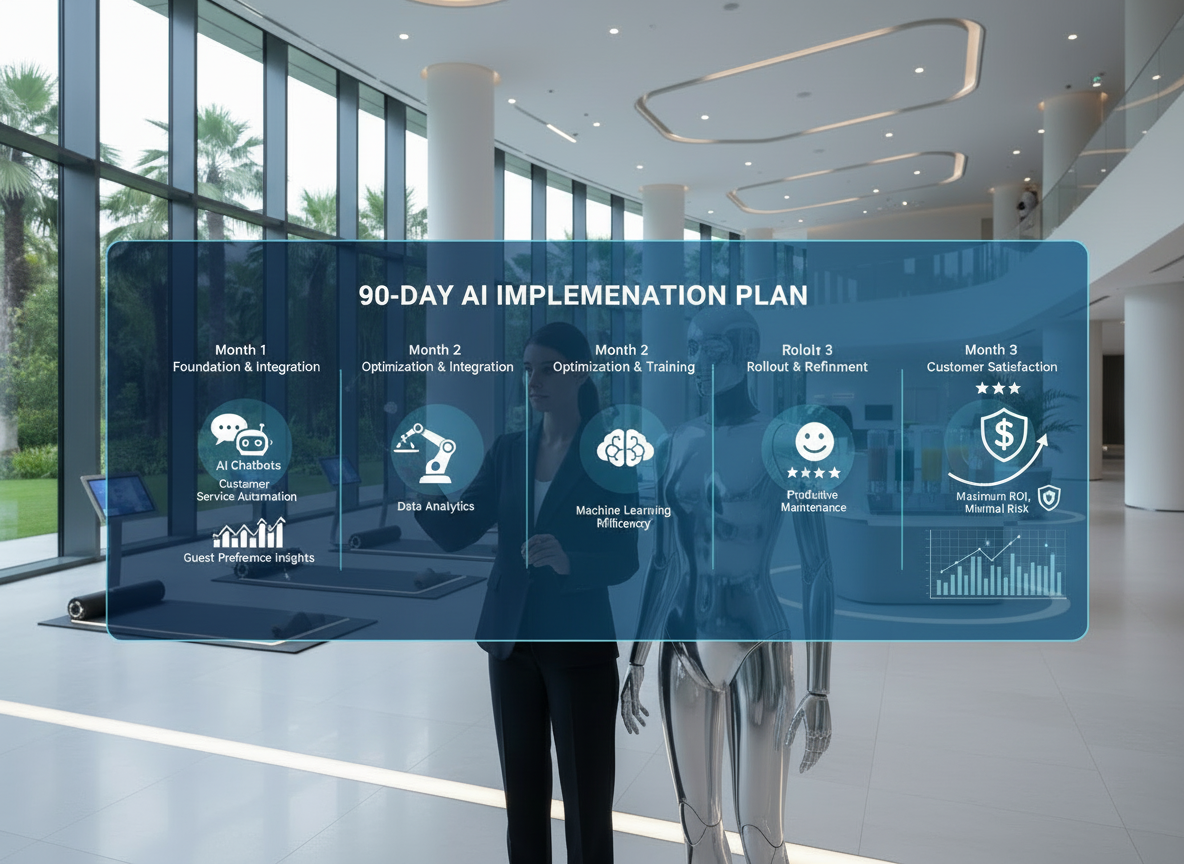
The 90-Day Roadmap
- › Days 1–30: discovery + governance
- › Days 31–60: pilot design
- › Days 61–90: launch + evaluation
Proceed with scaling *only* if staff adoption exceeds 75% and overall sentiment remains positive.
Illustrative Scenario: Why Human-Centered Hospitality AI Strategy Matters
The success or failure of AI in hospitality management often depends less on the AI technology itself and more on how hospitality organizations integrate workforce training, operational workflows, guest experience standards, and human-centered service delivery into the implementation process.
Scenario 1 — AI Deployment Without Human-Centered Leadership
A luxury resort deploys advanced hospitality AI systems designed to personalize guest recommendations, automate operational workflows, optimize staffing coordination, and improve service responsiveness. The platform analyzes guest preferences, reservation history, operational patterns, occupancy trends, and service requests in real time.
However, without strong HR leadership, workforce training, or human-centered operational guidance, employees begin treating AI-generated recommendations as rigid instructions rather than adaptive service insights. Guest interactions become increasingly transactional, scripted, and operationally mechanical.
Although the organization improves certain operational efficiency metrics, the luxury hospitality experience begins to weaken. Employees lose confidence in personalized decision-making, service consistency declines, and guests perceive interactions as less authentic, emotionally intelligent, and brand-aligned.
Scenario 2 — HR-Led Hospitality AI Transformation
In a human-centered implementation model, HR leadership works alongside operations teams, hospitality executives, and AI strategy leaders to integrate workforce intelligence, employee training, luxury service standards, and brand culture directly into the AI deployment process.
Employees are trained to interpret AI-generated operational insights as decision-support tools rather than rigid commands. Staff learn how to adapt AI recommendations dynamically while maintaining empathy, personalization, emotional intelligence, and the brand tone expected in luxury hospitality environments.
AI becomes an operational intelligence layer that augments employee performance, improves service coordination, supports predictive staffing optimization, and enhances guest engagement without replacing the human touch that defines premium hospitality experiences.
The result is stronger guest satisfaction, improved employee engagement, better workforce retention, more consistent luxury service delivery, enhanced operational resilience, and a scalable hospitality AI architecture aligned with long-term brand identity and customer loyalty.
How to Measure AI Success in Hospitality HR, Workforce Operations, and Guest Experience
Successful AI adoption in hospitality management is not measured solely by automation or labor reduction. High-performing hospitality AI systems must simultaneously improve operational efficiency, workforce engagement, employee retention, service consistency, and guest satisfaction while preserving the human-centered service culture that defines luxury hospitality brands.
Operational Efficiency Metrics
Evaluate how AI-powered hospitality operations improve workflow coordination, staffing efficiency, and administrative productivity across HR and resort operations.
- Time-to-hire reduction
- HR administrative workload reduction
- Interview scheduling acceleration
- Automation rate of HR inquiries
- Predictive staffing optimization
- Operational workflow efficiency gains
Workforce Intelligence & Employee Experience
Measure how hospitality AI implementation affects employee engagement, workforce trust, retention, training outcomes, and long-term organizational culture.
- Employee satisfaction (eNPS)
- Retention and turnover trends
- Training completion rates
- Manager effectiveness scores
- Employee burnout risk indicators
- AI adoption and engagement rates
Human-Centered Service Culture Metrics
Assess whether AI systems strengthen or weaken the personalized hospitality experience, workforce trust, and luxury service delivery standards.
- Employee sentiment toward AI systems
- Trust and fairness perception scores
- Quality of guest service interactions
- Human-centered service consistency
- Brand alignment across guest touchpoints
- Cross-department operational coordination
Guest Experience & Hospitality Performance
Measure the impact of hospitality AI systems on guest satisfaction, service personalization, operational responsiveness, and long-term customer loyalty.
- Guest satisfaction scores
- Luxury service consistency metrics
- Complaint resolution speed
- Repeat guest and loyalty rates
- Guest personalization effectiveness
- Revenue per guest optimization
Executive Insight: The most successful hospitality AI transformation strategies improve all four dimensions simultaneously — operational efficiency, workforce intelligence, human-centered service culture, and guest experience optimization. If efficiency improves while employee trust, luxury service quality, or guest satisfaction decline, the underlying hospitality AI architecture and operational strategy are likely misaligned.
AI Governance in Hospitality: The Non-Negotiable Foundation for HR-Led Transformation
Many luxury resorts, hotels, golf destinations, and hospitality organizations struggle with AI implementation in hospitality management because they deploy technology before establishing governance, workforce alignment, and operational accountability. In hospitality, AI governance is not a secondary technical layer — it is the strategic framework that protects employee trust, guest experience quality, operational consistency, workforce culture, and long-term brand integrity.
HR leadership must help design the hospitality AI governance architecture before AI pilots scale across recruiting, staffing optimization, workforce analytics, guest engagement systems, operational workflows, and service automation. Without governance, hospitality organizations risk introducing bias, reducing employee trust, weakening luxury service personalization, and creating inconsistent operational decision-making.
- AI Ethics Committee: Establish cross-functional governance involving HR, Legal, IT, Operations, hospitality executives, and employee representation to review AI use cases, workforce impact, operational risk, privacy protection, fairness, and bias mitigation.
- Automate Low-Risk Administrative Workflows: Use hospitality AI systems to automate repetitive HR functions such as interview scheduling, onboarding reminders, HR FAQs, policy lookup, staffing coordination, and employee support requests.
- Augment Workforce Decision-Making: Apply AI-assisted workforce intelligence to staffing optimization, labor forecasting, scheduling analytics, employee engagement insights, and recruiting support while maintaining human review and managerial oversight.
- Protect Human-Centered Service Zones: Preserve human leadership for disciplinary actions, sensitive employee matters, VIP guest experiences, conflict resolution, service recovery, and emotionally complex hospitality interactions.
- Protect Employee Rights & Transparency: Require explainability, transparency, override capability, privacy safeguards, and formal appeal paths for AI-influenced workforce and operational decisions.
AI Governance Framework for Hospitality, Luxury Resorts, and Workforce Transformation
Effective AI governance in hospitality management requires more than technology oversight. Modern hospitality AI systems must balance workforce intelligence, operational efficiency, employee trust, guest experience quality, AI ethics, data privacy, and service culture protection through a coordinated human-centered governance architecture.
HR Leadership & Hospitality AI Governance Core
Central leadership layer responsible for AI strategy, workforce alignment, employee trust, service culture protection, operational accountability, and final human decision authority.
Legal, Ethics & Compliance
AI ethics, workforce fairness, regulatory compliance, bias mitigation, privacy governance, and operational accountability.
Technology & Security Infrastructure
Hospitality AI infrastructure, cybersecurity, operational resilience, data protection, interoperability, and system integrity.
Hospitality Operations & Guest Experience
Guest experience orchestration, workflow validation, staffing coordination, service consistency, and operational optimization.
Employee Experience & Workforce Voice
Workforce trust, employee engagement, AI transparency, operational fairness, and human-centered service culture.
Hospitality AI Decision Governance Framework
High-performing hospitality organizations define clear boundaries between AI automation, AI-assisted workforce augmentation, and human-only operational decisions. This governance model helps protect employee trust, guest experience quality, operational integrity, and luxury service standards.
✓ Automate
Repetitive administrative tasks including HR FAQs, interview scheduling, onboarding workflows, staffing coordination, and operational reporting.
⚡ Augment
AI-assisted workforce planning, staffing analytics, guest personalization insights, operational forecasting, and employee engagement intelligence.
✗ Human-Only Decisions
Service recovery, disciplinary action, emotionally sensitive guest interactions, VIP experiences, and complex workforce decisions.
Executive Insight: The future of AI-powered hospitality operations will likely depend on governance architectures capable of balancing automation, workforce intelligence, operational efficiency, employee trust, and human-centered guest experience simultaneously. Resorts that fail to establish governance early may increase operational risk, weaken workforce confidence, and damage long-term brand loyalty.
How AI Creates Measurable ROI in Luxury Hospitality and Resort Operations
AI in hospitality management does not generate value by itself. Measurable ROI is created when artificial intelligence is integrated into operational workflows, aligned with employee behavior, connected to guest experience systems, and delivered consistently across luxury resort operations, hotels, golf destinations, wellness properties, and premium hospitality brands.
Revenue Growth & Guest Spend Optimization
AI-powered personalization, dynamic pricing, targeted upsell offers, loyalty intelligence, and predictive guest recommendations can increase average spend per guest, upgrade rates, ancillary revenue, spa bookings, dining revenue, golf package sales, and long-term guest lifetime value.
Operational Efficiency & Workflow Automation
Hospitality AI systems reduce manual work, improve scheduling, automate routine service workflows, streamline front desk operations, support housekeeping coordination, and allow staff to focus on high-value guest interactions that preserve luxury service quality.
Guest Satisfaction & Service Personalization
Consistent personalization, faster service response, predictive service recovery, AI-assisted guest engagement, and better operational coordination can improve guest satisfaction scores, online reviews, repeat visitation, loyalty program participation, and premium brand perception.
Labor Optimization & Workforce Intelligence
AI-enabled workforce intelligence improves workload distribution, predictive staffing, HR automation, scheduling accuracy, employee support, and labor planning while helping reduce burnout, turnover, understaffing, overstaffing, and unnecessary operational inefficiencies.
Simplified Hospitality AI ROI Model
ROI = (Revenue Gains + Cost Savings + Guest Experience Lift + Workforce Retention Value) − AI Implementation Cost
In luxury hospitality, AI ROI should include more than immediate revenue gains or labor savings. Experience lift includes repeat visits, brand perception, guest loyalty, service consistency, positive reviews, employee retention, workforce productivity, and long-term customer lifetime value.
| ROI Area | Hospitality AI KPI | Example Impact Range |
|---|---|---|
| Revenue Optimization | Average spend per guest, upsell conversion, ancillary revenue | Directional lift varies by property and implementation |
| Operational Efficiency | Time per service interaction, workflow completion speed, admin workload | Reduced manual workload and faster response cycles |
| Guest Experience | Guest satisfaction, review scores, complaint resolution speed, repeat visits | Measurable improvement when AI supports service consistency |
| Labor & Workforce Intelligence | Staff productivity, retention, scheduling accuracy, turnover risk | Improved staffing efficiency and reduced workforce friction |
| Brand & Loyalty Performance | Guest lifetime value, loyalty engagement, premium brand perception | Long-term value increases through personalization and consistency |
The highest ROI from hospitality AI does not come from isolated automation tools. It comes from integrated AI architectures that connect guest data, workforce intelligence, operational workflows, predictive analytics, staff training, and human-centered service delivery. This is why HR-led implementation, governance, and operational alignment are critical: value is realized through people, workflows, and guest experience — not technology alone.
Translate Strategy into Measurable Impact
The ROI model above outlines how AI creates value across revenue, operations, and guest experience. The next step is to translate that framework into a practical estimate for your organization.
The calculator below provides a simplified way to estimate potential impact based on your current revenue, labor structure, and expected performance gains.
Estimate the Potential ROI of AI in Luxury Hospitality
This simplified model estimates how AI can improve revenue, reduce labor friction, and create operational savings when applied to guest experience and resort workflows.
Inputs
Estimated Results
This scenario suggests meaningful upside if AI is integrated into guest-facing and operational workflows with strong staff adoption and governance.
This calculator is intentionally simplified. Actual results depend on implementation quality, workflow design, staff adoption, guest mix, and how effectively AI is integrated into service delivery, personalization, and operating systems.
How to Measure AI Success in Hospitality HR, Workforce Operations, and Guest Experience
Successful AI adoption in hospitality is not measured by automation alone. A strong hospitality AI strategy must improve workforce outcomes, HR productivity, employee trust, service culture, operational efficiency, and guest experience quality at the same time.
Operational Efficiency Metrics
Track how AI improves HR workflows, staffing coordination, administrative speed, and operational productivity.
- Time-to-hire reduction
- HR administrative workload reduction
- Interview scheduling speed
- Automation rate of HR inquiries
- Onboarding workflow completion time
Workforce Intelligence & Employee Experience
Measure whether AI strengthens employee engagement, workforce retention, manager effectiveness, and trust.
- Employee satisfaction and eNPS scores
- Retention and turnover trends
- Training completion rates
- Manager effectiveness scores
- Employee confidence using AI tools
Service Culture & AI Trust Metrics
Evaluate whether AI supports human-centered hospitality, fair workforce decisions, and luxury service consistency.
- Employee sentiment toward AI
- Trust and fairness perception
- Quality of service interactions
- Adoption rates of AI tools
- Brand-aligned service consistency
Guest Experience & Hospitality Performance
Connect AI performance to guest satisfaction, personalization, service recovery, loyalty, and repeat visitation.
- Guest satisfaction scores
- Service consistency metrics
- Complaint resolution speed
- Repeat guest rates
- Guest personalization effectiveness
Executive Insight: The strongest hospitality AI implementations improve all four dimensions simultaneously: operational efficiency, workforce intelligence, service culture, and guest experience. If efficiency improves while employee trust, service quality, or guest satisfaction declines, the underlying AI strategy for hospitality HR is misaligned.
Applying AI in Luxury Hospitality Requires Strategy, Governance, and Human-Centered Design
Athena Fusion Solutions helps luxury resorts, hotels, wellness destinations, golf resorts, and hospitality organizations develop AI strategies for hospitality management that improve operational efficiency, workforce intelligence, guest experience personalization, and service consistency without weakening the human-centered hospitality experience that defines premium brands.
Our advisory approach focuses on hospitality AI architecture, operational intelligence, workforce transformation, AI governance, predictive analytics, and HR-led implementation strategies designed to align technology adoption with guest satisfaction, employee engagement, operational resilience, and long-term business value.
Request Hospitality AI Advisory DiscussionCritical Pitfalls to Avoid in Hospitality AI and HR Transformation
Many AI implementations in hospitality management fail not because of weak technology, but because organizations underestimate workforce dynamics, service culture, employee trust, operational integration, and human-centered hospitality delivery. These are the most common failure patterns in luxury hospitality AI transformation — and the strategic frameworks used to avoid them.
Launching AI Without Employee Voice
Hospitality organizations deploy workforce AI systems, scheduling platforms, or operational automation without consulting front-line employees, managers, or service teams. The result is resistance, shadow workflows, low adoption, reduced trust, and operational friction.
Establish employee advisory groups, hospitality listening sessions, workforce pilots, and transparent communication channels before scaling AI transformation initiatives.
Treating Hospitality AI as an IT Project
IT-led AI initiatives often optimize for technical integration and operational efficiency while underestimating workforce culture, employee experience, service consistency, guest personalization, and organizational trust.
HR and hospitality leadership should guide AI transformation strategy while IT serves as the operational and technical enabler.
Neglecting Warmth, Empathy & Service Culture
Poorly designed hospitality AI systems can create transactional efficiency that weakens emotional connection, guest engagement, empathy, and the relational core of luxury hospitality experiences.
Protect high-touch guest interactions and use AI to reduce administrative burden so employees have more time for personalized service delivery.
Over-Automating Guest-Facing Touchpoints
Automating emotionally sensitive guest interactions, VIP experiences, or complex service recovery workflows can weaken luxury brand differentiation and reduce perceived hospitality quality.
Define human-only service zones for VIP guest experiences, conflict resolution, emotional situations, and premium hospitality moments.
Insufficient AI Bias Testing & Governance
Recruitment AI, workforce analytics, scheduling systems, and operational intelligence tools can inherit historical bias, creating fairness, compliance, diversity, and workforce trust risks.
Require bias audits, demographic analysis, explainability reviews, governance oversight, and human validation for AI-influenced workforce decisions.
Lack of Transparent AI Communication
Unclear communication about hospitality AI systems creates anxiety, workforce distrust, misinformation, and resistance long before technical implementation problems emerge.
Communicate clearly what AI systems do, what they do not do, how decisions are reviewed, and how employees can raise concerns or request human review.
The Common Pattern Behind Hospitality AI Failures
Most failed hospitality AI transformation strategies share the same pattern: technology moves faster than organizational culture. AI systems are deployed before employee trust is established, operational efficiency outruns workforce readiness, and hospitality leadership treats HR as a downstream implementation function rather than a strategic driver.
Successful hospitality AI transformations reverse this model: HR leads the strategy, culture defines the pace of adoption, governance protects trust, and AI serves both employees and guests.
What Research Shows: HR’s New Strategic Role in Hospitality AI Transformation
Recent studies on AI in hospitality HR, workforce analytics, employee experience, and organizational change reveal a critical implementation insight: employee perception determines whether AI adoption drives engagement, productivity, and trust — or resistance, anxiety, and workarounds. When staff view AI as supportive, transparent, and designed to improve work quality, adoption is more likely to succeed. When employees feel surveilled, displaced, or controlled, even technically strong hospitality AI systems can fail.
For luxury resorts, hotels, wellness destinations, golf resorts, and premium hospitality brands, HR’s role now expands beyond hiring, compliance, payroll, and policy administration. HR becomes a strategic operator responsible for aligning hospitality AI strategy, workforce intelligence, service culture, AI governance, employee training, and human-centered operational transformation.
- Culture guardian: Protecting luxury service warmth, guest empathy, emotional intelligence, and brand-aligned hospitality culture while implementing AI-enabled efficiency tools.
- Capability architect: Building AI learning ecosystems, workforce training programs, manager enablement, prompt literacy, and employee confidence with AI-assisted hospitality workflows.
- Governance leader: Ensuring fairness, transparency, explainability, privacy, bias mitigation, employee rights, and ethical AI use in hospitality workforce decisions.
- Change operator: Redesigning jobs, workflows, service roles, and operating models around human strengths — judgment, empathy, relationship-building, creativity, and service recovery — rather than cost reduction alone.
What Successful Hospitality AI Transformation Looks Like
In high-performing hospitality AI environments, artificial intelligence becomes a force multiplier rather than a workforce replacement strategy. AI handles repetitive administrative workflows, operational coordination, workforce analytics, scheduling support, and data synthesis — while employees focus on human-centered hospitality delivery, emotional intelligence, personalized guest engagement, judgment, creativity, service recovery, and luxury experience excellence.
Successful AI implementation in hospitality management strengthens operational efficiency without weakening the relational core of luxury hospitality. Resorts that integrate workforce intelligence, operational governance, employee training, guest personalization, and AI-assisted workflows into unified operational ecosystems are more likely to improve employee engagement, guest satisfaction, service consistency, workforce retention, and long-term brand loyalty simultaneously.
Strategic Next Steps for Hospitality AI Adoption
Effective hospitality AI transformation strategies require phased implementation, governance alignment, workforce readiness, and operational integration rather than rushed technology deployment.
- This Week — Assess Organizational Readiness: Evaluate operational workflows, workforce culture, employee trust levels, AI maturity, guest experience priorities, and existing hospitality technology infrastructure.
- Next 30 Days — Build AI Governance & Workforce Alignment: Establish AI governance frameworks, define human-only service zones, create employee communication plans, align HR and operational leadership, and identify low-risk hospitality AI pilot opportunities.
- Days 31–90 — Launch Controlled AI Pilot Programs: Deploy targeted hospitality AI pilots in areas such as workforce scheduling, HR automation, operational analytics, guest engagement workflows, or service coordination while continuously measuring employee adoption, operational impact, and guest satisfaction outcomes.
The hospitality organizations that successfully align AI governance, workforce intelligence, operational strategy, and human-centered service delivery may gain significant long-term advantages in talent retention, luxury guest experience optimization, workforce resilience, operational efficiency, and premium hospitality differentiation by 2028 and beyond.
Part of the Athena AI Core Ecosystem
This page is part of the Athena AI Core ecosystem, a strategic knowledge framework designed to connect foundational artificial intelligence concepts with real-world implementation, enterprise AI architecture, operational intelligence, workforce transformation, and human-centered AI deployment strategies across industries.
The Athena AI Core series explores how organizations can move beyond isolated AI tools toward integrated AI ecosystems that combine operational workflows, predictive analytics, workforce intelligence, AI governance, data orchestration, and strategic decision support into scalable enterprise environments.
Topics within the ecosystem include AI strategy, neuro-symbolic AI, retrieval-augmented generation (RAG), operational AI architecture, healthcare AI systems, hospitality AI transformation, AI governance frameworks, workforce intelligence, human-centered automation, and enterprise deployment strategy — helping organizations align technology adoption with operational resilience, employee engagement, customer experience, and measurable business outcomes.
Executive Q&A: Orchestrating AI in Luxury Environments
High-stakes AI adoption requires more than technical readiness; it demands cultural and operational alignment. These insights address the core concerns of resort executives and HR leaders navigating the transition to an intelligent operating model.
How is AI fundamentally reshaping the HR function at luxury resorts?
Why must HR, rather than IT, lead the AI transformation journey?
Will the push for autonomous operations eventually replace resort staff?
Which use cases offer the highest ROI with the lowest cultural risk?
Which KPIs define a successful HR-led AI implementation?
Operational Excellence: Reduction in time-to-hire and workflow cycle times.
Workforce Resilience: Improvements in retention and schedule predictability.
Cultural Integrity: Employee sentiment scores and manager readiness levels.
Guest Impact: Consistency in service delivery and improvement in VIP recovery times.
Hospitality AI Architecture & Longitudinal Operational Intelligence
The future of AI in hospitality management depends on building integrated hospitality AI architectures capable of connecting workforce systems, guest engagement platforms, operational workflows, predictive analytics, AI orchestration layers, operational intelligence engines, and human-centered service delivery into adaptive longitudinal hospitality ecosystems.
From Fragmented Hospitality Systems to Longitudinal Operational Intelligence
Many luxury resorts, hotels, golf destinations, wellness properties, and hospitality organizations still operate through fragmented technology environments where HR systems, staffing platforms, reservation systems, guest engagement applications, housekeeping workflows, maintenance operations, CRM environments, and operational analytics platforms function independently.
Modern hospitality AI architecture introduces interoperable intelligence layers capable of continuously synthesizing operational data across the entire hospitality ecosystem. This creates longitudinal operational intelligence that improves workforce coordination, predictive staffing optimization, operational visibility, service recovery management, labor efficiency, and AI-assisted guest experience orchestration.
Instead of relying on isolated automation tools, hospitality organizations can deploy AI-assisted operational workflow systems designed to continuously learn from workforce behavior, occupancy trends, guest preferences, staffing patterns, operational bottlenecks, service recovery outcomes, and customer engagement signals over time.
Core Components of Hospitality AI Architecture
- AI Workflow Integration supporting front desk operations, housekeeping coordination, guest services, staffing management, and maintenance workflows
- Longitudinal Workforce Intelligence analyzing staffing trends, burnout risk, workforce productivity, retention signals, and labor optimization patterns
- Predictive Guest Intelligence combining guest preferences, engagement behavior, loyalty trends, personalization data, and service recovery analytics
- Operational AI Orchestration connecting hospitality software systems into unified operational intelligence environments
- Human-Centered Hospitality AI designed to augment employee performance while preserving personalized luxury service delivery
- Predictive Staffing & Scheduling Analytics improving labor planning, operational efficiency, and workforce coordination
- Interoperable Hospitality Intelligence Systems integrating PMS systems, CRM environments, analytics engines, guest applications, and workforce platforms
- Executive Operational Dashboards delivering real-time visibility into workforce dynamics, operational bottlenecks, guest satisfaction trends, and service efficiency
Why Hospitality AI Architecture Determines Long-Term Success
Most hospitality AI transformation projects fail not because of weak AI models, but because of fragmented operational systems, disconnected workflows, limited interoperability, poor workforce alignment, and weak integration between operational intelligence systems, guest engagement platforms, and executive decision-making environments.
High-performing hospitality organizations increasingly depend on AI-powered operational intelligence architectures capable of continuously learning from guest interactions, workforce behavior, service outcomes, staffing patterns, operational bottlenecks, and luxury hospitality workflows.
Organizations that successfully implement longitudinal hospitality intelligence systems may gain significant advantages in operational efficiency, workforce retention, employee experience, predictive service management, staffing optimization, luxury guest experience personalization, and long-term hospitality brand differentiation.
Hospitality AI Governance Framework for Longitudinal Workforce & Operational Intelligence
As AI adoption in hospitality management accelerates across luxury resorts, hotels, wellness destinations, workforce management systems, operational analytics platforms, and guest engagement environments, organizations increasingly require structured hospitality AI governance frameworks capable of balancing innovation, workforce trust, operational transparency, AI ethics, compliance, and human-centered service delivery.
Why Hospitality AI Governance Matters
Many hospitality organizations are deploying AI systems faster than they are developing operational governance structures. Without governance, hospitality AI systems can create workforce distrust, fragmented workflows, inconsistent operational decisions, compliance exposure, and weakened guest experience quality across front desk operations, staffing coordination, guest engagement systems, and operational intelligence platforms.
Effective hospitality AI governance requires more than technical oversight. It requires strategic alignment between HR leadership, operations management, workforce engagement, guest experience standards, AI ethics, data governance, cybersecurity, and longitudinal operational intelligence systems.
In luxury hospitality environments, governance frameworks must support workforce augmentation, explainable AI decision support, operational transparency, and predictive workforce intelligence while preserving the emotional intelligence, empathy, personalization, and interpersonal trust that define premium guest experiences.
Core Governance Components
The Strategic Future of Hospitality AI Governance
The future of AI-powered hospitality operations will likely depend on organizations that successfully integrate workforce trust, operational intelligence, AI governance, predictive analytics, interoperable systems, and human-centered service models into scalable hospitality AI architectures.
Luxury hospitality organizations implementing structured governance frameworks for longitudinal operational intelligence, workforce analytics, AI-assisted workflow orchestration, and guest personalization systems may gain substantial advantages in employee retention, staffing optimization, operational resilience, service consistency, and long-term luxury guest experience differentiation.
Longitudinal Operational Intelligence & AI Transformation in Hospitality
Modern hospitality AI systems are evolving beyond isolated automation tools toward integrated longitudinal operational intelligence architectures capable of continuously synthesizing workforce behavior, staffing dynamics, operational workflows, guest engagement patterns, predictive analytics, and service delivery data across luxury hospitality environments.
In luxury resorts and hospitality organizations, AI transformation increasingly depends on interoperable hospitality systems, AI workflow integration, predictive staffing intelligence, workforce analytics, human-centered AI governance, and operational orchestration platforms capable of improving operational efficiency, workforce coordination, employee experience, and guest satisfaction simultaneously.
Effective hospitality AI architecture connects HR systems, guest services, housekeeping workflows, maintenance operations, reservation systems, CRM platforms, operational dashboards, and executive decision-support systems into scalable intelligence environments designed to support longitudinal workforce intelligence, predictive operational visibility, and AI-assisted hospitality management.
Key topics include hospitality AI governance, longitudinal workforce intelligence, operational AI systems, hospitality workflow integration, predictive staffing analytics, human-centered hospitality AI, luxury resort AI strategy, guest intelligence systems, AI-assisted workforce management, operational orchestration, and enterprise hospitality AI transformation.
References (APA)
Bastida, M., et al. (2025). Human resource's journey with artificial intelligence: Strategic integration, opportunities and challenges. ScienceDirect.
CIPD. (2024, February 19). CIPD to develop principles and guidance for safe and responsible use of artificial intelligence in the workplace. Chartered Institute of Personnel and Development.
CIPD. (2026). What's HR's role in AI governance? Chartered Institute of Personnel and Development.
Fenwick, A., McCahery, J. A., & Vermeulen, E. P. M. (2024). Revisiting the role of HR in the age of AI: Bringing humans and machines together. Frontiers in Artificial Intelligence.
Mo, Z., et al. (2025). How AI adoption in human resource management influences employees' organizational commitment: Competence–warmth perceptions and leadership effects. Journal of Hospitality and Tourism Management. Elsevier.
Venugopal, M. (2024). Transformative AI in human resource management: Opportunities, risks, and emerging practices. Cogent Business & Management.
World Economic Forum. (2025). The Future of Jobs Report 2025.
AI Strategy for
Luxury Resorts
Executive frameworks, operational playbooks, ROI models, and experience design systems built specifically for luxury hospitality leaders navigating AI adoption.
Athena Fusion Solutions provides AI strategy consulting focused on luxury resorts, hospitality operations, wellness ecosystems, and human-centered guest experiences. We help organizations move from fragmented experimentation to measurable operational and guest-focused outcomes.
AI Strategic Hub
How AI Works Technical Foundations AI Architecture RAG & Edge AI Governance & DeploymentHospitality AI
AI for Luxury Resort Executives Resort AI Strategy ROI in Luxury Resorts Nordic Hospitality Model The Future of Golf & AIStrategy & Insights
Why AI Projects Fail 90-Day AI Pilot Strategy Automation Strategy Longevity Resort DesignMove from AI Exploration to Hospitality Transformation
Schedule an executive AI briefing to evaluate operational efficiency opportunities, guest experience transformation, wellness personalization strategies, and measurable ROI use cases for luxury hospitality organizations.
Request Executive Briefing