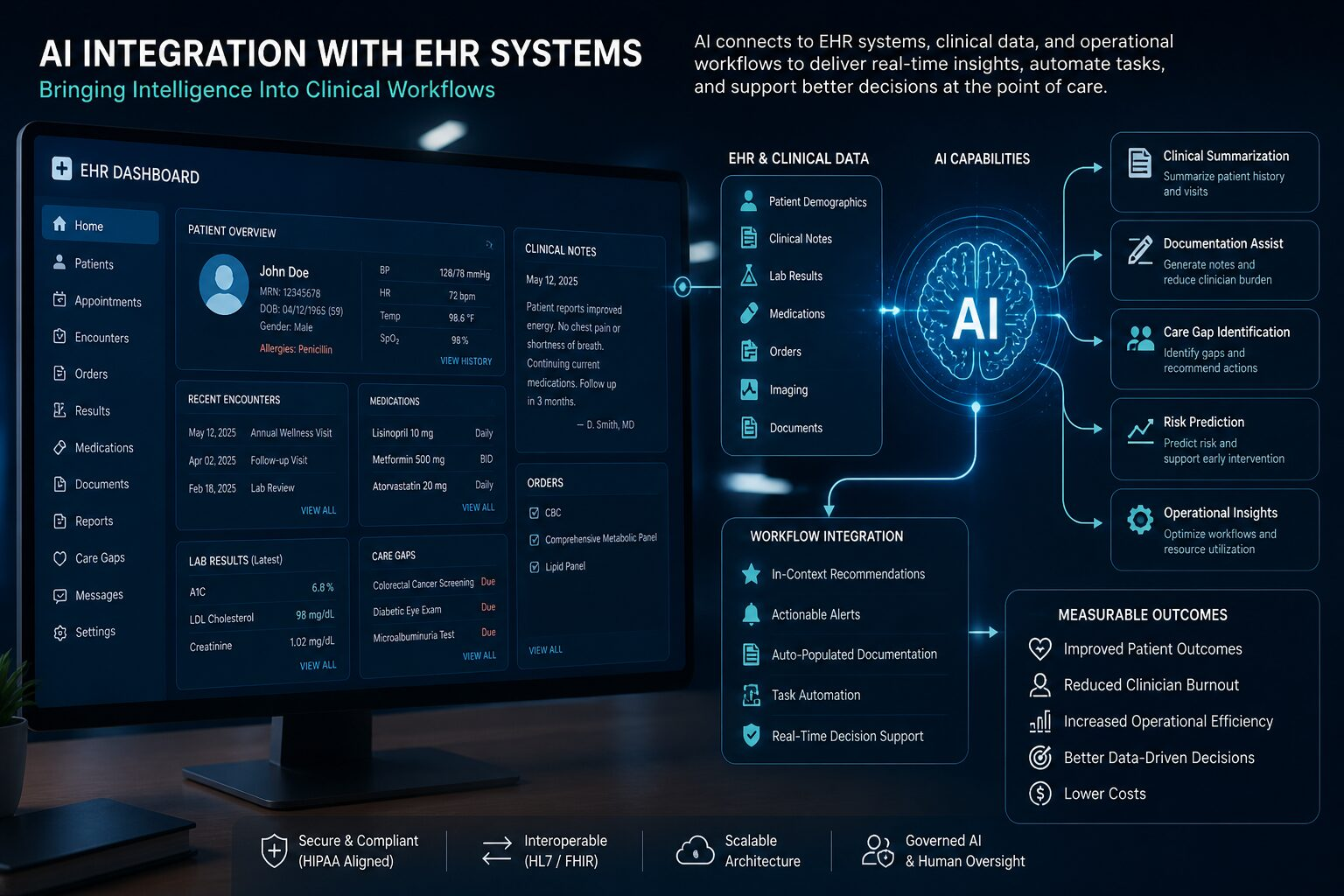
AI Integration with EHR Systems
Integrating artificial intelligence with electronic health record systems is the defining challenge in healthcare AI. Real value is created when AI connects securely to clinical data, EHR workflows, governance controls, and operational decision-making.
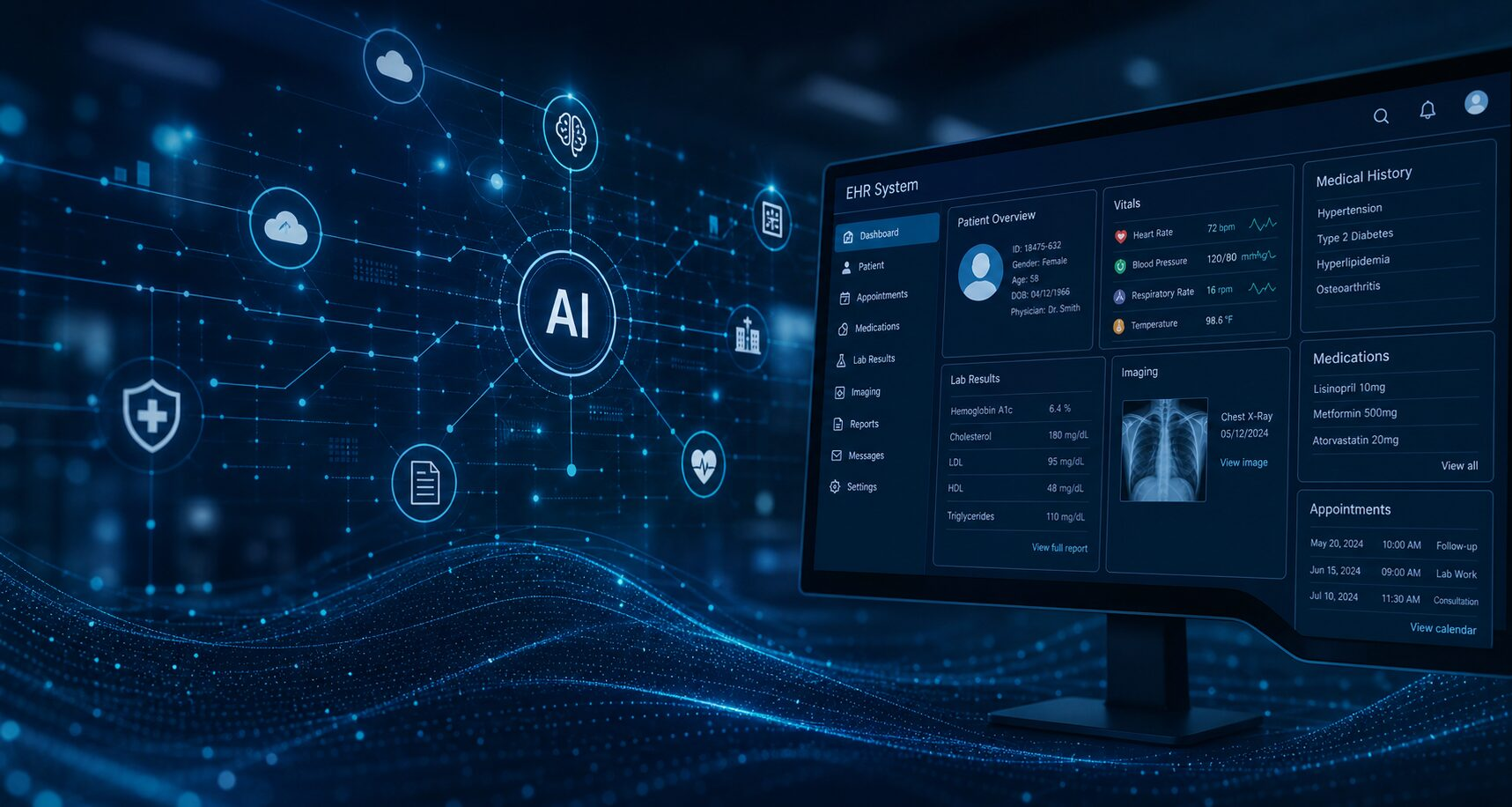
AI–EHR Integration Is the Foundation of Practical Healthcare AI
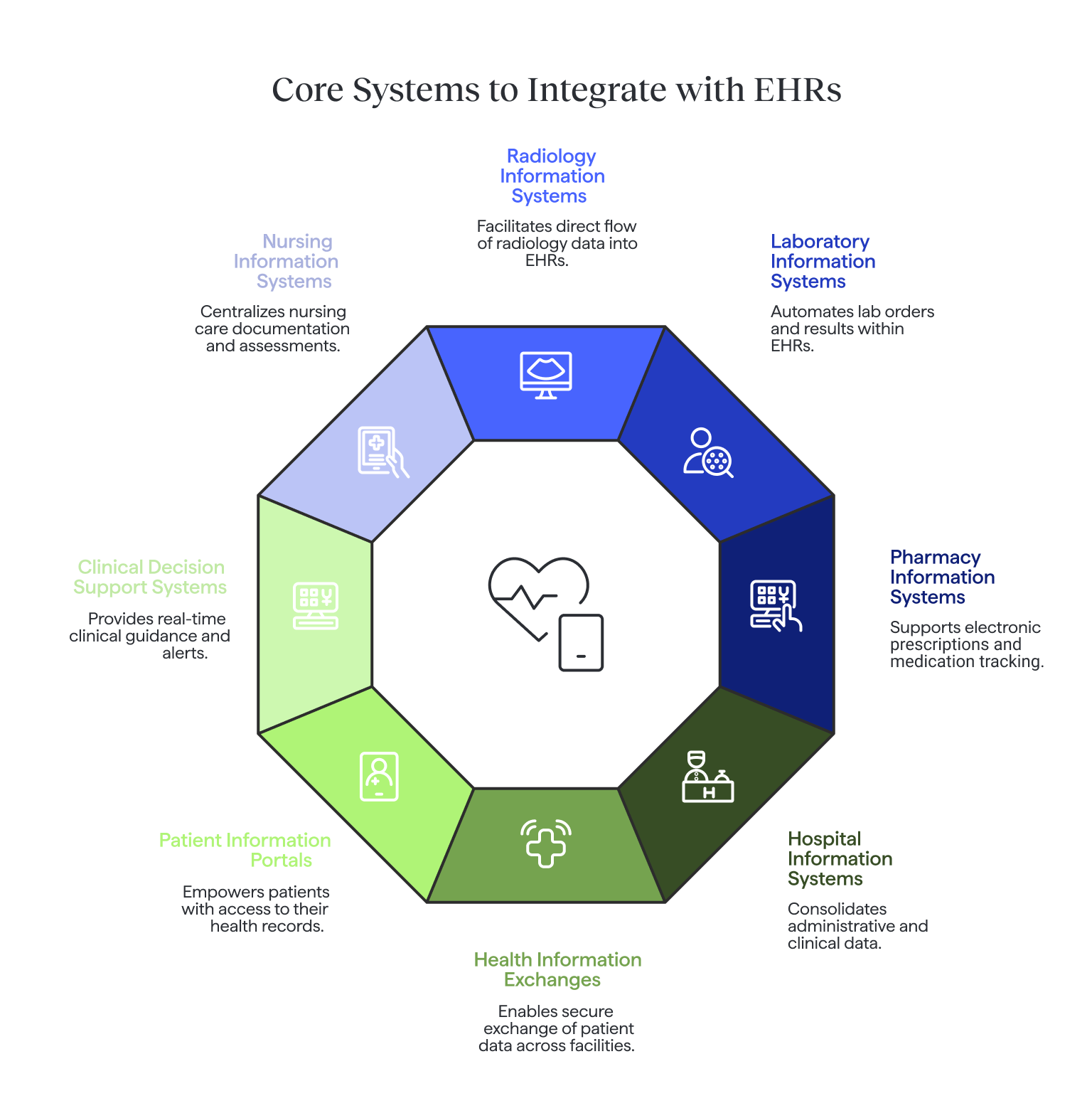
Healthcare AI integration succeeds only when artificial intelligence is connected to the systems where clinical, administrative, and operational decisions actually occur. For most hospitals, clinics, and health systems, that means integrating AI with electronic health record systems, clinical documentation workflows, interoperability layers, patient engagement platforms, scheduling systems, and governance controls.
Many healthcare AI initiatives fail because they are deployed as isolated tools rather than workflow-integrated capabilities. A model may be technically impressive, but if it cannot access trusted clinical data, operate inside existing EHR workflows, support clinician review, and produce measurable improvements in care delivery or efficiency, it will not create durable organizational value.
Successful AI integration with EHR systems such as Epic, Oracle Health/Cerner, Athenahealth, and other clinical platforms requires a system-level strategy: secure data access, HL7/FHIR interoperability, workflow design, human oversight, auditability, privacy safeguards, performance monitoring, and clear ROI metrics.
Clinical Workflow Alignment
AI outputs must appear where clinicians and staff already work—inside documentation, inbox, care coordination, population health, or administrative workflows.
Interoperable Data Architecture
EHR integration depends on secure APIs, HL7/FHIR interfaces, normalized data, identity controls, and reliable access to structured and unstructured clinical information.
Governance and Measurable ROI
Healthcare AI must include human review, compliance safeguards, audit trails, model monitoring, adoption metrics, and measurable operational or clinical outcomes.
Strategic takeaway: AI–EHR integration should be treated as an enterprise healthcare operating model, not a software add-on. The objective is to connect AI capabilities to trusted data, governed workflows, accountable decision-making, and measurable improvements in patient care and organizational performance.
What AI–EHR Integration Actually Requires
AI integration with electronic health record systems is not simply a technical connection between an algorithm and a database. It requires a coordinated operating model that connects clinical data, workflow design, interoperability, governance, security, human oversight, and measurable business outcomes. Without these elements, healthcare AI remains isolated from the point of care and fails to improve outcomes or efficiency.
1. Data Access
AI must access structured and unstructured clinical data, including diagnoses, medications, lab values, imaging reports, visit notes, care plans, and operational records.
2. Workflow Embedding
AI recommendations must appear inside the clinician’s normal workflow, not in a separate tool that adds friction, creates alert fatigue, or interrupts care delivery.
3. Governance Controls
Healthcare AI requires audit trails, privacy safeguards, explainability, human review, model monitoring, and clear accountability for clinical and operational decisions.
A Practical Roadmap for AI Integration with EHR Systems
Phase 1 — Select the Right Use Case
Begin with a narrow, high-value use case such as documentation support, care gap identification, patient outreach, prior authorization workflow, discharge planning, or clinical inbox management.
Phase 2 — Map the Workflow
Identify where data is created, reviewed, acted upon, and documented. AI should support these points rather than introduce a parallel process.
Phase 3 — Define Data and Integration Requirements
Determine what EHR fields, notes, reports, scheduling data, claims data, or patient engagement records are needed to support the use case.
Phase 4 — Add Governance and Human Oversight
Establish who reviews outputs, who owns decisions, what gets logged, how errors are escalated, and how performance is monitored over time.
Phase 5 — Pilot Before Scaling
Launch in a controlled workflow with defined success metrics, baseline measurements, user feedback, and a clear decision gate before expansion.
Phase 6 — Measure ROI and Reliability
Track time saved, adoption rate, error reduction, staff satisfaction, patient access, throughput, documentation quality, and operational cost impact.
The AI–EHR Integration Stack
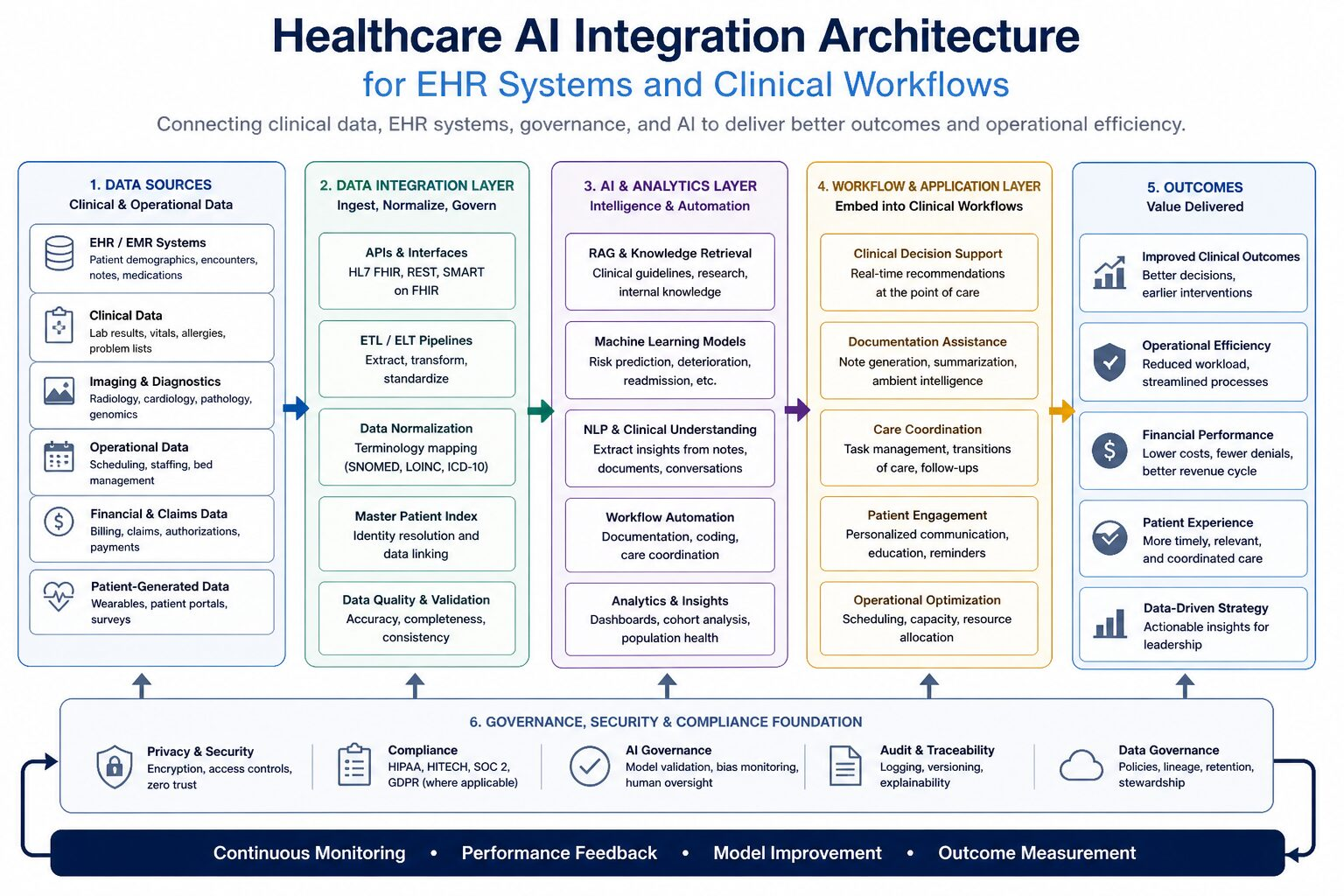
A production-grade AI–EHR environment requires more than a model layer. It requires a full integration stack that connects clinical data sources, EHR interoperability, AI orchestration, governance controls, workflow delivery, and performance measurement. This layered architecture allows healthcare AI to move from isolated experiments to reliable, workflow-integrated clinical and operational systems.
Expected impact: Organizations implementing AI–EHR integration correctly typically see improvements in clinician productivity, documentation efficiency, patient throughput, and reduction in administrative burden.
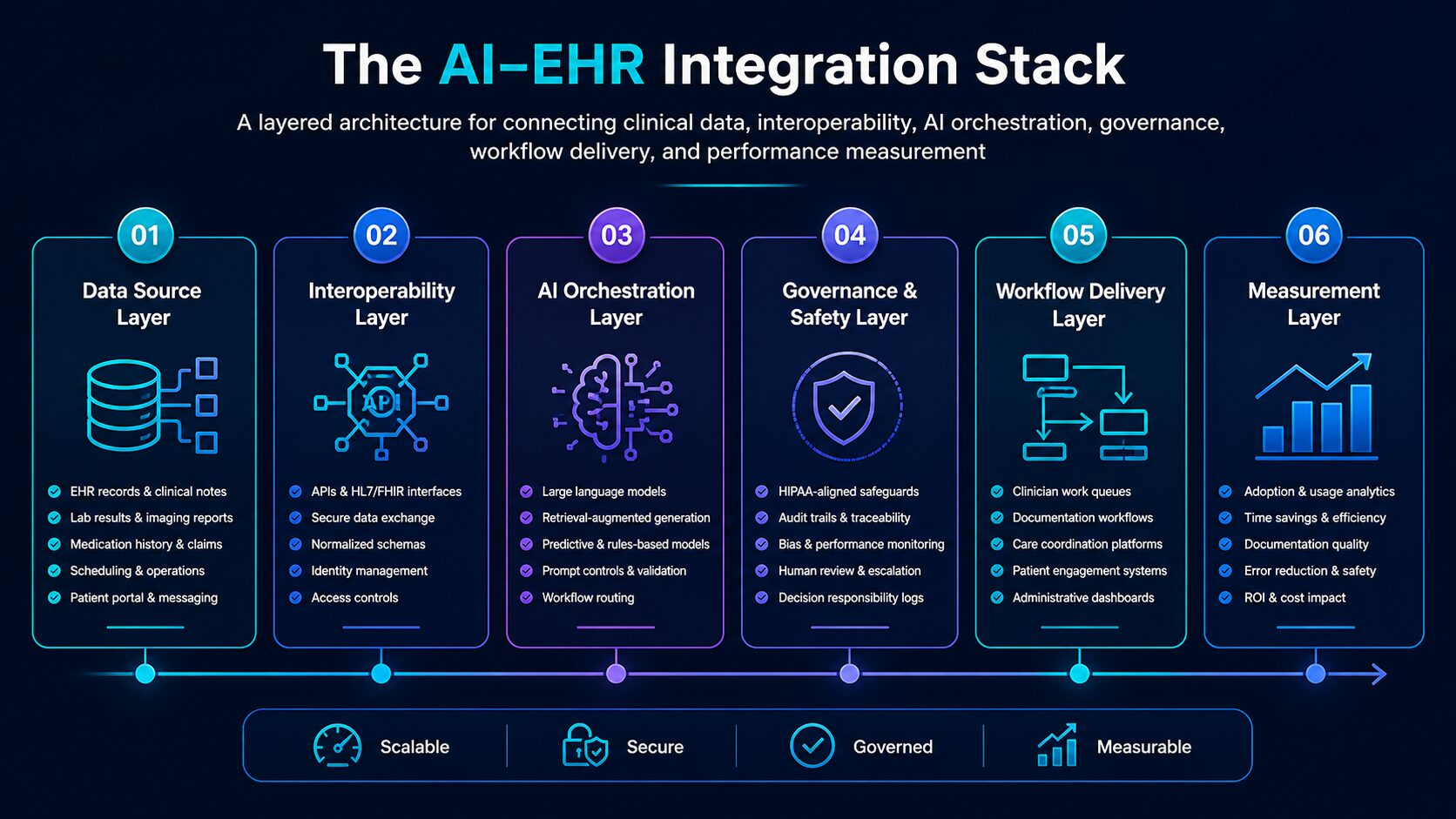
1. Data Source Layer
EHR records, clinical notes, lab results, medication history, imaging reports, claims data, scheduling systems, patient portal messages, and operational data.
2. Interoperability Layer
APIs, HL7/FHIR interfaces, secure data exchange, normalized schemas, identity management, and access controls.
3. AI Orchestration Layer
Large language models, retrieval-augmented generation, rules engines, predictive models, prompt controls, validation logic, and routing workflows.
4. Governance and Safety Layer
HIPAA-aligned safeguards, audit trails, bias monitoring, model performance tracking, human review, escalation rules, and documentation of decision responsibility.
5. Workflow Delivery Layer
Outputs delivered inside clinician work queues, patient engagement systems, documentation workflows, care coordination platforms, and administrative dashboards.
6. Measurement Layer
Adoption, time savings, documentation quality, error reduction, patient throughput, clinician satisfaction, cost impact, and ROI.
Key insight: AI–EHR integration is not a single application. It is a full-stack healthcare architecture connecting trusted clinical data, interoperability, AI logic, governance, workflow delivery, and measurable outcomes.
AI–EHR Data Flow: From Clinical Data to Actionable Insight
AI systems must transform raw clinical data into validated, workflow-integrated outputs that clinicians can trust and act on. This requires a structured data flow across EHR systems, interoperability layers, and AI orchestration pipelines.
AI–EHR Data Flow: From Clinical Record to Actionable Workflow
The technical challenge is not only extracting data from the EHR. The greater challenge is transforming clinical data into reliable, explainable, workflow-ready outputs that can be reviewed, acted upon, and measured.
1. Source Data
Clinical notes, labs, diagnoses, medications, imaging, encounters.
2. Normalize
Map data into usable structures, resolve identifiers, clean inconsistencies.
3. Retrieve
Use context retrieval, rules, or RAG to surface relevant information.
4. Generate
Produce summaries, recommendations, documentation, or workflow actions.
5. Review + Act
Human oversight, approval, audit trail, and workflow execution.
Technical implication: AI should not be treated as a black-box layer sitting outside the EHR. It should be governed as an integrated decision-support capability with defined data inputs, traceable outputs, human review, and continuous performance monitoring.
AI–EHR Integration Maturity Model
Healthcare organizations should not attempt full-scale AI deployment before they understand their current level of data readiness, workflow maturity, governance discipline, and operational alignment. The maturity model below provides a practical way to assess where an organization stands and what must be improved before AI can be safely scaled.
Level 1
Disconnected
AI tools operate outside the EHR with limited workflow alignment, manual data transfer, and unclear ownership.
Level 2
Connected
AI accesses selected clinical or operational data through APIs, exports, or limited integrations.
Level 3
Workflow-Integrated
AI outputs are embedded into clinical workflows with role-based access, human review, and measurable performance.
Level 4
Governed System
AI operates as part of a monitored, governed, and continuously improved healthcare operating system.
Start Your Healthcare AI Integration Strategy
If you are evaluating AI integration with EHR systems, we provide structured, governance-first advisory focused on measurable outcomes and real-world implementation.
Request Executive BriefingWhy AI Integration with EHR Systems Is Challenging
Integrating artificial intelligence with electronic health record (EHR) systems is not a typical software deployment challenge. It is a systems integration problem involving fragmented clinical data, complex workflows, regulatory constraints, and the need for real-time, trustworthy decision support. Most healthcare AI initiatives fail because they do not address these constraints simultaneously.
Fragmented Healthcare Data
Patient, clinical, imaging, laboratory, and operational data are distributed across multiple systems including EHRs, radiology, pharmacy, and external platforms. Integrating these data sources into a unified, usable format is one of the most complex challenges in healthcare AI.
Workflow Misalignment
AI tools often operate outside clinician workflows, requiring additional steps, separate interfaces, or manual data transfer. This creates friction, reduces adoption, and prevents AI from influencing real clinical decisions.
Governance, Safety, and Compliance
Healthcare AI must meet strict requirements for privacy, auditability, bias mitigation, explainability, and human oversight. Without these controls, AI cannot be safely deployed in clinical environments.
Key insight: AI–EHR integration fails not because of weak models, but because of poor alignment between data, workflows, and governance. Successful healthcare AI requires a coordinated system that connects clinical data, EHR workflows, and accountable decision-making.
AI–EHR Integration Framework
Integrating artificial intelligence with electronic health record (EHR) systems requires a structured framework that aligns clinical use cases, data access, interoperability, workflow integration, and governance. Organizations that follow a disciplined approach can move from isolated AI experiments to scalable, measurable healthcare AI systems.
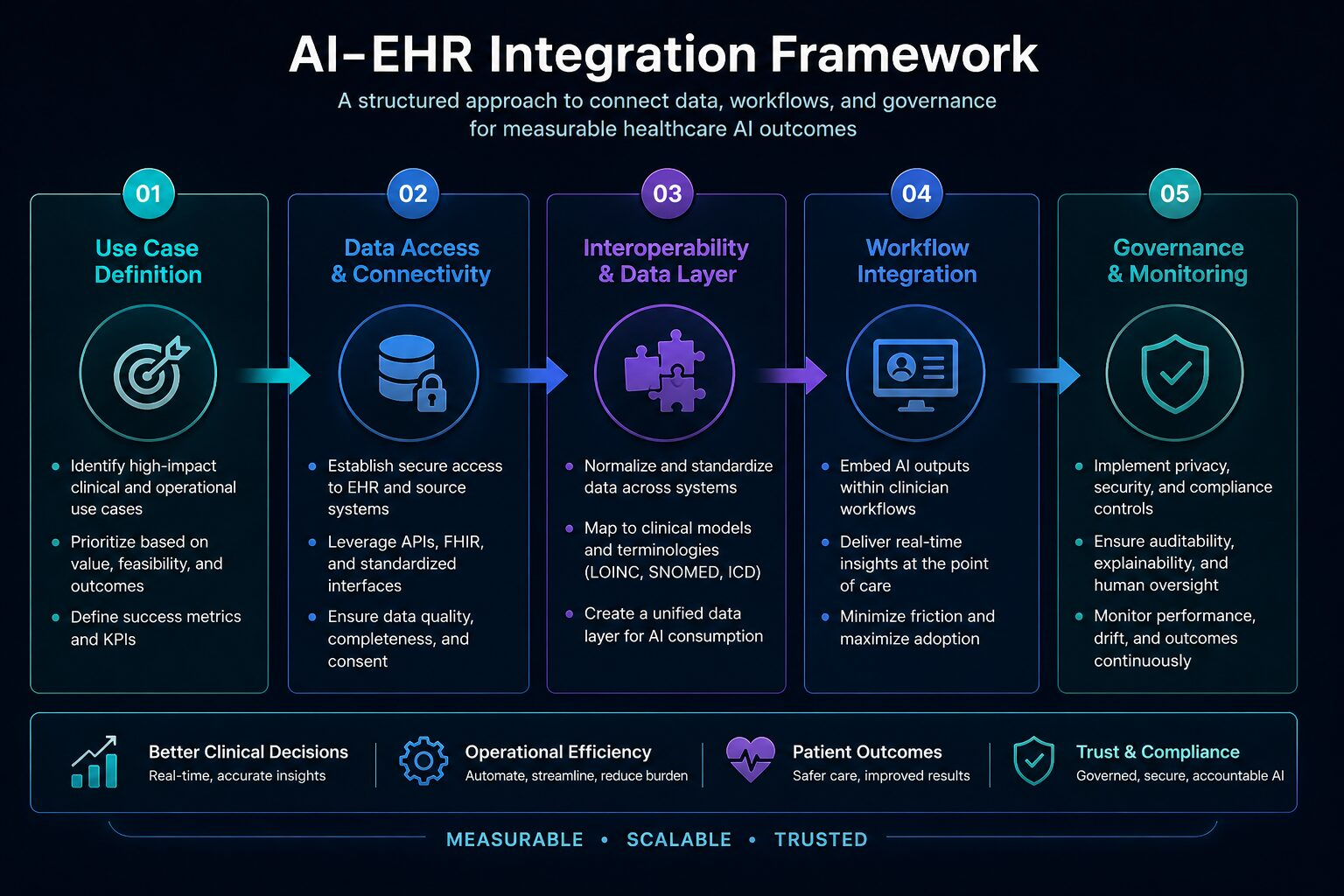
1. Use Case Definition
Identify high-impact clinical and operational workflows where AI can deliver measurable improvements.
2. Data Access
Establish secure access to EHR systems, clinical data, and operational sources using APIs and FHIR standards.
3. Interoperability
Normalize and connect data across systems, ensuring consistency and reliability across healthcare platforms.
4. Workflow Integration
Embed AI outputs directly into clinician workflows to drive adoption and real-world impact.
5. Governance & Monitoring
Apply compliance, auditability, human oversight, and performance monitoring to ensure safe deployment.
Key insight: AI–EHR integration succeeds when organizations treat it as a coordinated framework, aligning data, workflows, and governance into a unified system rather than isolated technical components.
Evaluate Your AI–EHR Integration Readiness
We help healthcare leaders assess EHR integration strategy, identify high-impact AI use cases, and design governed pilot programs with measurable ROI.
Request Executive AI BriefingContinue the Healthcare AI Integration Framework
AI–EHR integration is one part of a broader healthcare AI operating model. Explore the related strategy, governance, architecture, and implementation resources that support responsible deployment.
Healthcare AI Integration Architecture
Engineering a Longitudinal AI Ecosystem for Prostate Cancer Care
The future of prostate cancer AI is not a collection of isolated prediction models. It is a coordinated clinical ecosystem that connects imaging, pathology, genomics, biomarkers, workflow orchestration, governance, and longitudinal patient monitoring into a unified systems-engineering framework.
AI in Prostate Cancer Requires Integrated Clinical Infrastructure
Research increasingly shows that artificial intelligence in prostate cancer care already spans MRI interpretation, digital pathology, PSMA PET imaging, genomics, radiotherapy planning, biomarker analysis, and longitudinal monitoring. The challenge is no longer whether AI models can perform isolated tasks — it is whether these technologies can operate safely, reliably, and transparently within real clinical systems.
A systems-engineering approach provides the structure needed to coordinate data pipelines, clinical workflows, human oversight, governance controls, interoperability, and validation across the full patient journey.
Core System Architecture
Integrates imaging, pathology, genomics, labs, clinical notes, wearables, and outcomes data into standardized, quality-controlled pipelines.
Connected AI models for screening, lesion detection, prognosis, treatment planning, recurrence prediction, and response monitoring.
Embeds AI into radiology, pathology, urology, oncology, and radiation oncology workflows while preserving clinician oversight.
Auditability, drift monitoring, fairness validation, role-based access, human review, and post-deployment surveillance.
From Clinical Mission to Validated Deployment
High-Value Initial Use Cases
The most effective early deployment targets are those that provide measurable workflow improvement, reduced variability, and clinically actionable intelligence.
Prostate Cancer AI Must Operate as Regulated Clinical Infrastructure
A prostate cancer AI ecosystem should not be treated as a standalone research algorithm. It should function as a clinically governed infrastructure layer with continuous oversight, safety controls, explainability standards, auditability, and post-deployment monitoring.
The strongest research-backed conclusion is that prostate cancer AI works best when engineered as a longitudinal ecosystem connecting data, models, clinicians, workflows, and governance across the entire continuum of care.
FAQ: AI Integration with EHR Systems
Start Your Healthcare AI Integration Strategy
If you are evaluating AI integration with EHR systems, we provide structured, governance-first advisory focused on measurable outcomes and real-world implementation.
Request Executive BriefingHealthcare AI
Systems & Integration
Clinical AI frameworks, EHR integration models, disease-specific applications, and governance systems built for healthcare executives, clinicians, and IT leaders.
Download the AI Integration with EHR Systems Guide
Learn how artificial intelligence integrates with Electronic Health Record (EHR) systems to improve healthcare interoperability, clinical workflow automation, predictive analytics, longitudinal patient monitoring, operational efficiency, and AI-driven clinical decision support. This guide explores healthcare AI architecture, governance frameworks, retrieval-augmented generation (RAG), and modern digital health infrastructure strategies.
Athena Fusion Solutions provides AI strategy consulting focused on healthcare, EHR integration, and workflow-driven AI systems. We help organizations move from experimentation to measurable results.
AI Strategic Hub
How AI Works Technical Foundations AI Architecture RAG & Edge AI Governance & DeploymentMove from AI Exploration to Execution
Schedule an executive briefing to evaluate your AI strategy, EHR integration readiness, and high-impact use cases.
Request Executive Briefing