
Technical Foundations of Artificial Intelligence: AI Fundamentals, Machine Learning, and Systems Architecture
Appendix A explains how artificial intelligence works by introducing the core concepts, machine learning fundamentals, data representation methods, neural network principles, and AI systems architecture behind modern enterprise AI. This section provides a structured foundation for executives, engineers, and professionals preparing to evaluate, govern, and deploy AI systems in real-world environments.
Artificial Neurons and Neural Networks: How AI Represents Information
The Artificial Neuron in Machine Learning
At the most fundamental level, modern artificial intelligence and machine learning systems are built from artificial neurons. Each neuron processes inputs, applies learned weights, adds a bias, and produces an output that feeds into the next stage of computation within a neural network.
Weights, Biases, and Model Parameters
These weights and biases are collectively referred to as model parameters. In large-scale AI systems such as deep learning models and large language models (LLMs), there can be billions or even trillions of these adjustable values. These parameters determine how the system identifies patterns, relationships, and meaning within data.
Plain English Explanation
Artificial neurons act like small decision units, and parameters are the adjustable dials that allow the system to learn from data and improve performance over time.

Real-World Example
In natural language processing, one neuron may activate for sentiment patterns, while another responds to syntax or contextual relationships. Together, layers of neurons form a deep learning system capable of understanding and generating human language.
These simple computational units scale into complex neural network architectures. While each neuron performs a basic mathematical operation, their combined behavior enables AI systems to recognize patterns, model language, and generate outputs that appear intelligent and context-aware.
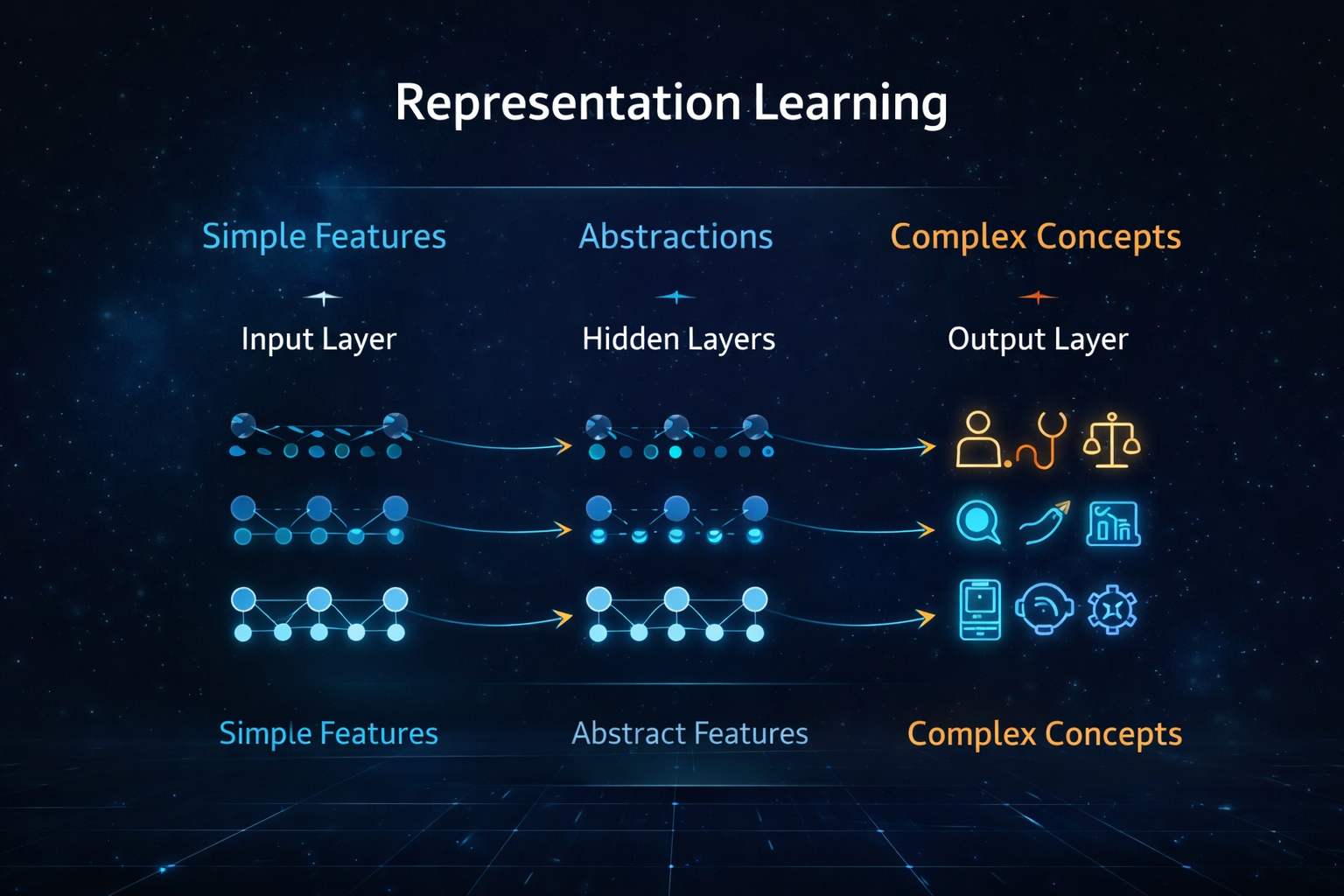
Example: Representation Learning in Language Models
Early layers in a language model detect simple token patterns and word structures. As information flows deeper, later layers capture grammar, semantic relationships, and context—enabling the model to understand meaning and generate coherent responses.
Representation Learning: How Neural Networks Build Meaning Across Layers
Layered Transformation in Neural Networks
Neural networks organize computation into multiple layers, transforming raw input data into increasingly abstract internal representations. Each layer processes the output of the previous layer, refining signals and enabling downstream tasks such as classification, prediction, and natural language understanding.
How Deep Learning Models Learn Representations
This process, known as representation learning, allows deep learning models to automatically discover patterns, relationships, and features directly from data. Instead of relying on manually defined rules, the model learns hierarchical structures that capture both low-level features and high-level semantic meaning.
Plain English Explanation
Early layers detect simple features. Deeper layers combine those features into patterns, relationships, and meaning—allowing artificial intelligence systems to interpret complex data.
This layered transformation is a key reason modern artificial intelligence and machine learning systems are highly flexible across tasks. Rather than storing fixed knowledge, models build internal representations that support interpretation, reasoning, prediction, and generation across diverse applications.
Transformer Architecture: The Foundation of Modern AI Models and Large Language Models
Parallel Processing in Transformer Models
Transformer architectures process entire sequences simultaneously rather than step-by-step. Unlike earlier sequence models that handled tokens one at a time, transformers evaluate context across all inputs in parallel, enabling faster training and more scalable artificial intelligence systems.
Self-Attention Mechanism
Transformers use self-attention mechanisms to model relationships between all elements in a sequence. Each token can reference every other token, allowing the system to capture long-range dependencies, semantic relationships, and contextual meaning more effectively.
This architectural shift made modern large language models (LLMs) possible by improving training efficiency, scaling performance, and enabling stronger reasoning across long-context language tasks.
Plain English Explanation
A transformer model looks across the full context at once instead of moving word by word, allowing it to connect ideas that may be far apart in a sentence, paragraph, or document.

Example: Context Across a Sentence
In the sentence “The doctor reviewed the scan before explaining the results to the patient,” a transformer can connect “doctor,” “scan,” “explaining,” and “patient” as part of one unified context, instead of processing each word independently.
This ability to process relationships across an entire sequence is one of the key reasons modern AI systems, natural language processing models, and large language models can perform effectively across writing, summarization, reasoning, question answering, and retrieval-augmented generation.
Example: Resolving Meaning Through Context
In the sentence “The nurse called the patient because she had missed the appointment,” the model must determine whether “she” refers to the nurse or the patient. Self-attention helps the system weigh surrounding words and decide which earlier token is most relevant for interpreting the pronoun correctly.
Self-Attention Mechanism: How Transformer Models Understand Context
How Self-Attention Works in AI Models
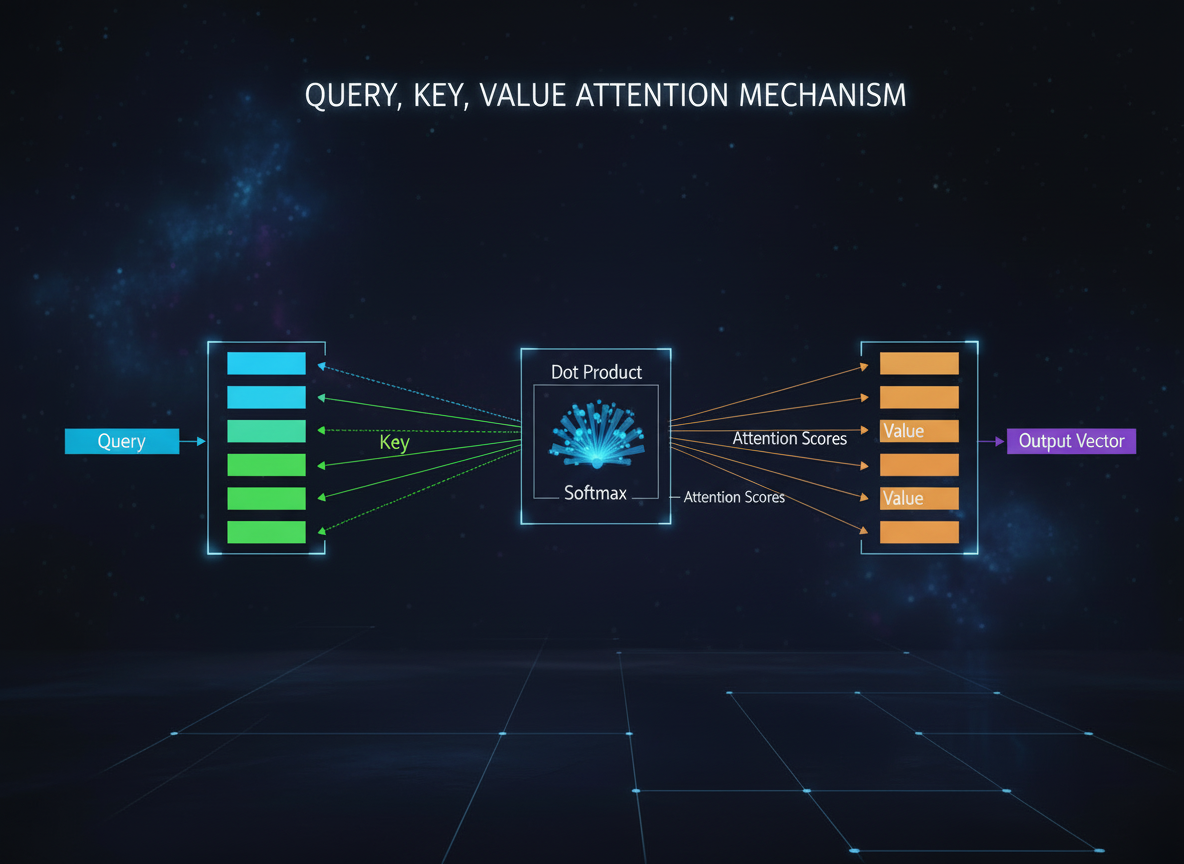
Self-attention allows each token to evaluate its relationship to every other token in a sequence. Rather than treating words or data points in isolation, a transformer model calculates which other tokens matter most for interpreting meaning at that moment.
Query, Key, and Value Vectors
This process is implemented using query, key, and value vectors. The model compares queries against keys, calculates attention scores, and uses those scores to weight the corresponding values. The result is a context-aware representation of each token that supports stronger language understanding, reasoning, and generation.
Plain English Explanation
The model decides what matters most at each moment. It looks across the sequence and gives more weight to the words or tokens that are most useful for understanding the current word.
In practical terms, self-attention is what allows modern large language models (LLMs) to connect references, preserve context, and interpret meaning across long passages. It helps the model determine whether a later word refers back to a person, action, object, concept, or instruction introduced earlier.
Without attention mechanisms, modern AI systems would be far weaker at reasoning across paragraphs, following instructions, summarizing documents, answering questions, and producing coherent responses that reflect the broader context of a conversation or document.
Feedforward Networks, Residual Connections, and Layer Normalization in Transformer Models
Feedforward Networks in Transformer Architecture
Within each transformer layer, feedforward neural networks refine the representation of each token after the self-attention mechanism has identified relevant context. These networks apply nonlinear transformations that strengthen important features, enhance signal clarity, and suppress less relevant patterns.
Residual Connections in Deep Learning Models
Residual connections allow earlier information to pass forward alongside newly transformed outputs. This mechanism preserves meaning, improves gradient flow, and prevents the model from losing critical signals as it moves through deep neural network layers.
Plain English Explanation
Attention decides what matters. Feedforward layers refine that information, while residual pathways ensure the model does not lose important meaning as it processes deeper layers.
Example: Context Preservation in Language Models
In the sentence “The bank approved the loan after reviewing the applicant’s income history,” attention identifies the financial context. The feedforward network strengthens that interpretation, while residual connections preserve the broader sentence meaning so the model does not distort context.
Layer Normalization and Model Stability
Layer normalization is paired with feedforward and residual components to keep numerical values stable across deep layers. It ensures consistent scaling of activations, improves training convergence, and enables large-scale deep learning models to operate reliably under varying inputs and conditions.
Together, feedforward networks, residual connections, and normalization form the structural backbone of modern transformer-based AI systems and large language models (LLMs), enabling depth, stability, and high-performance learning.
Example
During training, a model predicting the next word in “The patient was diagnosed with…” might incorrectly predict “weather.” The system calculates the error using a loss function and adjusts internal parameters so similar mistakes are less likely.
This process repeats billions of times across large datasets, enabling the model to learn statistical patterns and improve accuracy over time.
AI Model Training: Backpropagation, Loss Functions, and Gradient Descent
How AI Models Learn
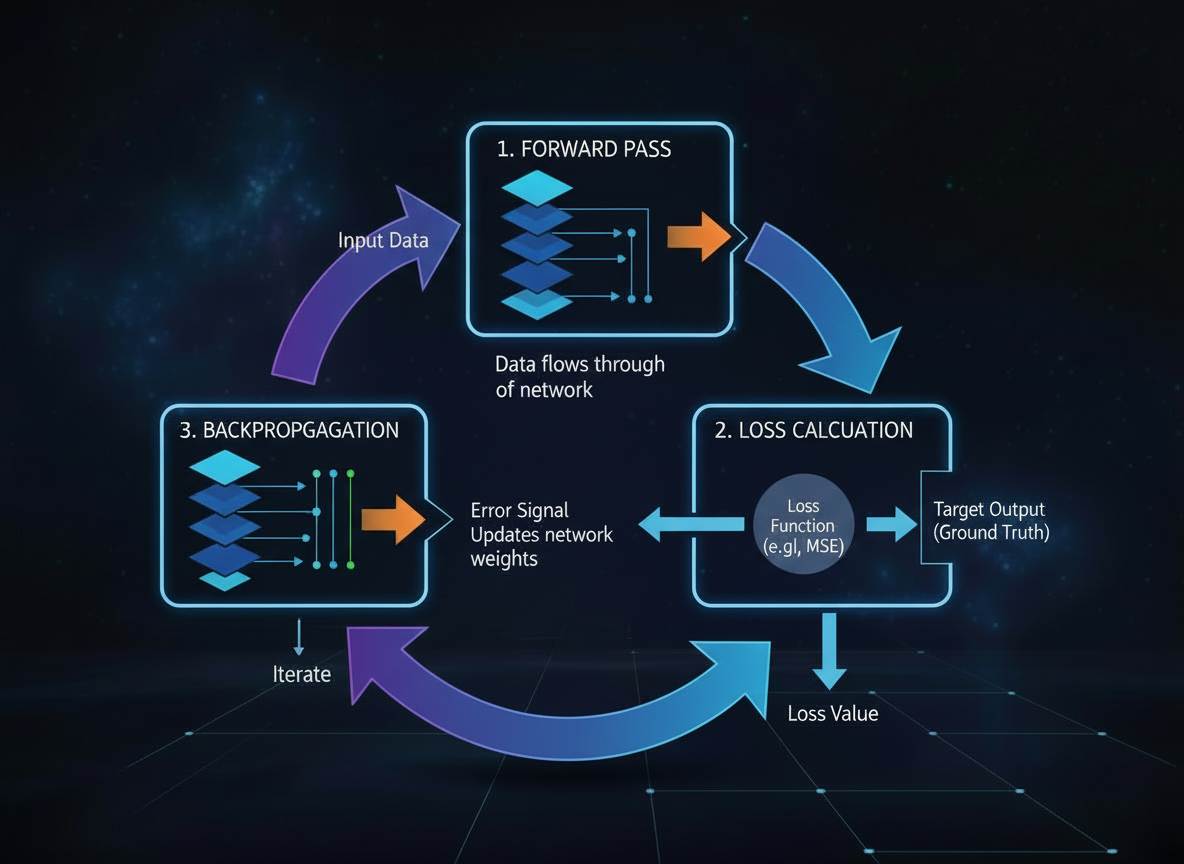
AI model training is the process by which machine learning systems learn patterns from data. The model makes predictions, compares them to correct answers, and measures error using a loss function. This feedback loop allows the system to improve performance over time.
Optimization and Gradient Descent
Learning occurs through backpropagation and optimization algorithms such as gradient descent. Backpropagation distributes error signals backward through the network, while gradient descent updates weights and biases to minimize error across repeated iterations.
Plain English
The model makes a prediction, checks how wrong it is, and adjusts itself. This happens over and over again until the model improves.
In practice, training modern deep learning models and large language models (LLMs) requires massive datasets, significant computational resources, and careful tuning of model architecture and parameters.
Most organizations do not train models from scratch. Instead, they use pre-trained models and adapt them through fine-tuning or retrieval-based approaches to meet specific use cases.
The quality of a model’s output is heavily influenced by the training data, model design, and optimization process used during development.
AI Inference and Performance Optimization: Latency, Throughput, and KV Caching
What Happens During AI Inference
AI inference is the process of using a trained model to generate an output from a new input. During inference, the model does not relearn from scratch; it applies previously learned parameters to produce predictions, classifications, summaries, or natural-language responses.
Latency, Throughput, and Real-Time AI Performance
In production systems, inference performance is measured by latency, throughput, compute cost, and response consistency. These factors determine whether an AI system feels responsive, scales across users, and can support real-time enterprise workflows.
Plain English
Training teaches the model. Inference is when the model is actually used. Performance optimization makes that use faster, cheaper, and more reliable.
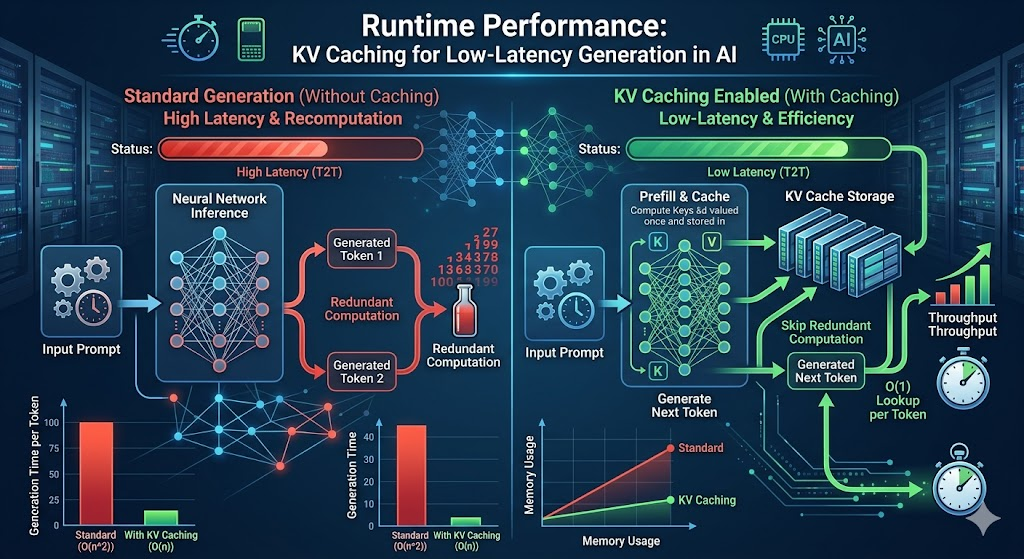
Example: Real-Time AI Response
In a chatbot, clinical assistant, or enterprise search system, users expect responses in seconds. Performance optimizations such as KV caching, batching, quantization, and efficient serving infrastructure help reduce delay while supporting more simultaneous users.
KV Caching and Transformer Inference
In transformer-based AI systems, each generated token depends on prior context. Without optimization, the model may repeatedly recompute information from earlier tokens. KV caching stores key and value tensors from previous steps so the model can reuse them during generation.
This reduces redundant computation and improves large language model inference efficiency, especially in long-context applications such as document analysis, retrieval-augmented generation, customer support, and clinical decision support.
Production AI systems often combine KV caching with model quantization, batching, GPU optimization, prompt management, and retrieval filtering to improve speed, reliability, and cost efficiency.
Probabilistic Prediction in AI: Softmax, Token Sampling, and Output Generation
How AI Models Generate Outputs
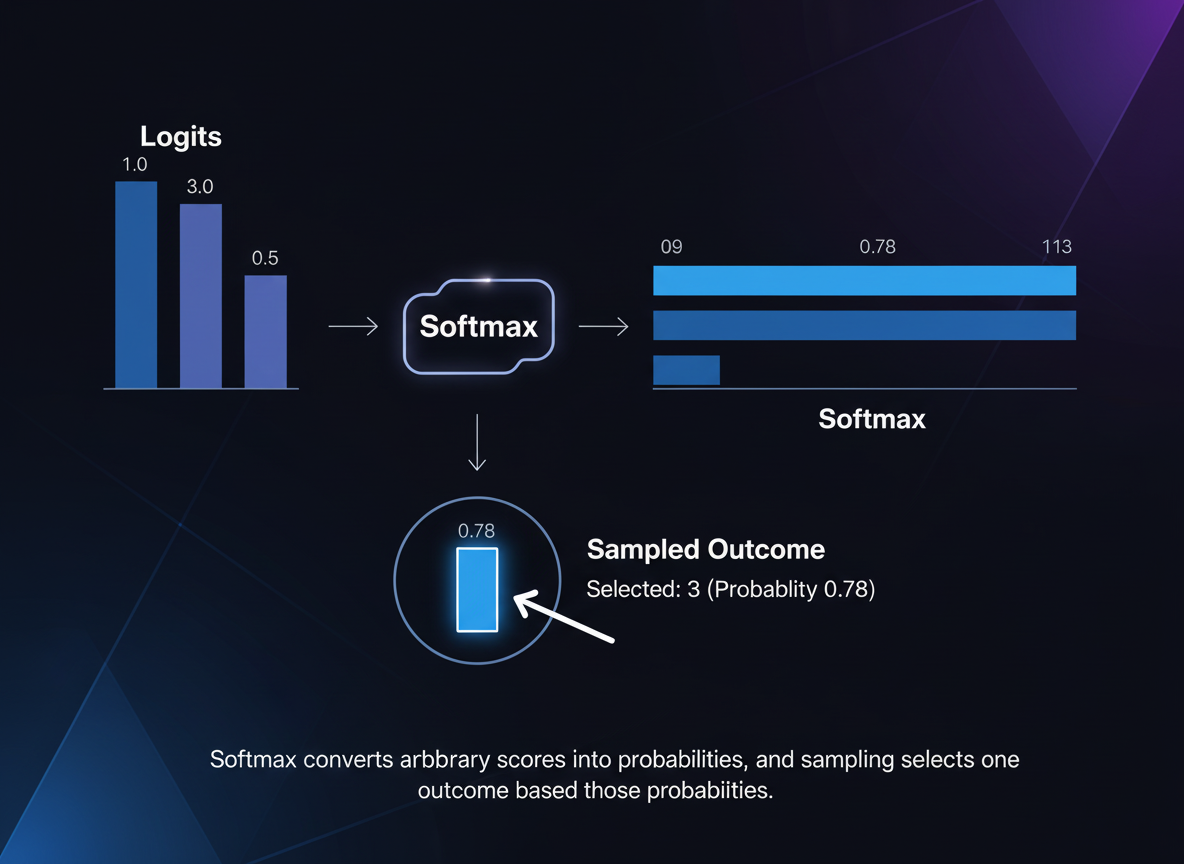
Modern artificial intelligence systems and large language models (LLMs) generate responses by computing a probability distribution over possible next tokens and sampling from that distribution. Rather than retrieving verified facts, the model produces outputs that are statistically most likely based on patterns learned during training.
Softmax and Probability Distribution
This probability distribution is created using the softmax function, which converts model scores into normalized probabilities across all candidate tokens. These probabilities guide which words, phrases, or outputs are selected during generation.
Token Sampling Controls
- Temperature: Controls randomness and creativity
- Top-k sampling: Limits selection to the highest-probability tokens
- Top-p (nucleus sampling): Selects tokens within a cumulative probability threshold
Plain English Explanation
The AI predicts what sounds most likely next based on learned patterns—not what has been verified as objectively correct.
Concrete Example
Prompt: “The capital of France is…”
- Paris → 92%
- Lyon → 3%
- Marseille → 2%
- Other → 3%
The system samples from this probability distribution—typically selecting “Paris”—but it is making a probability-based prediction, not verifying factual correctness.
Why AI Errors Occur (Hallucination Risk)
When probability is distributed across multiple plausible options or the model lacks strong context, it may generate outputs that are fluent but incorrect. This is a key source of AI hallucination.
AI Safety, Alignment, and Guardrails for Responsible AI Systems
What Is AI Alignment?
AI alignment refers to the methods used to shape artificial intelligence systems so their outputs remain consistent with human intent, organizational objectives, ethical standards, and operational constraints. Alignment techniques, policy guardrails, and human oversight help guide model behavior, but they cannot guarantee perfect safety in probabilistic AI systems.
Guardrails and Runtime Safety Mechanisms
Safety mechanisms such as reinforcement learning from human feedback (RLHF), policy constraints, content filtering, confidence thresholds, runtime monitoring, and human-in-the-loop escalation are used to reduce harmful outputs and improve AI system reliability. These controls are essential for responsible AI deployment, especially in enterprise, healthcare, finance, and other high-stakes environments.
Plain English Explanation
The model is guided, monitored, and constrained—but not perfectly controlled. That is why governance and human oversight remain essential.
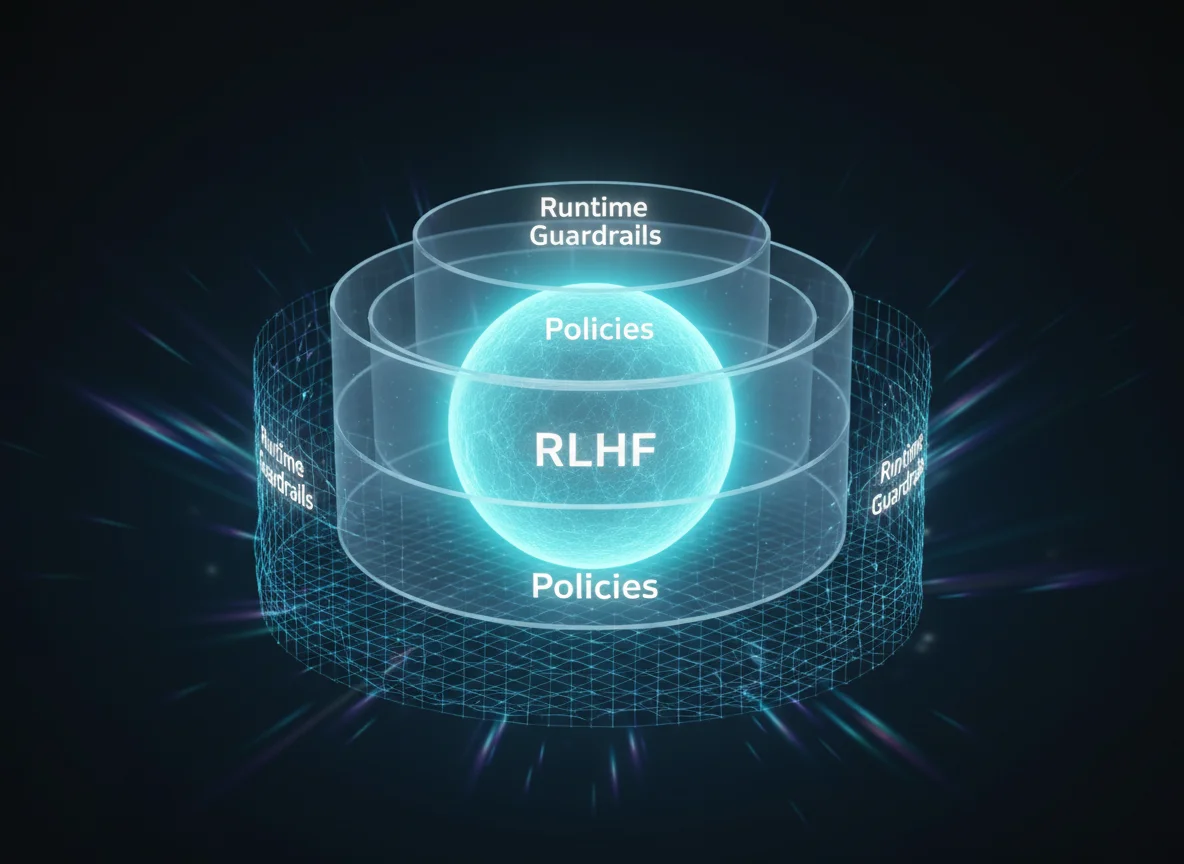
Example: Layered AI Safety Controls
A language model may use alignment training to reduce harmful outputs, policy rules to restrict unsafe requests, and runtime guardrails to escalate uncertain or high-risk responses to a human reviewer. These layers reduce risk, but no AI system should be treated as fully autonomous or perfectly safe without oversight.
While alignment and safety mechanisms can reduce risk, they cannot eliminate it entirely. Effective AI governance requires a combination of technical constraints, policy frameworks, auditability, validation, monitoring, and human judgment.
This governance-first approach is especially important for enterprise AI systems, clinical decision support, financial workflows, defense applications, and regulated environments, where errors can create operational, legal, ethical, or safety consequences.
AI Limitations and System Boundaries in Artificial Intelligence
What AI Systems Cannot Do
Modern artificial intelligence systems and large language models (LLMs) do not possess true understanding, awareness, reasoning intent, or consciousness. Instead, they generate outputs based on probabilistic prediction derived from patterns in training data. This means AI systems can be highly useful, fluent, and persuasive—while still being incorrect or misleading.
Why AI System Boundaries Matter
Because AI operates through statistical inference rather than verified knowledge, outputs must be interpreted within clearly defined operational boundaries and governance frameworks. These boundaries determine where automation is appropriate, where safeguards are required, and where human judgment must remain in control.
Understanding these limits is essential for enterprise AI deployment, healthcare applications, financial systems, defense operations, and other high-risk environments where incorrect outputs can create safety, legal, or reputational consequences.
Plain English Explanation
AI predicts outcomes based on patterns—it does not truly know or verify truth.
AI Deployment, Integration, and Governance: Translating Foundations into Enterprise Systems
From Technical Understanding to Operational AI Systems
Understanding how artificial intelligence systems and large language models (LLMs) work is only the starting point. The real value—and the real risk—emerges during AI deployment, system integration, and operational use within enterprise workflows, healthcare systems, and business environments.
What Changes at Deployment
In production, AI systems operate as probabilistic decision-support tools. They generate outputs based on likelihood, not verified truth, which means they can be highly useful—and highly convincing—while still being incorrect. This fundamentally changes how organizations must design, validate, and govern AI usage.
Operational Implications of AI Deployment
- Output validation: AI-generated content must be reviewed before use
- Context sensitivity: Performance depends on data, prompts, and system design
- Workflow integration: AI must be embedded into structured business processes
- Human oversight: Humans become part of the system architecture
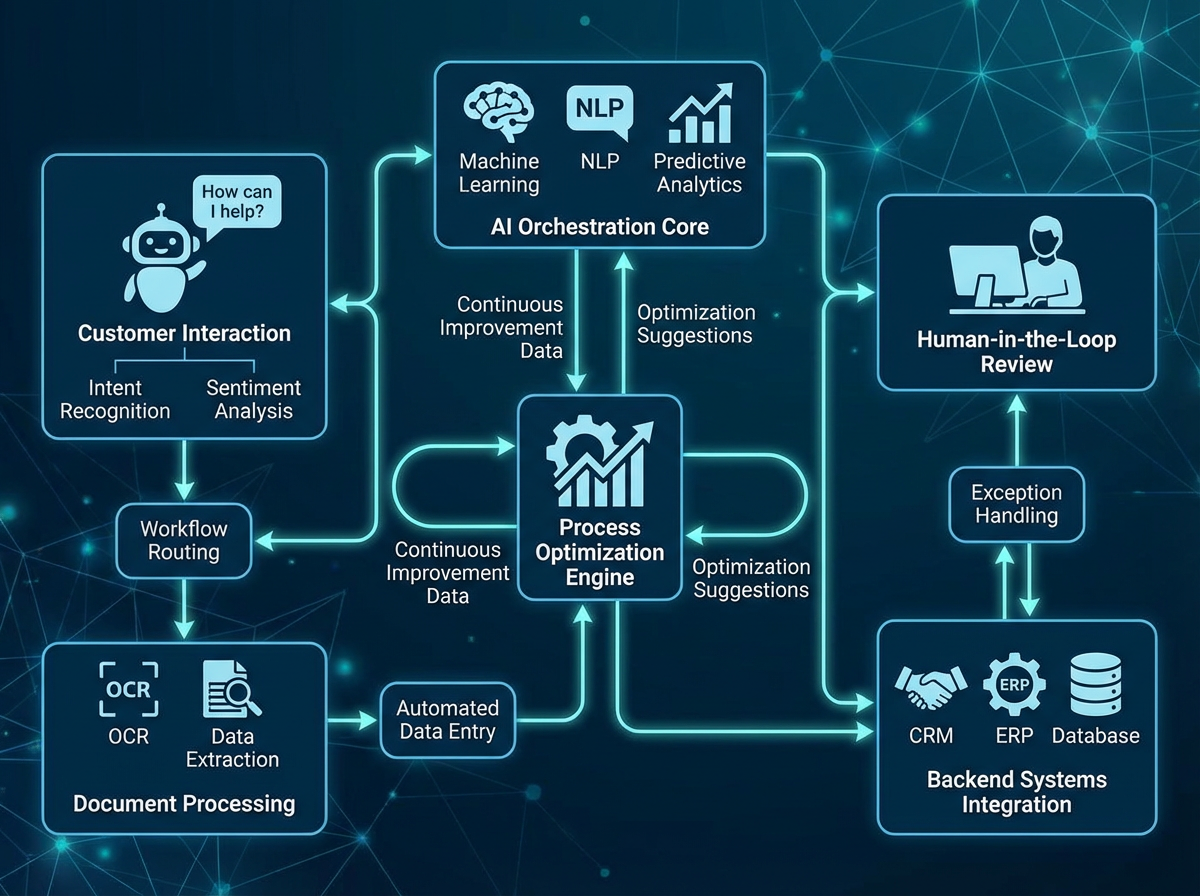
Example: AI Deployment Risk in Business Workflows
A company uses AI to generate client proposals. The output is polished and persuasive, but includes outdated assumptions and a subtle technical error. Without validation, the mistake reaches the client.
The system did not fail—it generated the most probable response. The failure occurred in deployment design, validation processes, and governance controls, not the model itself.
Why AI System Design and Governance Matter
Organizations that succeed with AI design human-in-the-loop systems where AI supports, rather than replaces, decision-making. They define validation layers, establish accountability, and integrate AI into structured workflows with clear escalation paths and governance frameworks.
Effective AI deployment requires thinking beyond the model itself and focusing on the full operating environment: data quality, prompt design, monitoring, auditability, user training, compliance, and governance. These factors determine whether AI creates value—or introduces risk.
The technical foundations in this appendix explain why AI can be powerful, scalable, and efficient. Deployment strategy explains why those same systems can fail when introduced without structure, oversight, and clearly defined decision boundaries.