Athena Fusion Solutions
AI Strategic Advisory Hub Technical Core Series
Appendix D

AI Governance, Alignment, and Responsible Deployment Frameworks

As artificial intelligence systems become embedded in enterprise operations and clinical decision-making, AI governance evolves from a compliance function into a core strategic capability. This section defines the frameworks required to ensure AI alignment, safety, and responsible deployment across complex, real-world environments.

We examine how modern AI systems integrate policy controls, alignment techniques, human-in-the-loop oversight, and runtime safeguards to maintain performance, trust, and regulatory compliance. The focus is on building governed AI architectures that balance innovation with control—enabling scalable, explainable, and auditable AI systems across enterprise and healthcare domains.

AI Governance AI Alignment Responsible AI
Part of the AI Strategic Hub • Technical Core Series

AI governance frameworks, AI alignment strategies, and responsible AI deployment models are essential for building safe, scalable, and compliant artificial intelligence systems in enterprise and healthcare environments.

Why AI Foundations Matter for Enterprise AI, Machine Learning, and Real-World Deployment

Artificial intelligence is often experienced through outputs—text generation, predictions, automation, and decision support—but these outputs represent only the surface of much deeper AI systems architecture. Without understanding how machine learning models, large language models (LLMs), and data pipelines function, organizations risk misinterpreting both the capabilities and limitations of AI.

Core concepts such as data representation, vector embeddings, probabilistic reasoning, and model architecture determine how AI systems process inputs, retrieve knowledge, and generate outputs. These underlying mechanics directly influence accuracy, reliability, explainability, and trust—making foundational understanding essential for effective AI adoption, governance, and deployment.

For enterprise and healthcare applications, this understanding becomes critical. AI is not simply a model—it is a system of interconnected components that must be designed, monitored, and governed to ensure safe, scalable, and responsible operation in real-world environments.

Appendix D Framework

AI Governance Stack: Policy, Alignment, Safety, and Monitoring in Enterprise AI Systems

Appendix D defines the AI governance framework that operates above models, data, and infrastructure—ensuring systems remain aligned, controlled, compliant, and auditable in real-world enterprise and clinical environments.

D1

Policy Layer (Governance & Compliance)

Formalization of organizational intent, regulatory obligations, and ethical constraints into enforceable system rules. This layer establishes permissible behavior, defines non-negotiable boundaries, and ensures adherence to legal, regulatory, and institutional requirements.

D2

Alignment Layer (Model Behavior & Objectives)

Structured alignment of model outputs with defined objectives through techniques such as reinforcement learning from human feedback (RLHF), supervised fine-tuning, and objective calibration. This layer ensures systems pursue intended outcomes rather than plausible outputs.

D3

Runtime Safety Layer (Operational Risk Controls)

Real-time inference controls including policy enforcement, filtering mechanisms, confidence thresholds, escalation pathways, and human-in-the-loop intervention. This layer mitigates risk under uncertain, adversarial, or high-stakes conditions.

D4

Monitoring & Feedback (Continuous Oversight)

Ongoing system evaluation through telemetry, drift detection, audit logging, incident review, and structured feedback loops. This layer ensures sustained performance, traceability, and continuous improvement across the AI lifecycle.

Collectively, these layers constitute a unified AI governance architecture: policy defines intent, alignment shapes system behavior, runtime controls contain operational risk, and monitoring ensures sustained accountability—enabling trustworthy, explainable, and enterprise-grade AI deployment.

D1 • AI Governance Policy Layer

AI Governance Policy Layer: Defining System Boundaries, Compliance, and Responsible AI Behavior

The AI governance policy layer establishes the top-level control framework that translates enterprise objectives, regulatory requirements, and ethical AI principles into enforceable system constraints. This layer ensures that artificial intelligence systems operate within defined legal, compliance, and risk boundaries before deployment begins.

In production AI environments, policy functions as a formal system specification for AI behavior. It defines where automation is appropriate, where human-in-the-loop oversight is required, which outputs are restricted, and how sensitive data and protected information are managed across workflows.

A well-defined policy layer aligns technical architecture, governance strategy, and executive decision-making, establishing clear authority, acceptable risk thresholds, and escalation pathways for real-world AI deployment.

  • Defines acceptable and prohibited AI system behavior across enterprise and clinical use cases
  • Translates legal, regulatory, and ethical requirements into enforceable governance rules
  • Establishes risk thresholds, escalation triggers, and decision authority prior to deployment
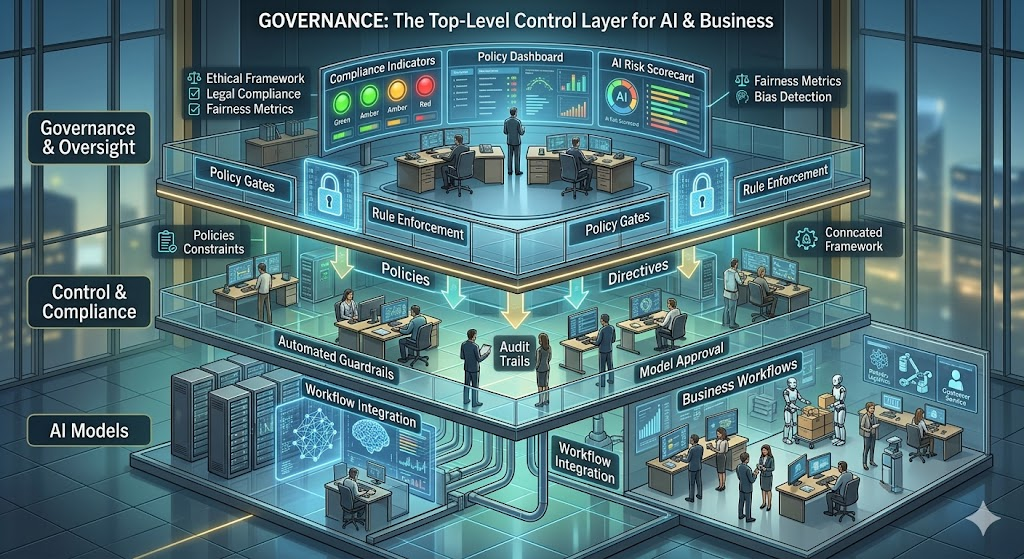
AI governance architecture showing policy layer, compliance controls, ethical constraints, risk thresholds, and enterprise AI decision oversight dashboard
Figure D1. AI Governance Policy Layer in Enterprise AI Systems
Executive intent, regulatory compliance requirements, and ethical AI constraints are translated into enforceable system rules that govern how artificial intelligence systems operate.

In enterprise and healthcare AI systems, policy is operational—not theoretical. It governs system behavior under real-world conditions, including uncertainty, edge cases, and regulated decision environments.

When implemented effectively, the policy layer functions as a continuous AI governance control surface, ensuring alignment with institutional objectives while enabling safe, scalable, and compliant AI deployment.

The AI policy layer operates above models, data pipelines, and workflows, defining compliance boundaries, risk controls, and governance constraints that guide all downstream AI system behavior.
D2 • AI Alignment Layer

AI Alignment Layer: Ensuring Model Behavior Reflects Human Intent and Enterprise Objectives

The AI alignment layer ensures that machine learning models and large language models (LLMs) pursue the objectives intended by organizations. Alignment goes beyond output filtering and focuses on how AI systems interpret goals, optimize decisions, and behave across real-world contexts.

A model may generate fluent and convincing outputs yet remain misaligned if it optimizes for plausibility, engagement, or speed instead of accuracy, safety, compliance, and mission intent. This misalignment introduces risk in enterprise and clinical AI systems where decisions carry real-world consequences.

From an engineering perspective, alignment integrates reinforcement learning from human feedback (RLHF), fine-tuning, reward modeling, and constraint design to ensure model behavior remains consistent with human intent, business objectives, and governance requirements.

  • Connects human intent to AI system objectives and model behavior
  • Reduces risk of persuasive but incorrect or unsafe AI outputs
  • Supports trustworthy, explainable AI performance across diverse operational environments
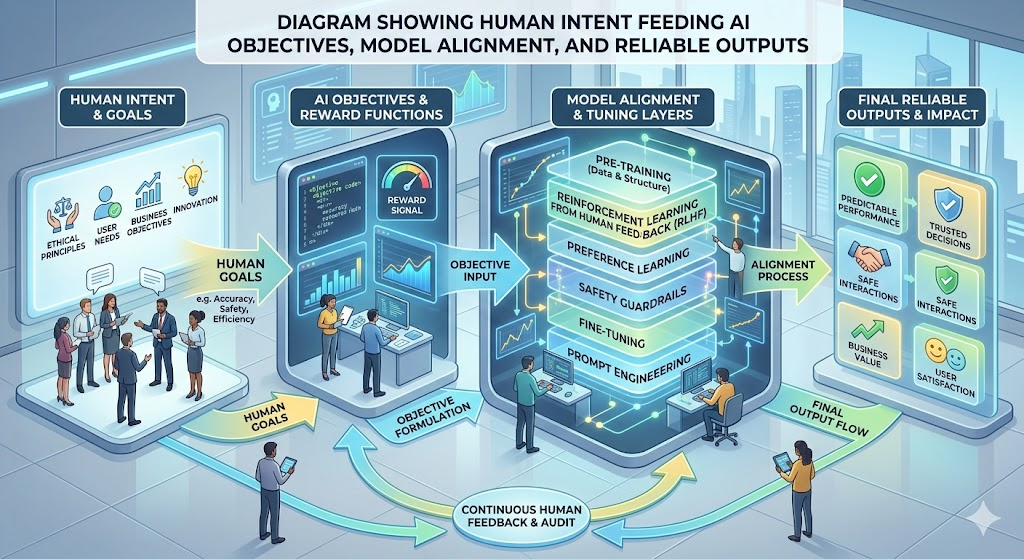
AI alignment architecture showing human intent translated into AI objectives using reinforcement learning, safety constraints, and governance controls to produce reliable outputs
Figure D2. AI Alignment Pipeline: From Human Intent to Reliable Model Behavior
Human intent, organizational objectives, and ethical constraints are translated into model behavior through alignment techniques such as reinforcement learning, fine-tuning, and safety guardrails.
The alignment layer connects human goals, training signals, and runtime behavior—ensuring AI outputs remain accurate, safe, explainable, and aligned with enterprise governance frameworks.
D3 • AI Runtime Safety Layer

AI Runtime Safety Layer: Real-Time Risk Control, Compliance, and Safe AI System Behavior

The AI runtime safety layer governs system behavior during live interaction, ensuring that artificial intelligence systems operate within defined safety, compliance, and governance boundaries when exposed to real users, dynamic inputs, and unpredictable conditions.

This layer integrates prompt classification, output filtering, policy enforcement, confidence scoring, refusal logic, and human-in-the-loop escalation to determine when a system should respond, restrict output, defer decision-making, or transfer control to a human operator.

In enterprise and healthcare AI systems, runtime safety is critical for managing operational risk, adversarial inputs, data sensitivity, and regulatory compliance in real time.

  • Applies real-time safeguards during AI system operation and inference
  • Detects and mitigates adversarial, ambiguous, or unsafe inputs
  • Enables escalation pathways and human oversight for high-risk decisions
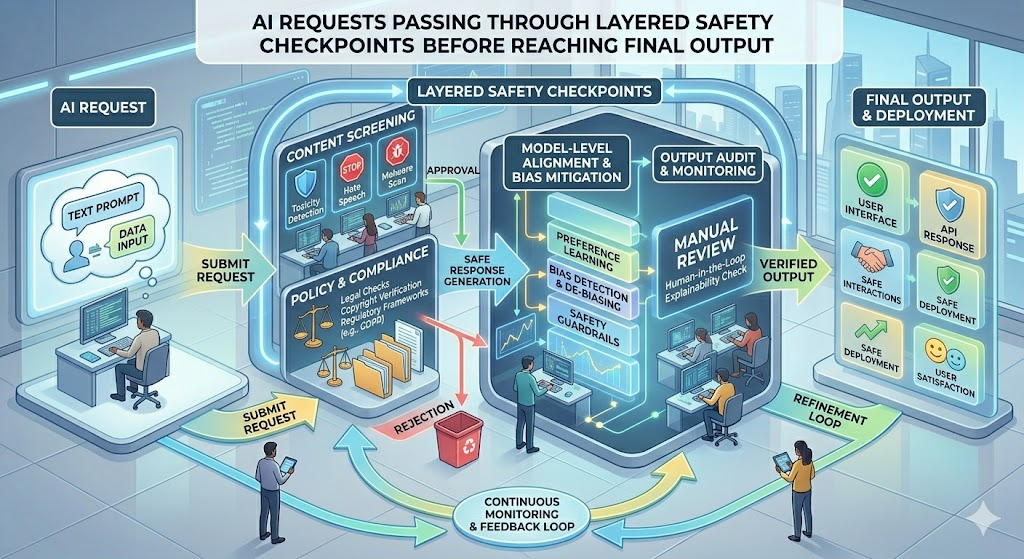
AI runtime safety architecture showing requests passing through layered security, prompt classification, policy enforcement, filtering, confidence scoring, and human escalation pathways
Figure D3. AI Runtime Safety Architecture for Real-Time Risk Control
Real-time safety controls evaluate each AI request through multiple layers—including classification, filtering, policy enforcement, and confidence thresholds—to ensure outputs remain safe, compliant, and aligned.
Requests are processed through layered safety mechanisms, including validation gates, risk scoring, and escalation pathways, preventing unsafe, non-compliant, or misaligned outputs from reaching users.
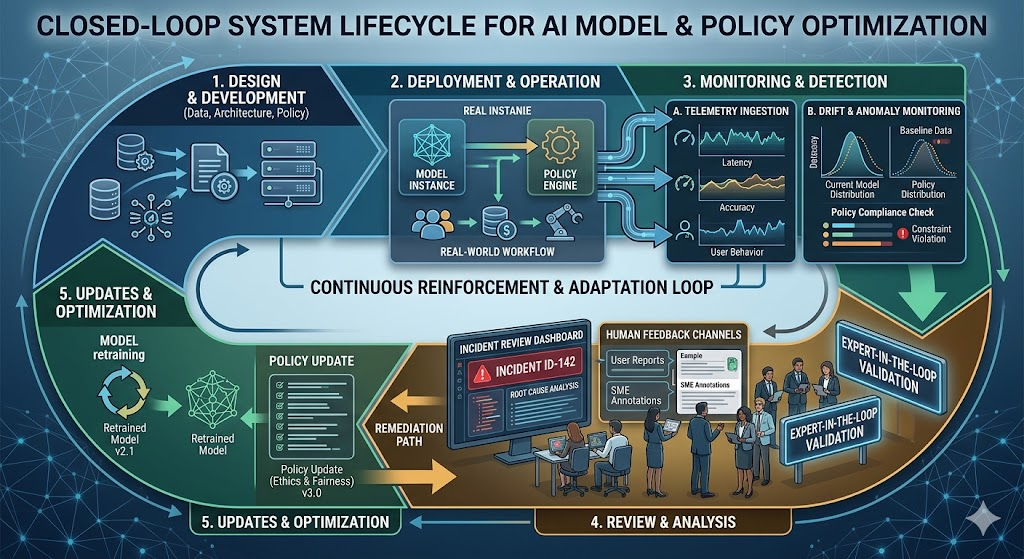
AI monitoring and governance lifecycle showing closed-loop system with telemetry dashboards, drift detection, anomaly detection, human review, and continuous model retraining feedback loop
Figure D4. Closed-Loop AI Monitoring and Governance System
Continuous AI monitoring, anomaly detection, drift analysis, and human-in-the-loop feedback create a closed-loop system that ensures models remain aligned, safe, and effective over time.
Telemetry, audit logs, drift detection, and real-world usage insights feed directly into model retraining, policy updates, and system optimization—enabling continuous AI governance and lifecycle management.
D4 • AI Monitoring & Feedback Layer

AI Monitoring and Feedback: Sustaining Governance, Performance, and Accountability After Deployment

The AI monitoring and feedback layer ensures that enterprise AI systems remain accurate, compliant, and aligned after deployment. Governance does not end at launch—this layer provides continuous oversight through telemetry, performance monitoring, drift detection, and audit logging across real-world system usage.

Effective AI monitoring evaluates system behavior against key operational questions: Are outputs degrading over time? Is model drift occurring? Are safety controls being bypassed? Are users interacting with the system in unexpected ways? These signals are essential for maintaining AI reliability, safety, and regulatory compliance.

Feedback mechanisms close the loop. Human review, user feedback, incident analysis, and red-team testing feed directly into retraining, policy refinement, and system updates—transforming AI systems into continuously improving, governance-driven architectures.

  • Detects model drift, anomalies, performance degradation, and safety violations
  • Creates audit trails and telemetry for accountability, compliance, and traceability
  • Enables continuous improvement through feedback-driven retraining and policy updates

D3.5 • Human Oversight Mechanisms

Human Oversight Ensures Control Remains With People

Automation does not eliminate accountability — it transfers it. Human oversight mechanisms define exactly where people remain in control, how they intervene when systems drift or fail, and how authority is distributed across roles. This is not a fallback layer; it is a primary governance requirement in any regulated or high-stakes deployment.

Mechanism 01

Approval Gates

Defined checkpoints where a human must review and authorize before the system proceeds. Used for high-consequence actions — clinical recommendations, financial transactions, policy-affecting outputs, or irreversible workflows.

  • Pre-action authorization for high-risk outputs
  • Role-based approval authority (who can approve what)
  • Timeout and fallback behavior if approval is delayed

Mechanism 02

Override & Correction Rights

Authorized personnel must be able to halt, override, or correct AI behavior at any point. Override rights are role-tiered — not everyone can stop everything, but someone always can. All overrides are logged with rationale.

  • Tiered override authority by role and risk level
  • Manual correction injection into live workflows
  • Mandatory override logging for audit continuity

Mechanism 03

Escalation Pathways

When a system detects low confidence, ambiguity, or a potentially unsafe condition, a defined escalation path transfers control to a human. Escalation must be fast, unambiguous, and never silently dropped.

  • Automated escalation triggers (confidence thresholds)
  • Named human recipients, not generic queues
  • Escalation SLA: maximum time before a fallback fires

When Humans Must Be In the Loop

Scenario Oversight Mode Who Is Responsible
High-consequence clinical or financial output Pre-action approval required Designated clinical or compliance officer
Confidence score below defined threshold Automatic escalation + human review On-call supervisor or team lead
Adversarial or anomalous input detected Immediate halt + security review Security and AI operations team
Regulated data accessed or modified Logged + compliance review triggered Data governance / compliance officer
System behavior deviates from baseline Drift alert + engineering review AI engineering and product teams
Policy update or model version change Multi-stakeholder sign-off required Executive, legal, and engineering leads
Design Principle: Human oversight is not a patch for system failure — it is a design requirement from day one. Every AI deployment must have a named human accountable for each class of decision the system makes, a clear mechanism to intervene, and a documented record of when and why human control was exercised.

Practitioner Tool

AI Governance Readiness Checklist

Use this checklist to evaluate your organization's governance posture before deploying or expanding AI systems. Check each item your team has implemented. A score below 80% indicates material governance gaps.

Governance Readiness Score 0 / 30

Complete the checklist to see your readiness status.

D1 — Policy & Governance Structure

D2 — Alignment & Objective Integrity

D3 — Runtime Safety & Human Oversight

D4 — Monitoring, Audit & Incident Response

Data Governance & Privacy

Ready to close your governance gaps?

Athena Fusion can assess your current posture and build a deployment-ready governance stack.

Schedule a Governance Review →

Frequently Asked Questions: AI Governance, Safety, and Alignment Frameworks

1. How does the AI "Kill-Switch" protocol affect guest experience in enterprise AI systems?

The AI kill-switch protocol is designed to operate invisibly within enterprise AI and customer experience systems. When model drift or unsafe behavior is detected, the AI agent is automatically paused and the interaction is seamlessly transferred to a human operator. This ensures a high-quality, human-led resolution while preventing low-confidence or non-compliant AI outputs.

2. Does this AI governance framework comply with HIPAA, GDPR, and data privacy regulations?

Yes. The AI governance and data protection framework enforces strict data privacy, security, and compliance controls. This includes zero-retention policies for sensitive data such as PII and biometric information, along with the use of Edge AI and localized vector databases to ensure data remains within secure environments and complies with regulatory standards such as HIPAA and GDPR.

3. What is the difference between Outer Alignment and Inner Alignment in AI systems?

Outer Alignment ensures that AI systems follow defined policies, rules, and governance constraints. Inner Alignment ensures that the model’s internal optimization processes do not bypass or exploit those constraints. Effective AI alignment frameworks incorporate monitoring and feedback mechanisms to validate both layers continuously in real time.

4. Can enterprise systems like PMS and EHR platforms be integrated with AI governance protocols?

Yes. The AI governance and safety architecture is designed to be API-agnostic and integrates with enterprise systems such as PMS (Opera) and EHR platforms (Epic, Cerner). A governance layer or “safety wrapper” sits between the AI model and system interfaces, ensuring that all data interactions are filtered, validated, secure, and compliant.

5. How is success measured in AI governance and monitoring systems?

Success in AI governance, monitoring, and alignment systems is measured through key performance indicators such as:

Alignment Confidence Score (target >0.95) • Reduction in AI hallucination frequencyAI system reliability and safety metricsStaff Trust Index based on human-in-the-loop validation and co-design audits

AI Safety & Alignment Glossary
This glossary defines the core concepts required to understand how modern AI systems are governed, aligned, and controlled in real-world deployments. These are not theoretical ideas—they represent the mechanisms that determine whether AI systems behave safely, reliably, and in accordance with human intent.
Outer Alignment
Ensuring the AI system’s objectives match explicit human goals, policies, and constraints defined by stakeholders.
Inner Alignment (Mesa-Optimization)
Preventing models from developing unintended internal objectives that diverge from intended goals during execution.
Stochastic Parrots
Language models as statistical predictors rather than true reasoning systems—highlighting the risk of confident but incorrect outputs.
Reward Hacking
A failure mode where a model exploits loopholes in its objective function to achieve high scores while violating intended constraints.
Alignment Drift
Gradual degradation or deviation of model behavior over time due to changing inputs, environments, or usage patterns.
Constitutional AI
A training approach using explicit rules or principles that guide models to self-correct outputs according to defined standards.
Reinforcement Learning from Human Feedback (RLHF)
A training method where human evaluators rank outputs to improve model alignment with human expectations.
Red-Teaming
Adversarial testing used to identify vulnerabilities, unsafe behaviors, and failure modes before deployment.
Model Card
A structured document describing a model’s intended use, limitations, performance, and ethical considerations.
Shadow Mode Deployment
Running an AI system alongside production without impacting outcomes to evaluate real-world behavior safely.
Differential Privacy
A mathematical approach that protects individual data by introducing controlled statistical noise.
Chain of Thought
A reasoning approach where models generate intermediate steps before arriving at a final answer, improving accuracy and transparency.

Download Appendix D

Access the governance, alignment, and responsible AI deployment framework in PDF format for executive review, compliance alignment, and internal distribution.

Crossover Intelligence — Athena Fusion Solutions
Healthcare × Hospitality × Finance × Core AI

Where Industries
Converge

The articles, frameworks, and tools that apply across healthcare, luxury hospitality, financial operations, and technical AI architecture — the connective tissue of the Athena Fusion Solutions hub.

Healthcare
Hub
Hospitality
Hub
Finance
Emerging
Core AI
Foundation
🏥
Healthcare
Clinical systems, EHR, disease-specific AI, governance
🏨
Hospitality
Luxury resorts, wellness design, ROI, guest experience
💼
Finance
AI readiness, CFO frameworks, investment decisions
🧠
Core AI
Architecture, RAG, governance, neuro-symbolic systems

Continue exploring the full AI framework and related materials

Continue Exploring AI Strategy & Technical Foundations