
AI Strategy Consulting for Luxury Resorts and Hospitality Organizations
Most hospitality organizations approach AI the wrong way—starting with tools instead of strategy. Athena Fusion Solutions helps luxury resort and hospitality leaders identify high-impact AI use cases, improve operations, enhance guest experience, strengthen governance, and build measurable ROI without compromising brand trust.
Request Executive AI Strategy BriefingAI Strategy for Luxury Resorts and Hospitality Organizations
Luxury resorts operate in an environment defined by elevated guest expectations, labor constraints, and the need for consistent, high-touch service delivery across every interaction. In this context, even small breakdowns in coordination, communication, or personalization can directly impact guest satisfaction, brand perception, and revenue performance.
Artificial intelligence in hospitality presents a significant opportunity to improve resort operations, enhance guest experience, and support workforce efficiency. However, most hospitality organizations struggle to realize value because AI is implemented through disconnected tools, isolated pilots, or vendor-driven experimentation rather than through a structured, governance-led AI strategy aligned with measurable ROI.
Athena Fusion Solutions provides AI strategy consulting for luxury resorts and hospitality organizations, helping leadership teams identify high-impact use cases, evaluate operational and reputational risks, establish AI governance frameworks, and design implementation roadmaps aligned with measurable ROI, operational integration, and long-term service excellence.
AI in Luxury Hospitality: Operational Challenges and Strategic Opportunity
High Guest Expectations
Luxury resorts operate in an environment where personalized guest experiences, rapid response times, and seamless coordination are expected across all departments—from front desk to housekeeping to concierge. Even minor breakdowns in service delivery can directly impact guest satisfaction, brand perception, and revenue performance.
Operational and Workforce Pressure
Hospitality organizations face ongoing challenges including labor shortages, rising operational costs, and fragmented technology systems. These pressures make it increasingly difficult to maintain service consistency while scaling operations efficiently, highlighting the need for AI-driven workflow optimization and operational intelligence.
AI as a Strategic Enabler
Artificial intelligence in hospitality enables improved information flow, real-time decision-making, and enhanced staff performance. When applied through structured AI strategy and governance frameworks, resorts can reduce operational friction, improve service consistency, and deliver personalized guest experiences at scale without increasing complexity or risk.
The objective is not automation for its own sake, but the strategic application of AI to augment human performance while preserving the integrity of the luxury guest experience. This is where AI strategy for hospitality organizations—grounded in governance, operational integration, and measurable ROI—becomes critical.
AI Use Cases in Luxury Resorts and Hospitality Operations
AI strategy consulting for luxury resorts and hospitality organizations focuses on identifying high-impact opportunities across guest experience, operations, and revenue optimization. The objective is to improve performance while preserving service quality, brand integrity, and measurable ROI.
Guest Experience Optimization
Artificial intelligence in hospitality enables personalized guest experiences through predictive recommendations, AI-driven concierge support, and journey orchestration across touchpoints—from booking to on-property engagement and post-stay retention. These capabilities enhance satisfaction while increasing lifetime guest value.
Operational Efficiency and Staffing
AI for hospitality operations improves housekeeping coordination, maintenance scheduling, and workforce allocation through real-time operational intelligence and workflow automation. This reduces friction while maintaining service consistency in high-demand luxury environments.
Revenue Optimization and ROI
AI-driven analytics and revenue management systems support demand forecasting, dynamic pricing, and targeted upsell strategies. When implemented through structured AI strategy and governance frameworks, these capabilities translate into measurable revenue growth, margin expansion, and ROI.
High-Value AI Use Cases for Luxury Resorts and Hospitality Organizations
AI strategy consulting for luxury resorts should begin with specific, measurable use cases — not generic technology adoption. The strongest hospitality AI opportunities improve guest experience, resort operations, workforce performance, revenue efficiency, service consistency, and measurable ROI while protecting the human-centered nature of luxury hospitality.
1. AI-Assisted Concierge and Guest Planning
AI-assisted concierge systems can help guest-service teams respond faster, answer property questions, recommend experiences, and support personalized guest journeys before, during, and after the stay.
For luxury resorts, the objective is not to replace concierge service, but to give staff better information, faster context, and more time for high-touch interactions.
Reference: Hilton AI Planner2. Virtual Concierge and Local Recommendations
AI in hospitality can support personalized recommendations for dining, entertainment, spa services, wellness experiences, activities, and local attractions while preserving the role of human judgment.
This is especially valuable for resorts that want to improve guest engagement without overwhelming front desk, concierge, or guest-experience teams.
Reference: Marriott RENAI by Renaissance3. Guest Preference Intelligence
AI can help luxury resorts identify guest preferences across booking, rooms, dining, activities, wellness services, and return visits, creating a more consistent and personalized guest experience.
Used properly, guest preference intelligence supports service anticipation while avoiding intrusive or impersonal automation.
Reference: McKinsey — Hotel of the Future4. Direct Booking and Revenue Efficiency
AI can improve direct booking flows, guest matching, package recommendations, demand forecasting, and targeted upsell opportunities, reducing dependence on third-party platforms.
For hospitality organizations, this creates a direct connection between AI strategy, guest engagement, revenue optimization, and measurable ROI.
Reference: Reuters — AI and Hotel Booking Innovation5. Workforce and Resort Operations Optimization
AI for resort operations can support housekeeping coordination, maintenance scheduling, staffing alignment, task routing, service recovery, and internal decision support.
These applications are often among the highest-value AI opportunities because they address labor constraints, service consistency, and operational friction at the same time.
Reference: McKinsey — Future of Hotels6. Internal Knowledge Assistants for Hospitality Teams
Internal AI knowledge assistants can help resort staff quickly access property procedures, service standards, policies, escalation guidance, event details, and guest-related information.
This can improve onboarding, seasonal workforce readiness, multi-department coordination, and service consistency across complex hospitality environments.
Reference: IBM — AI AgentsThese AI use cases should be evaluated through controlled 90-day pilots before broader rollout. A disciplined hospitality AI strategy allows leadership to measure value, risk, guest impact, workforce adoption, operational feasibility, data readiness, governance requirements, and ROI before committing to enterprise-scale implementation.
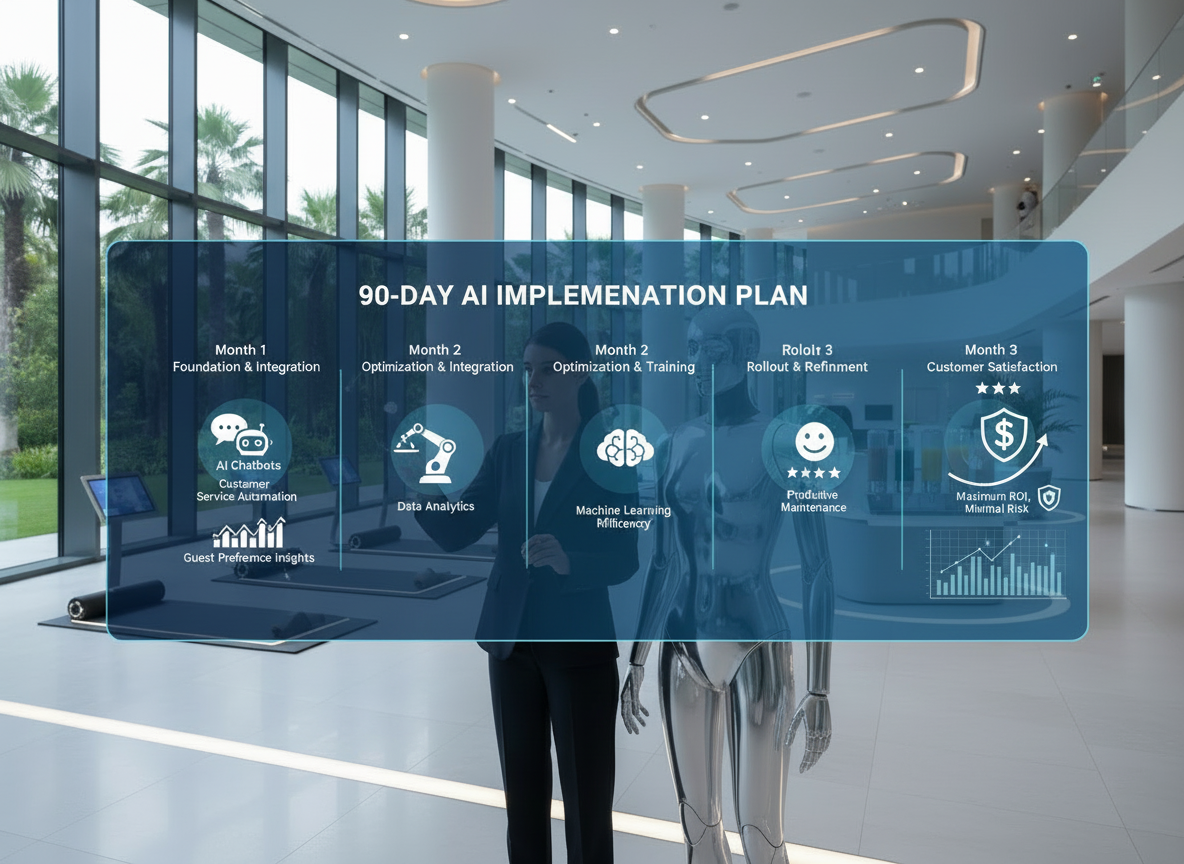
90-Day AI Pilot Program for Luxury Resorts and Hospitality Organizations
A structured AI pilot program for luxury resorts allows hospitality organizations to evaluate AI opportunities without committing to large-scale implementation. This approach enables leadership to test AI in real operational environments, validate business value, and minimize risk to guest experience and daily operations.
-
Opportunity Identification:
Identify high-impact AI opportunities in hospitality by analyzing resort operations, guest interactions, and service workflows to determine where AI can improve efficiency and guest experience. -
Use-Case Prioritization:
Prioritize AI use cases based on ROI potential, operational feasibility, data availability, and alignment with luxury hospitality service standards. -
AI Pilot Design and Validation:
Design a controlled AI pilot program with defined success metrics, governance frameworks, and clear operational impact before deployment. -
Executive AI Implementation Roadmap:
Develop a scalable AI implementation roadmap for hospitality organizations, including vendor evaluation, staffing considerations, and long-term ROI measurement.
This disciplined AI strategy approach enables luxury resorts to reduce implementation risk, improve decision-making, and build a clear, data-driven path to enterprise AI adoption and measurable ROI.
AI Governance, Risk Management, and Brand Protection in Luxury Hospitality
AI adoption in luxury resorts and hospitality organizations requires more than technical implementation—it requires a disciplined AI governance framework. Luxury hospitality brands operate in environments where trust, privacy, and service consistency are core to the guest experience. Any AI deployment must be aligned with these expectations to avoid reputational risk, service degradation, data exposure, or operational disruption.
AI governance in hospitality ensures that artificial intelligence systems are deployed in a controlled, transparent, and accountable manner. This includes defining how AI systems access data, how decisions are made, how outputs are validated, and how staff interact with AI-supported workflows across resort operations.
Data Privacy and Security
AI systems in hospitality must protect guest data, personal preferences, and transaction information. Strong governance frameworks ensure compliance with data privacy regulations and security standards while maintaining guest trust and protecting brand reputation.
Service Consistency and Brand Standards
Luxury resorts rely on consistent, high-touch service delivery. AI must reinforce—not disrupt—brand standards by ensuring outputs align with tone, service expectations, and defined guest experience guidelines.
Human Oversight and Decision Control
AI should augment human decision-making, not replace it. Governance models ensure that staff maintain control over guest interactions, service recovery, and high-impact decisions, preserving the human-centered nature of luxury hospitality.
Risk Management and Operational Integrity
AI systems must be monitored, validated, and continuously evaluated to prevent errors, bias, or unintended outcomes. A structured AI risk management framework protects both operational performance and long-term brand integrity.
For luxury hospitality organizations, AI governance is not a technical constraint—it is a strategic requirement. When properly implemented, governance frameworks enable safe experimentation, controlled AI adoption, and scalable deployment, while protecting the core elements that define the luxury guest experience.
AI Strategy Consulting for Luxury Resorts: Frequently Asked Questions
Answers to common executive questions about AI in hospitality, resort operations, guest experience personalization, AI pilot programs, governance, risk management, and measurable ROI for luxury hospitality organizations.
How can AI improve the guest experience in luxury resorts?
AI for luxury resorts can improve guest experience through personalized recommendations, faster response times, better guest request routing, and stronger coordination across front desk, housekeeping, concierge, dining, spa, and wellness teams. The goal is not to replace human service, but to give hospitality staff better information and more time for high-touch guest interactions.
Where should luxury resorts start with an AI strategy?
The best starting point for AI strategy in luxury hospitality is a focused, measurable use case such as housekeeping coordination, guest request management, internal knowledge access, staff scheduling, or direct booking optimization. These controlled AI pilots allow resort leaders to evaluate ROI, operational feasibility, workforce adoption, data readiness, governance requirements, and guest impact before scaling.
Can AI reduce staffing pressure in hospitality operations?
Yes. AI can reduce staffing pressure in hospitality operations by automating routine administrative work, improving staff scheduling, prioritizing tasks, supporting onboarding, and helping teams access policies, procedures, and guest information faster. This allows employees to focus on higher-value service interactions while maintaining luxury brand standards.
How is AI ROI measured in hospitality and luxury resorts?
AI ROI in hospitality is measured through operational efficiency, labor productivity, faster service delivery, improved guest satisfaction, direct booking conversion, revenue optimization, and reduced process friction. A disciplined AI pilot program should define success metrics before deployment so leadership can measure value before expanding implementation.
What are the risks of AI adoption in luxury hospitality?
The main risks include poor guest experience, weak data privacy controls, inconsistent service outputs, vendor-driven implementation, lack of staff adoption, and AI tools that do not align with luxury brand standards. AI governance for hospitality organizations helps control these risks through oversight, policies, validation, risk controls, and clear human decision authority.
Why is AI governance important for luxury resorts?
AI governance is essential because luxury hospitality depends on trust, privacy, consistency, and brand protection. Governance defines how AI systems use data, how outputs are reviewed, when human oversight is required, and how resort leaders evaluate performance, risk, guest impact, and long-term scalability.
AI ROI in Luxury Resorts: Measuring Impact Across Hospitality Operations and Guest Experience
AI strategy consulting for luxury resorts and hospitality organizations should focus on measurable business outcomes rather than technology alone. AI in hospitality delivers value through improved guest experience, workforce productivity, operational efficiency, and revenue optimization. A structured, governance-led AI approach ensures that every initiative is aligned with clearly defined ROI metrics and performance objectives.
Actual results vary based on property size, operational complexity, data maturity, and implementation approach.
- Reduction in administrative workload: AI in hospitality can automate repetitive coordination, reporting, and internal communication tasks across resort departments. Typical impact: 20–40% reduction in administrative workload and manual effort
- Improved staff productivity and operational efficiency: AI for hospitality operations improves workflow alignment between housekeeping, front desk, maintenance, and guest services through real-time coordination and decision support. Typical impact: 10–25% increase in staff productivity and operational efficiency
- Faster response times to guest requests: AI-assisted routing, concierge support, and service coordination improve response times and service delivery across touchpoints. Typical impact: 30–60% faster response times in guest service operations
- Increased guest satisfaction and retention: Personalization and service consistency driven by AI improve guest experience and increase repeat bookings and long-term loyalty. Typical impact: 5–15% improvement in guest satisfaction scores and retention
- Operational cost reduction and resource optimization: AI improves demand forecasting, staffing allocation, and resource utilization across hospitality operations, reducing inefficiencies. Typical impact: 8–20% reduction in operational inefficiencies and cost leakage
- Revenue growth through personalization and direct engagement: AI-driven recommendations, dynamic pricing, and pre-arrival engagement improve upsell performance and direct booking conversion. Typical impact: 5–12% increase in ancillary revenue and direct booking conversion rates
By defining AI success metrics before implementation, hospitality leaders can evaluate performance, manage risk, and make data-driven decisions about scaling AI initiatives. This ensures that AI investments in luxury resorts are aligned with measurable ROI, long-term operational value, and sustained improvements in guest experience.
Evaluate AI Opportunities for Your Luxury Resort or Hospitality Organization
Begin with a structured AI strategy briefing for luxury resorts and hospitality organizations, focused on guest experience, resort operations, workforce efficiency, AI governance, and measurable ROI. Athena Fusion Solutions helps hospitality leaders identify high-impact AI use cases, reduce implementation risk, and design controlled pilot programs before scaling to enterprise deployment.
Request Executive AI Strategy BriefingAI Strategy for
Luxury Resorts
Executive frameworks, operational playbooks, ROI models, and experience design systems built specifically for luxury hospitality leaders navigating AI adoption.
Download the AI Strategy Consulting Guide
Explore how organizations can move from AI experimentation to measurable operational outcomes through workflow automation, AI transformation strategy, governance frameworks, operational AI integration, executive advisory, pilot-to-production deployment models, and scalable enterprise AI architecture. This guide outlines practical approaches for healthcare organizations, luxury hospitality, financial operations, and cross-functional enterprise environments.
Athena Fusion Solutions provides AI strategy consulting focused on luxury resorts, hospitality operations, wellness ecosystems, and human-centered guest experiences. We help organizations move from fragmented experimentation to measurable operational and guest-focused outcomes.
AI Strategic Hub
How AI Works Technical Foundations AI Architecture RAG & Edge AI Governance & DeploymentHospitality AI
AI for Luxury Resort Executives Resort AI Strategy ROI in Luxury Resorts Nordic Hospitality Model The Future of Golf & AIStrategy & Insights
Why AI Projects Fail 90-Day AI Pilot Strategy Automation Strategy Longevity Resort DesignMove from AI Exploration to Hospitality Transformation
Schedule an executive AI briefing to evaluate operational efficiency opportunities, guest experience transformation, wellness personalization strategies, and measurable ROI use cases for luxury hospitality organizations.
Request Executive Briefing