What Is Retrieval-Augmented Generation (RAG), Edge AI, and Modern AI Architecture?
This guide explains how modern AI systems combine retrieval-augmented generation (RAG), vector databases, and edge AI architectures to deliver real-time, context-aware intelligence. Learn how AI moves beyond static models by integrating external knowledge, reducing hallucinations, and enabling scalable, production-ready systems.
From foundational concepts to production deployment, this section bridges AI theory, system architecture, and real-world implementation.
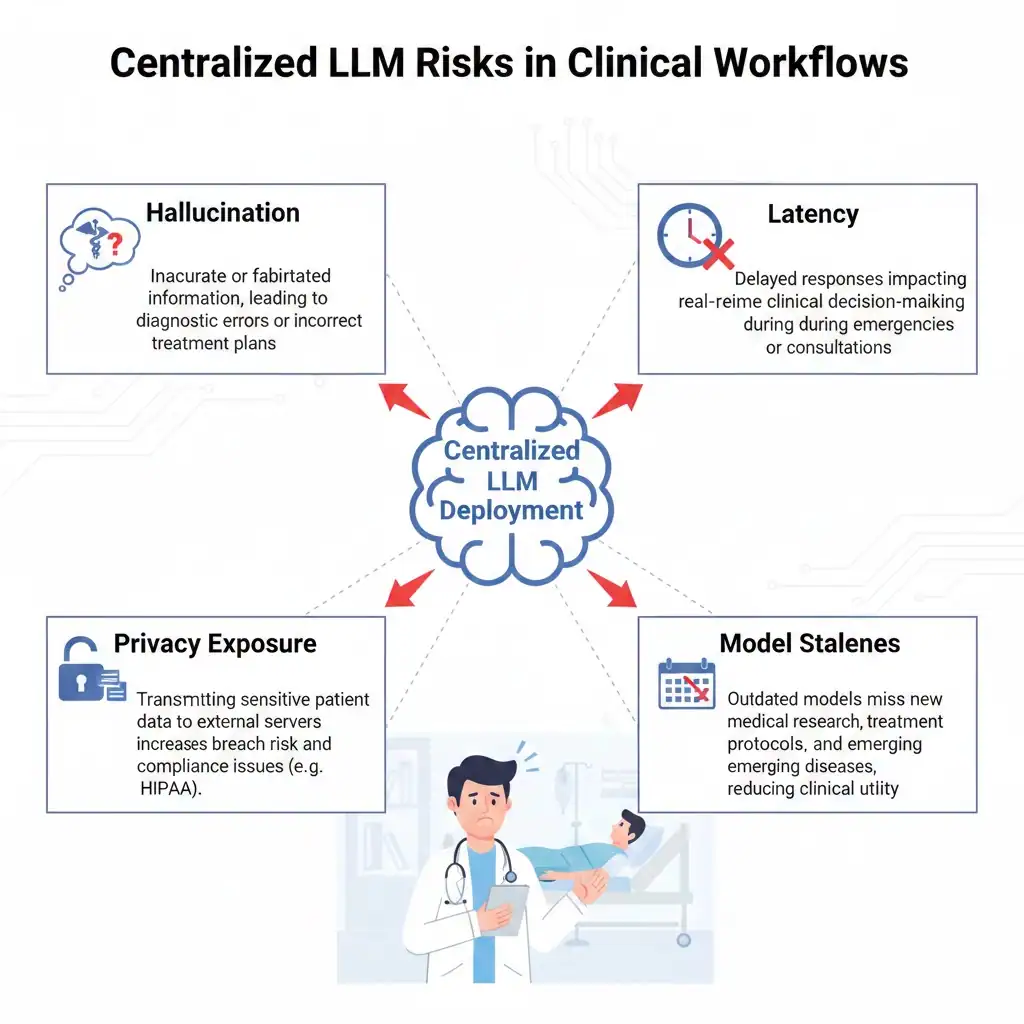
Illustrates: hallucination risk, latency constraints, PHI/privacy exposure, and model staleness in real-world AI systems.
C1. Engineering Motivation for Retrieval-Augmented Generation (RAG) and Edge AI Systems
Healthcare AI systems operate under constraints that differ fundamentally from consumer applications. Clinical environments require deterministic behavior, bounded error rates, low latency, and strict protection of protected health information (PHI). These requirements expose critical limitations in traditional centralized large language model (LLM) architectures.
Centralized AI inference introduces multiple risks, including unpredictable latency, external data transmission, model staleness, and hallucinated outputs when handling ambiguous or incomplete inputs. In regulated domains such as healthcare, these are not performance issues—they are safety, compliance, and liability risks.
Primary engineering drivers for RAG and Edge AI architectures:
- Reduction of hallucination risk: Grounding AI outputs in verified data through retrieval-augmented generation (RAG).
- Real-time data integration: Accessing up-to-date clinical knowledge beyond static model training.
- Low-latency inference: Leveraging edge AI for localized processing and faster response times.
- Data privacy and security: Minimizing external transmission of sensitive patient data.
- Model freshness and adaptability: Decoupling knowledge from model weights using vector databases and retrieval pipelines.
- Regulatory and governance alignment: Supporting auditability, explainability, and human oversight.
These constraints drive the shift from model-centric AI to architecture-centric AI systems, where RAG pipelines, vector databases, and edge computing form the foundation of reliable, production-grade artificial intelligence.
C2. RAG Architecture: From Knowledge Sources to Grounded AI Answers
Retrieval-Augmented Generation (RAG) architecture combines two complementary capabilities: a retrieval system that finds relevant information from trusted knowledge sources, and a large language model (LLM) that generates a natural-language answer grounded in that evidence. This design improves factual accuracy, reduces hallucination risk, and allows AI systems to use current, domain-specific information without retraining the core model.
A production RAG pipeline begins with content ingestion from enterprise documents, clinical knowledge bases, research repositories, databases, or operational systems. That content is then processed through chunking, transformed into vector embeddings, and stored in a vector database for semantic search and similarity-based retrieval.
At query time, the system compares the user’s question against embedded knowledge, retrieves the most relevant passages using top-k similarity search, optionally applies reranking or policy filters, and inserts the selected evidence into a structured prompt. The LLM then generates a response that is grounded in retrieved context rather than relying only on model memory.
Core RAG engineering design choices:
- Chunking strategy: Defines passage size, overlap, metadata, and structure-aware boundaries.
- Embedding model selection: Determines semantic accuracy, domain fit, and update cadence.
- Vector database design: Supports indexing, similarity search, metadata filtering, and retrieval speed.
- Retrieval configuration: Controls top-k retrieval, hybrid search, thresholds, and recall precision.
- Reranking and filtering: Improves relevance, removes duplicates, and enforces governance policies.
- Prompt assembly: Determines context ordering, citation format, evidence boundaries, and output constraints.
RAG creates a controllable evidence layer between users and the AI model. For enterprise, healthcare, defense, and regulated AI systems, this improves trust, auditability, explainability, and updateability across production workflows.
Illustrates: content ingestion, chunking, vector embeddings, semantic retrieval, reranking, prompt assembly, and evidence-grounded generation.
In production AI deployments, RAG shifts the primary failure mode from pure generative hallucination to retrieval quality. Engineering teams must optimize vector quality, index freshness, metadata filtering, reranking calibration, and prompt assembly discipline. In practice, effective RAG turns large language model deployment into a data architecture and retrieval optimization problem.
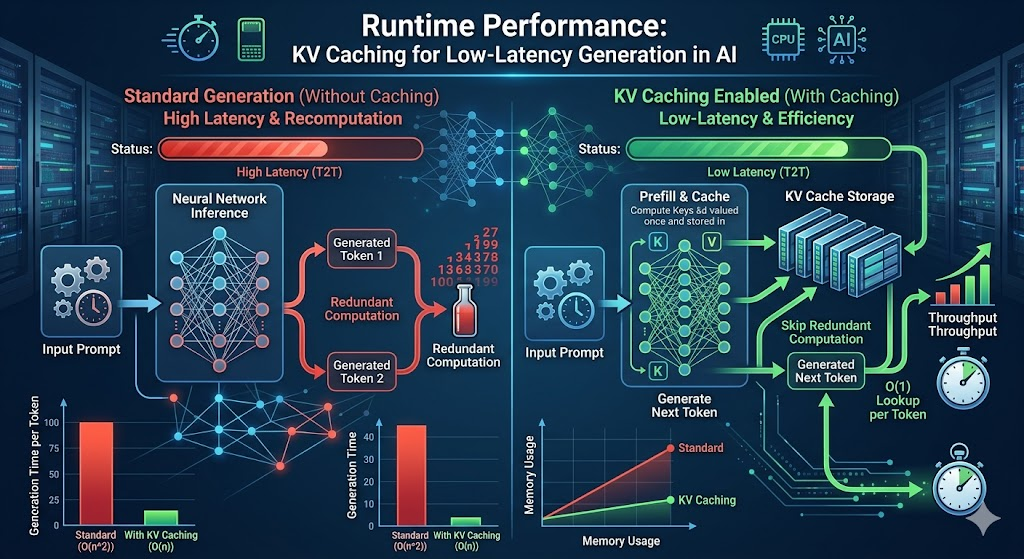
Illustrates: how cached key/value tensors reduce recomputation, improve response speed, and support efficient real-time AI generation.
KV caching allows transformer models to reuse previously computed attention data instead of recomputing the full prior context for every new token. This is especially important in retrieval-augmented generation (RAG), where retrieved passages, citations, policy rules, and conversation history can substantially increase prompt length.
As AI context windows expand, KV caching becomes a core inference optimization for maintaining low-latency generation, reducing infrastructure cost, and preserving a responsive real-time user experience in production AI systems.
C3. Inference Efficiency: KV Caching for Low-Latency RAG and LLM Systems
RAG systems often increase prompt length by inserting retrieved documents, clinical guidelines, policy snippets, citations, and conversation history into the model context. Because transformer decoders generate tokens autoregressively, longer contexts can increase compute cost, response time, and memory pressure.
Key-value caching, often called KV caching, is a foundational optimization for large language model inference. It stores the keys and values computed during prior decoding steps so the model does not repeatedly recompute attention over the entire prompt history for every new token.
During self-attention, each transformer layer computes keys (K) and values (V) for prior tokens. Without caching, generating token t may require repeatedly processing tokens 1 through t−1. KV caching preserves those tensors and reuses them during subsequent decoding, improving throughput while keeping model behavior unchanged.
Production benefits of KV caching:
- Lower inference latency: Faster token generation as sequence length and retrieved context grow.
- Higher throughput: More concurrent RAG sessions per GPU, server, or edge device.
- More stable p95/p99 latency: Reduced tail-latency variance under mixed prompt sizes.
- Improved user experience: Smoother streaming responses and shorter perceived wait time.
- Lower operating cost: Better compute utilization for high-volume enterprise AI deployments.
Engineering tradeoffs and constraints:
- Memory pressure: Cache size scales with context length, number of layers, attention heads, and active users.
- Context discipline: Retrieval filtering, deduplication, and chunk control reduce unnecessary cache growth.
- Batching strategy: Per-request caches affect GPU scheduling, serving efficiency, and throughput.
- Edge AI deployment: Local inference may require quantization, smaller context windows, and careful cache management.
KV caching materially improves RAG performance, LLM inference efficiency, and real-time AI responsiveness without changing the semantic behavior of the model. In production systems, it should be paired with disciplined retrieval design, latency monitoring, and memory observability.
C4. Transformer Stability: Residual Connections, Layer Normalization, and Reliable AI Systems
The stability of transformer architectures in production AI systems depends not only on model scale and training data, but on core architectural mechanisms that regulate gradient flow, numerical stability, and convergence behavior. Two foundational components—residual connections and Layer Normalization (LayerNorm)—enable deep large language models (LLMs) to train efficiently and perform reliably under real-world conditions.
Modern transformer systems typically adopt a Pre-LayerNorm (Pre-LN) architecture rather than Post-LayerNorm (Post-LN). Pre-LN improves gradient stability, accelerates training convergence, and reduces sensitivity to hyperparameter tuning—making it the preferred design for large-scale AI systems and RAG-based architectures.
Why transformer stability matters for RAG and Edge AI systems:
- Long-context reliability: Maintains stability as retrieval-augmented prompts expand context windows.
- Consistent inference behavior: Reduces variance across queries with different context sizes and structures.
- Noise robustness: Prevents amplification of conflicting or low-quality retrieved data.
- Predictable performance: Enables stable latency and throughput in production serving environments.
- Safer model updates: Supports controlled deployment cycles as retrieval indexes and policies evolve.
Residual connections create direct pathways for information and gradients to flow through deep networks, while LayerNorm stabilizes activations across layers. Together, they form a critical stability foundation for modern AI system architecture, particularly in environments where accuracy, consistency, and reliability are non-negotiable.
Illustrates: how normalization placement affects gradient flow, convergence stability, and reliability in large-scale AI systems.
Residual connections preserve information flow across deep transformer layers, while LayerNorm stabilizes activations at each step. These mechanisms make it possible to train and deploy extremely deep neural networks without instability or gradient collapse.
In production AI systems—especially those using retrieval-augmented generation (RAG)—these stability mechanisms ensure consistent performance under changing context lengths, noisy retrieved evidence, and large-scale inference workloads.
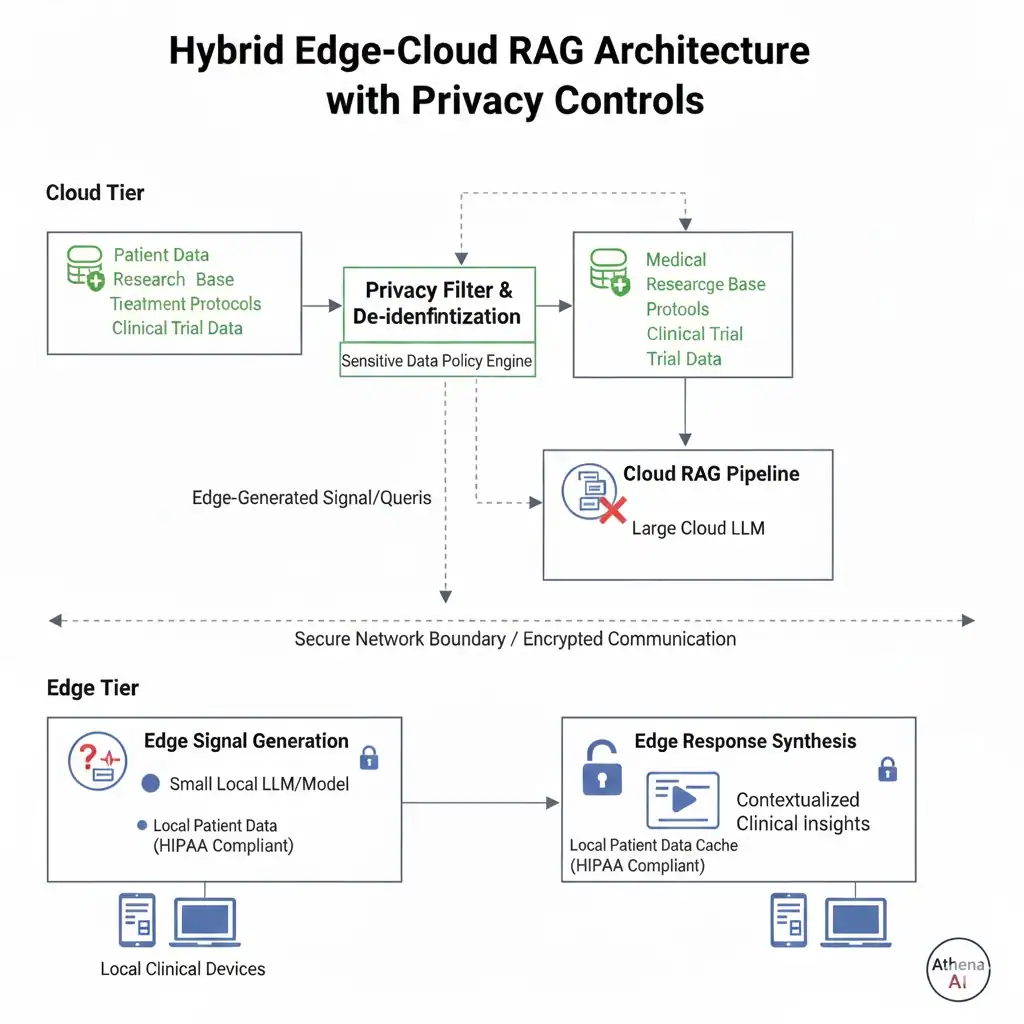
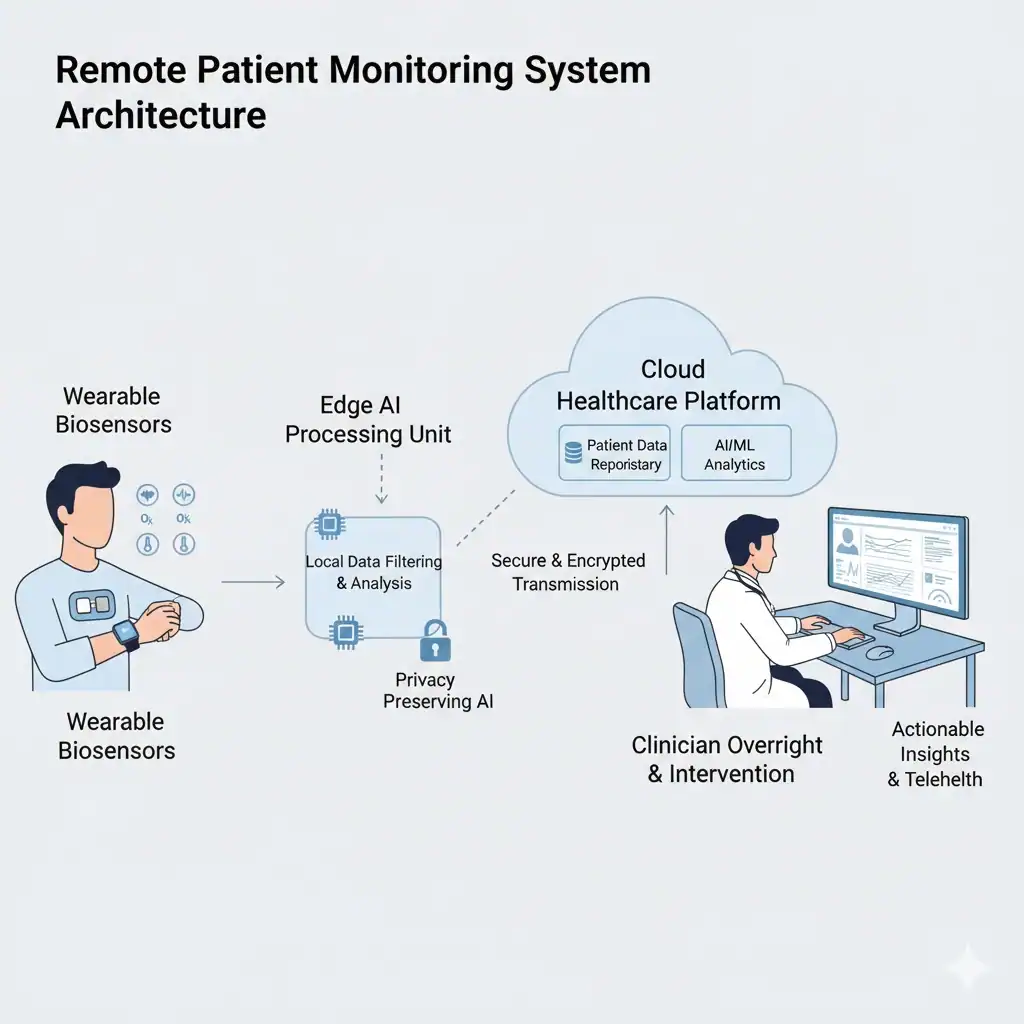
Illustrates: how local inference, cloud retrieval, vector databases, and governance controls can work together to improve latency, privacy, and contextual intelligence.
Hybrid RAG + Edge AI combines local processing with cloud-based retrieval and reasoning. This approach allows sensitive or time-critical data to be processed close to the user while larger knowledge retrieval and model orchestration can occur in controlled cloud environments.
In production systems, hybrid architecture helps balance low latency, data privacy, context-aware generation, and enterprise scalability—especially in healthcare, defense, industrial, and operational AI environments.
C5. Hybrid RAG + Edge AI Systems: Low-Latency, Privacy-Aware AI Architecture
Hybrid RAG and Edge AI systems combine the strengths of distributed computing, retrieval-augmented generation, and local inference. Instead of sending every request to a centralized cloud model, hybrid architectures determine which tasks should run at the edge, which should use cloud-based retrieval, and which require orchestration across both environments.
This architecture is especially important for enterprise AI systems where latency, privacy, bandwidth, reliability, and governance must be controlled. Edge AI can process sensor data, user context, device signals, or protected information locally, while RAG pipelines retrieve validated knowledge from vector databases, document repositories, knowledge graphs, or enterprise systems.
Why hybrid RAG + Edge AI matters:
- Lower latency: Local inference reduces round-trip time for time-sensitive AI workflows.
- Improved privacy: Sensitive data can be filtered, summarized, anonymized, or processed before cloud transmission.
- Context-aware intelligence: RAG systems retrieve current domain knowledge while edge systems preserve local context.
- Greater resilience: Edge processing can support degraded or intermittent network conditions.
- Scalable deployment: Workloads can be distributed across devices, gateways, servers, and cloud infrastructure.
- Governed AI execution: Policy controls, confidence thresholds, and human escalation can be embedded across the architecture.
Core design questions for deployment:
- What should run locally? Real-time signals, privacy-sensitive preprocessing, and low-latency inference.
- What should run in the cloud? Large-scale retrieval, model orchestration, analytics, and knowledge base updates.
- How is data protected? Through de-identification, encryption, access control, and audit logging.
- How is quality governed? Through retrieval thresholds, monitoring, evaluation, and human-in-the-loop review.
The value of hybrid RAG + Edge AI is not simply faster inference. It is the creation of an architecture-centric AI system that can deliver real-time performance, trusted knowledge retrieval, privacy protection, and operational governance at scale.
C6. AI Failure Modes and Safeguards for RAG + Edge AI Systems
Retrieval-Augmented Generation (RAG) and Edge AI systems improve accuracy, privacy, and responsiveness, but they also introduce new engineering failure modes. In high-stakes environments such as healthcare, clinical decision support, and enterprise AI systems, these risks must be managed through explicit safeguards, governance controls, and human oversight.
RAG systems depend on multiple interacting layers: vector embeddings, retrieval thresholds, knowledge-base quality, index freshness, prompt assembly, and model behavior. A failure in any layer can result in inaccurate, incomplete, or poorly grounded outputs.
Primary RAG and Edge AI failure modes:
- Low-confidence retrieval: Weak or irrelevant evidence returned from vector search.
- Embedding drift: Semantic meaning shifts as models or data evolve.
- Index staleness: Outdated knowledge impacting decision quality.
- Context contamination: Conflicting or duplicated retrieved data.
- Privacy exposure: Sensitive data improperly transmitted or stored.
- Automation overreach: AI outputs used without appropriate human validation.
Core safeguards for production AI systems:
- Retrieval confidence thresholds: Filter low-quality results.
- Embedding version control: Track model + index lineage.
- Human-in-the-loop oversight: Escalate high-risk decisions.
- Audit logging: Full traceability of inputs, retrieval, and outputs.
- Privacy-preserving edge processing: Protect PHI before transmission.
- Continuous evaluation: Monitor drift, hallucination, and system performance.
Effective AI governance requires an architecture-level safety layer where retrieval quality, privacy controls, and human oversight are embedded directly into system design.
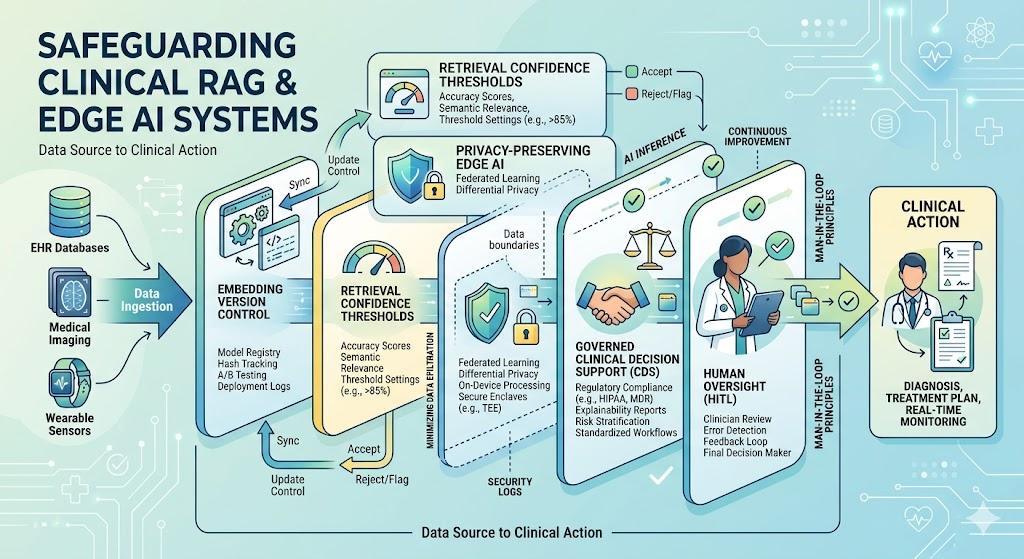
Illustrates: embedding version control, retrieval thresholds, privacy-preserving AI, governance layers, human oversight, and real-time clinical decision support.
This architecture transforms RAG into a governed AI system by introducing layered safeguards across the full pipeline—from ingestion through clinical action.
The goal is not automation alone, but trusted, evidence-grounded decision support with clear auditability, escalation pathways, and regulatory alignment.
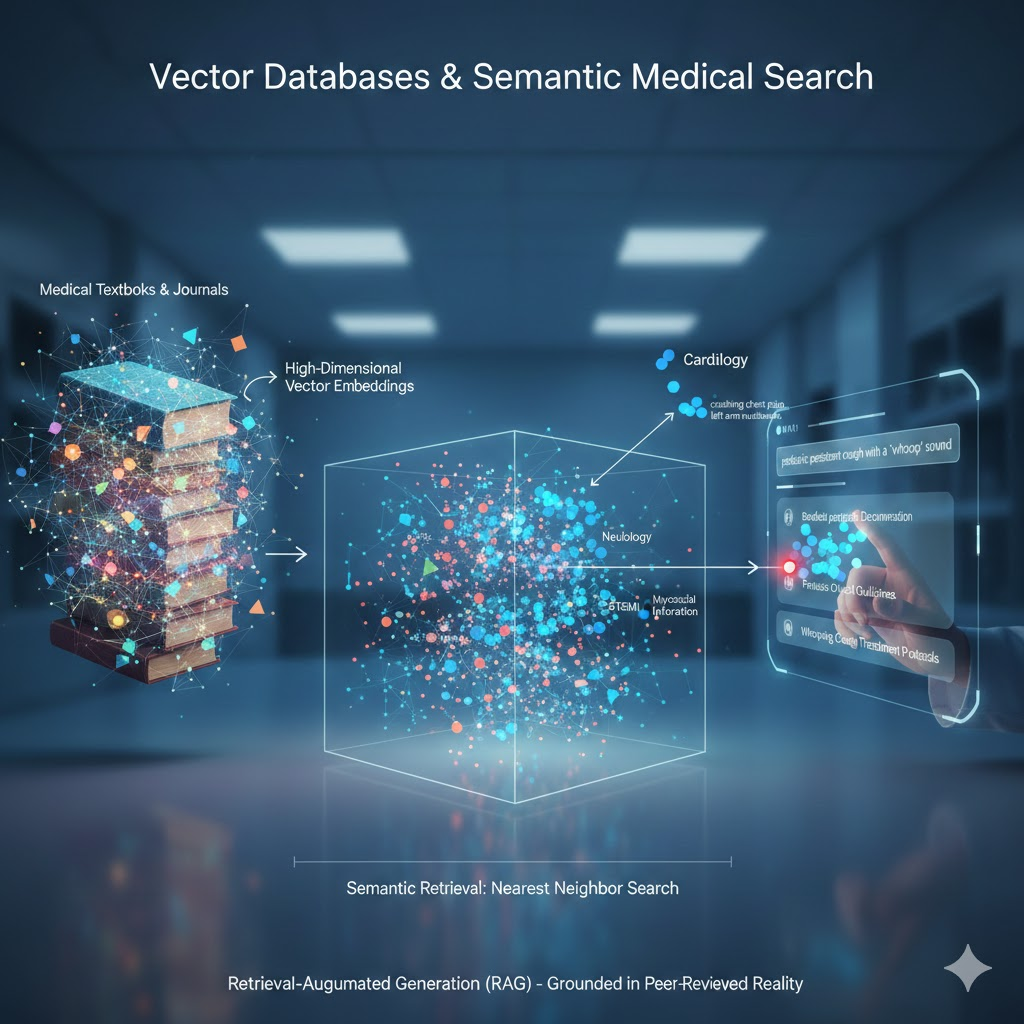
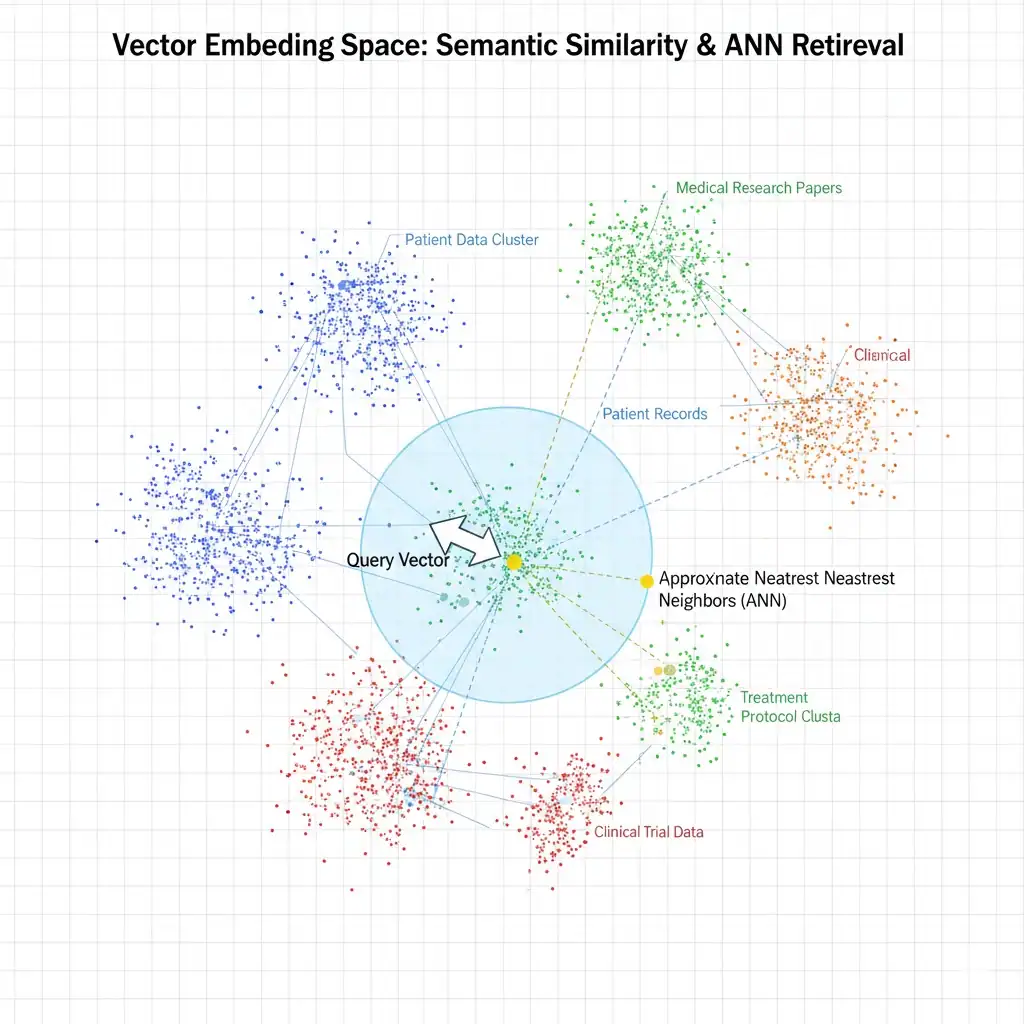
Illustrates: how medical literature, clinical guidelines, and patient-related knowledge can be transformed into vector embeddings for semantic retrieval and evidence-grounded AI responses.
Vector search enables healthcare AI systems to retrieve information based on meaning rather than exact wording. This is essential in medicine, where the same condition may appear as a clinical diagnosis, patient description, abbreviation, synonym, or billing code.
By mapping documents and queries into a shared embedding space, semantic medical search allows RAG systems to find relevant evidence across clinical notes, research papers, guidelines, and knowledge bases even when terminology differs.
C7. Vector Databases and Semantic Medical Search in RAG Healthcare AI
Traditional keyword search is often insufficient for clinical nuance. A patient query such as “chest tightness during exercise” may not directly match terms such as angina pectoris, exertional dyspnea, or related cardiovascular terminology. Vector embeddings enable semantic retrieval based on meaning, clinical context, and conceptual similarity rather than literal word matching.
In a retrieval-augmented generation (RAG) system, clinical documents are converted into high-dimensional vector embeddings that encode relationships between symptoms, diagnoses, procedures, medications, anatomical structures, and medical terminology. These embeddings are stored in a vector database optimized for fast similarity search and approximate nearest-neighbor retrieval.
When a clinician, patient, or workflow system submits a query, that query is embedded using the same model. The system retrieves the most semantically relevant passages and inserts them into the prompt as grounding evidence. This helps large language models generate more accurate, traceable, and evidence-based responses.
Key benefits of vector databases and semantic search in clinical AI:
- Clinical concept matching: Connects lay descriptions, physician terminology, ICD codes, SNOMED terms, and medical abbreviations.
- Evidence-grounded retrieval: Anchors AI outputs to relevant guidelines, literature, protocols, and patient-specific context.
- Approximate nearest-neighbor search: Enables fast retrieval across millions of clinical records, documents, or research passages.
- Hybrid retrieval support: Combines dense vector search with keyword, metadata, and rules-based filtering for higher precision.
- Continuous knowledge updates: Allows new research, guidelines, and protocols to be indexed without retraining the base model.
- Reduced hallucination risk: Grounds large language model generation in retrieved evidence rather than model memory alone.
- Auditability and citations: Retrieved passages can be surfaced for clinician review, compliance documentation, and verification.
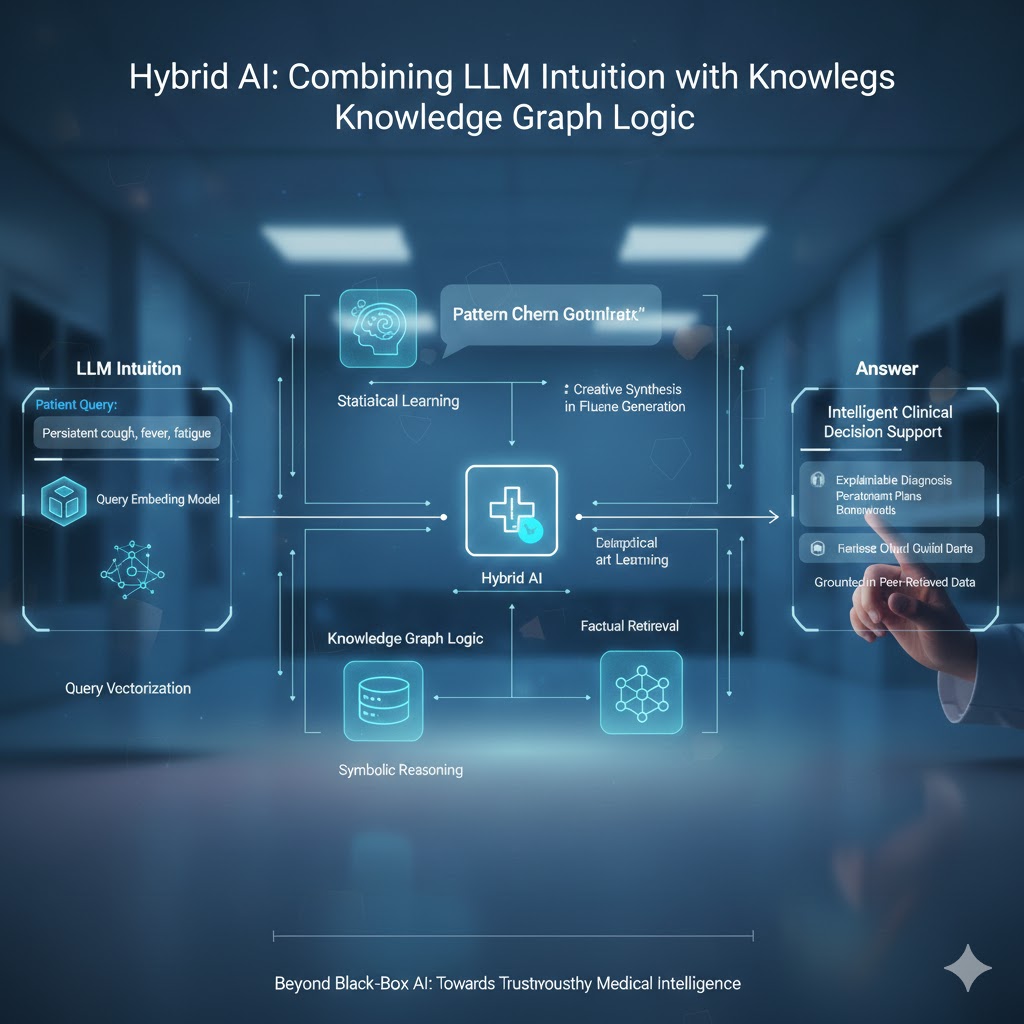
Illustrates: how symbolic AI, structured medical relationships, and rule-based validation can improve explainability, safety, and governance in clinical AI systems.
Knowledge graphs act as a deterministic control layer for clinical AI, helping ensure that AI-generated recommendations remain consistent with established medical rules, safety constraints, treatment pathways, and governance requirements.
By structuring relationships between drugs, diseases, biomarkers, procedures, and physiological systems, knowledge graphs provide a verifiable framework that complements probabilistic large language model reasoning.
C8. Knowledge Graph Integration: Symbolic AI for Safer Clinical Decision Support
Large language models (LLMs) provide powerful contextual reasoning, natural-language understanding, and synthesis across complex clinical information. However, LLMs remain probabilistic systems and cannot inherently enforce deterministic clinical constraints such as drug interactions, contraindications, dosing limits, procedural rules, or specialty-specific safety boundaries.
To address this limitation, production-grade hybrid AI systems can integrate a symbolic knowledge graph as a validation and governance layer. Knowledge graphs encode explicit relationships between clinical entities—including drugs, diseases, biomarkers, procedures, anatomy, guidelines, and patient-specific risk factors—so recommendations can be checked against structured rules before being surfaced to clinicians or users.
This combination of LLM reasoning and knowledge graph logic is a practical form of neuro-symbolic AI: probabilistic models generate and interpret language, while symbolic systems enforce consistency, explainability, and safety constraints.
Key clinical rule domains:
- Drug interactions: Contraindications, toxicity risks, medication conflicts, and adverse-event warnings.
- Supplement conflicts: Nutraceutical interactions, bleeding risk, hormone-sensitive pathways, and treatment interference.
- Anatomical relationships: Organ systems, physiological pathways, disease spread patterns, and affected structures.
- Dosing rules: Age, weight, renal function, hepatic function, treatment stage, and comorbidity constraints.
- Procedural limits: Contraindicated interventions, sequencing rules, eligibility criteria, and clinical workflow boundaries.
- Temporal logic: Disease progression, treatment timing, monitoring intervals, and escalation thresholds.
Operational advantages of knowledge graph integration:
- Hard safety constraints: Blocks recommendations that violate explicit medical rules or known contraindications.
- Automatic conflict detection: Identifies inconsistencies across medications, symptoms, diagnoses, and proposed interventions.
- Explainable reasoning: Provides traceable logic paths that clinicians, reviewers, and compliance teams can inspect.
- Independent rule updates: Allows new guidelines, protocols, and safety rules to be updated without retraining the base LLM.
- Specialty modularization: Supports domain-specific rule graphs for oncology, cardiology, neurology, primary care, and other specialties.
- Regulatory defensibility: Improves auditability, governance, and documentation for high-stakes AI deployment.
Clickable Layered Diagram: LLM Intuition + Knowledge Graph Logic
This interactive framework shows how hybrid AI combines large language model pattern recognition with knowledge graph reasoning, factual retrieval, and governance layers to support trustworthy clinical decision intelligence.
LLM Intuition Layer
The LLM layer provides rapid interpretation of unstructured inputs such as symptoms, clinical notes, care histories, and natural-language queries. It is useful for pattern recognition and synthesis, but should not be treated as a standalone source of clinical truth.
- Converts clinical language into usable representations
- Recognizes patterns across complex unstructured information
- Supports summarization, triage, and natural-language interaction
- Requires grounding to reduce hallucination and overconfidence

Illustrates: how probabilistic language models can be combined with structured reasoning, factual retrieval, and governance controls to move beyond black-box AI toward trustworthy medical intelligence.