The AI Strategic Advisory Hub
This AI Strategic Hub helps engineers, executives, healthcare organizations, hospitality leaders, and technical decision-makers understand artificial intelligence as a systems architecture challenge — not simply a software tool or model-selection problem.
Explore enterprise AI architecture, retrieval-augmented generation, neuro-symbolic AI, governance, workflow integration, healthcare AI, hospitality transformation, automation strategy, and ROI-focused deployment frameworks.
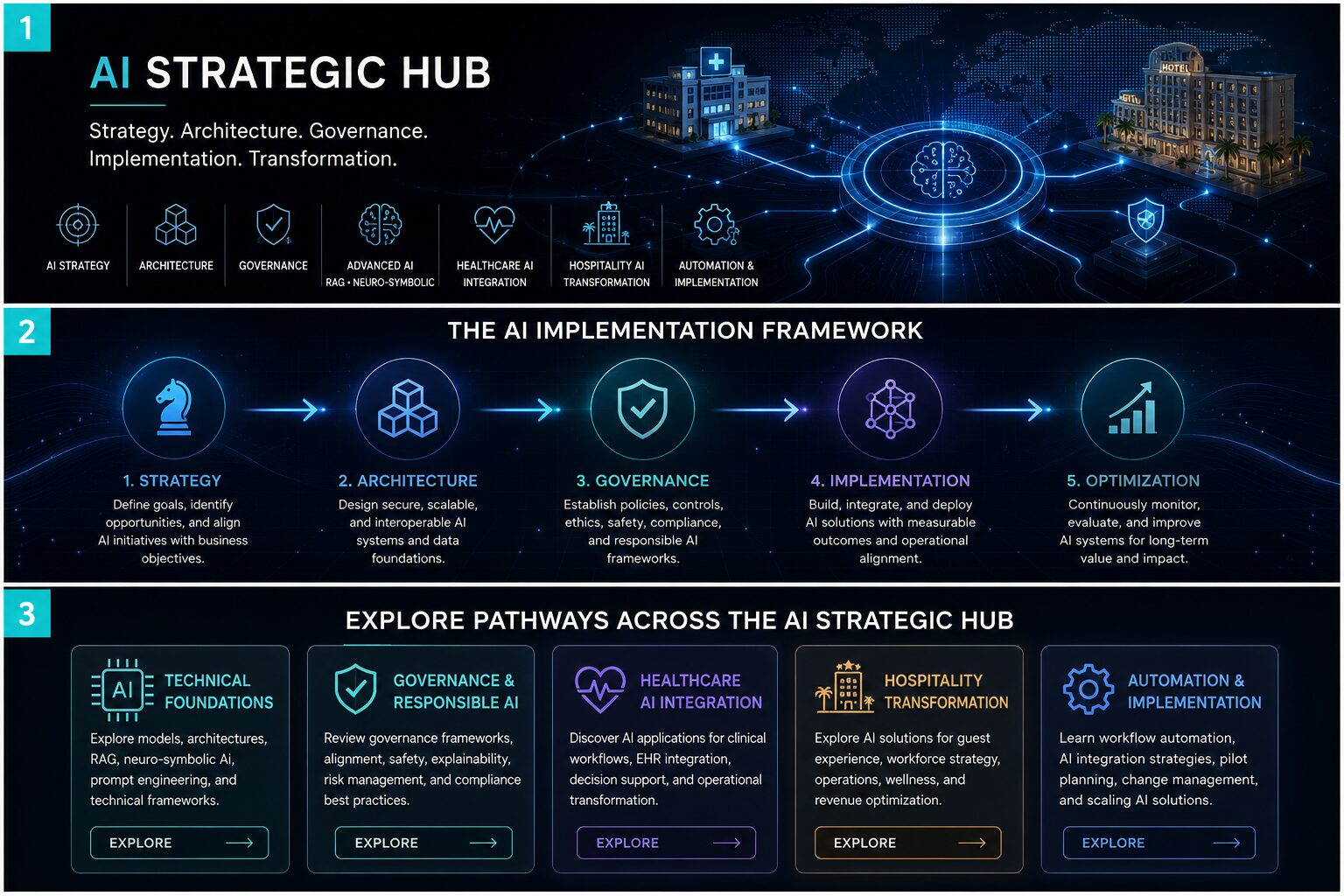
What the AI Strategic Hub Covers
The AI Strategic Hub provides structured guidance across enterprise AI strategy, AI systems architecture, AI governance frameworks, retrieval-augmented generation (RAG), neuro-symbolic AI, workflow automation, prompt engineering, healthcare AI integration, hospitality AI transformation, executive AI readiness, AI platform evaluation, and ROI-focused implementation planning.
Rather than treating artificial intelligence as a single technology, this hub organizes AI adoption as a connected system of strategy, architecture, governance, workflow integration, human oversight, and measurable business outcomes.
Start Here: Explore Enterprise AI Strategy, Architecture, and Transformation
Artificial intelligence is no longer just a software or model-selection discussion — it is an enterprise systems architecture, workflow integration, governance, and operational transformation challenge. This strategic AI hub helps engineers, enterprise leaders, healthcare organizations, hospitality executives, and technical decision-makers navigate modern AI from foundational concepts to scalable enterprise deployment.
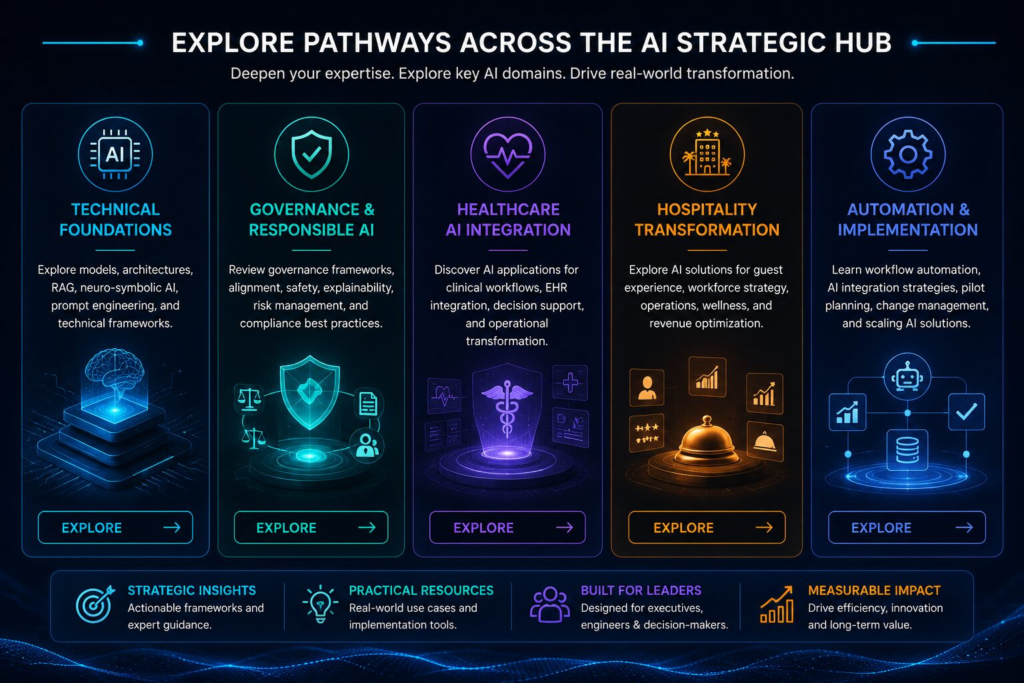
AI Foundations and Core Concepts
Develop a systems-level understanding of artificial intelligence, machine learning, large language models (LLMs), reasoning systems, prompt engineering, and modern AI architecture foundations.
Explore AI FoundationsEnterprise AI Architecture and RAG Systems
Explore retrieval-augmented generation (RAG), orchestration layers, vector databases, edge AI, workflow integration, and governance architectures that drive enterprise AI performance and scalability.
Explore AI ArchitecturesHealthcare AI and Clinical Integration
Learn how artificial intelligence integrates with EHR systems, clinical workflows, longitudinal patient monitoring, healthcare automation, and operational decision support.
Explore Healthcare AIHospitality AI and Wellness Transformation
Discover how AI systems, operational integration, workflow automation, and human-centered design improve guest experience, operational efficiency, personalization, and wellness-focused hospitality environments.
Explore Hospitality AIAI Governance and Deployment Strategy
Understand the operational, governance, architectural, integration, and workflow challenges that prevent many enterprise AI initiatives from successfully reaching production deployment.
Explore AI StrategyExecutive AI Strategy and Advisory
Explore how Athena Fusion Solutions helps organizations align enterprise AI architecture, workflow integration, governance frameworks, operational transformation, and measurable ROI-driven outcomes.
Request BriefingWhy AI Requires a Systems Engineering Approach
Most enterprise AI initiatives fail not because the models are incapable, but because organizations attempt to deploy artificial intelligence into fragmented operational environments without addressing workflow integration, governance, interoperability, data architecture, and organizational alignment.
AI Transformation Is an Operational Architecture Challenge
Artificial intelligence does not operate in isolation. Successful enterprise AI systems depend on how models interact with data pipelines, operational workflows, governance frameworks, human decision-making, security controls, legacy infrastructure, and organizational processes.
Many organizations focus heavily on selecting AI tools while underestimating the complexity of workflow integration, interoperability, orchestration, and enterprise-scale deployment. This creates disconnected AI initiatives that generate demonstrations but fail to produce measurable operational value.
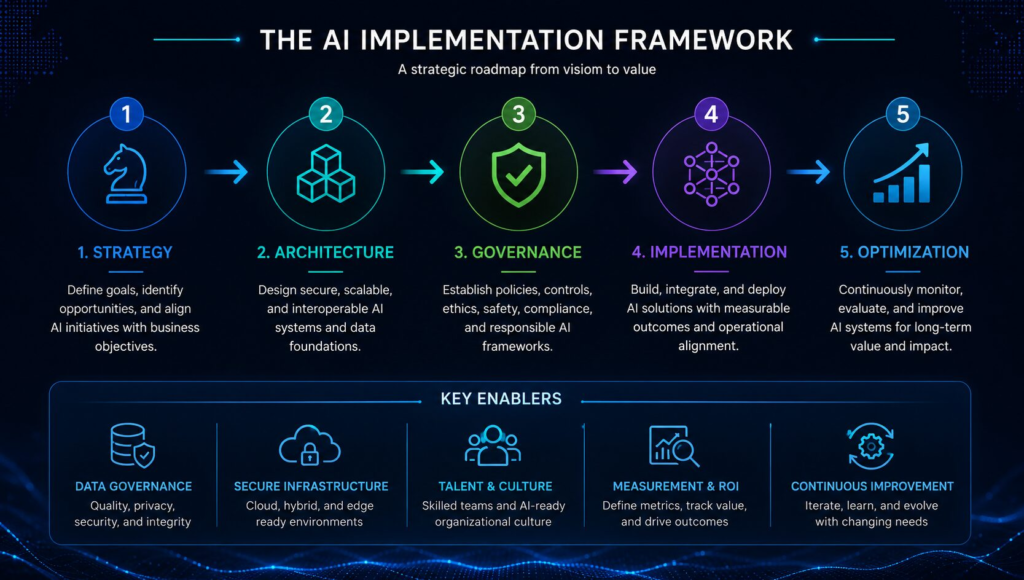
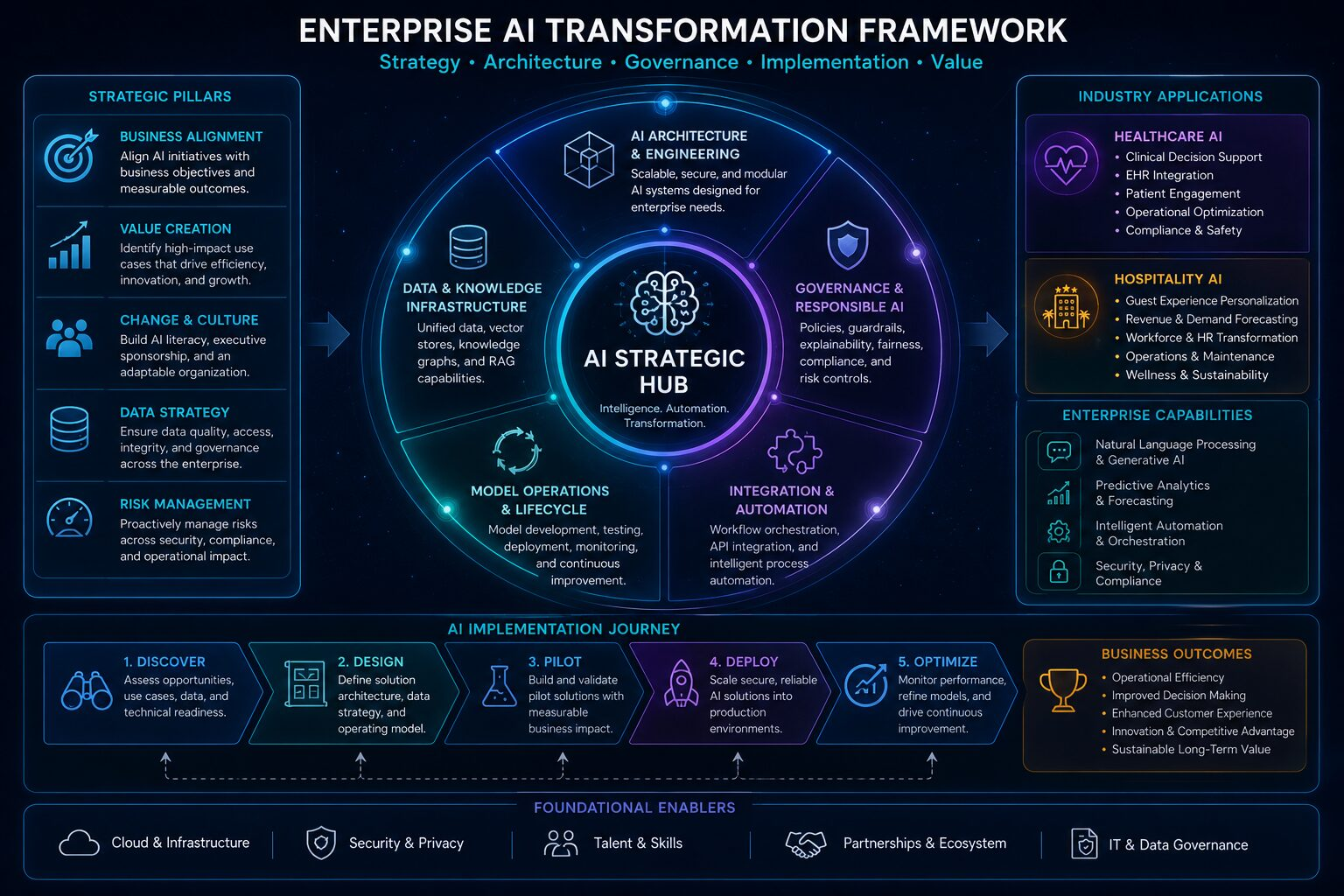
A systems engineering approach helps organizations align AI strategy, architecture, governance, implementation, optimization, and long-term operational sustainability into a unified enterprise transformation framework.
AI systems must integrate directly into operational workflows rather than function as disconnected productivity tools.
Enterprise AI requires governance frameworks for security, compliance, human oversight, accountability, and operational trust.
AI initiatives succeed when aligned with measurable operational objectives, organizational readiness, and long-term strategy.
Scalable AI systems require orchestration, interoperability, data pipelines, infrastructure design, and continuous optimization.
AI transformation is no longer primarily a software implementation issue — it is a systems engineering, workflow integration, governance, and organizational transformation challenge requiring coordinated enterprise architecture and long-term operational alignment.
Who the AI Strategic Hub Is Designed For
The AI Strategic Hub was created for enterprise leaders, engineers, systems architects, healthcare organizations, hospitality executives, operations teams, technology strategists, and business decision-makers seeking practical guidance on artificial intelligence strategy, enterprise AI architecture, AI governance, workflow automation, healthcare AI integration, hospitality AI transformation, and long-term implementation planning.
The goal is to provide structured, executive-level and technical insight that helps organizations move beyond AI experimentation toward scalable deployment, operational integration, measurable ROI, and responsible enterprise transformation.
AI Strategy, Clinical Systems
& Applied Industry Intelligence
Explore AI strategy frameworks, healthcare integration models, hospitality transformation playbooks, and cross-industry tools built for leaders who move first.
Access Enterprise AI Strategy, Architecture & Implementation Resources
Access enterprise AI strategy resources, technical frameworks, executive briefings, and implementation guidance designed to help organizations navigate artificial intelligence adoption, enterprise AI architecture, AI governance, workflow automation, healthcare AI integration, hospitality transformation, retrieval-augmented generation (RAG), and scalable operational deployment. Whether evaluating AI systems, modernizing workflows, or aligning AI initiatives with measurable business outcomes, this strategic hub provides a structured starting point for enterprise transformation.
Frequently Asked Questions About Enterprise AI Strategy, Architecture, and Transformation
What is the AI Strategic Hub?
The AI Strategic Hub is a centralized enterprise AI resource designed to help organizations and professionals understand artificial intelligence from both strategic and technical perspectives. It includes executive guidance, AI implementation frameworks, enterprise AI architecture, governance models, healthcare AI integration, hospitality AI strategy, workflow automation, and technical analysis of modern AI systems.
Who is the AI Strategic Hub designed for?
The AI Strategic Hub is intended for executives, engineers, systems architects, healthcare leaders, hospitality organizations, operations teams, strategists, and decision-makers seeking structured, enterprise-focused guidance on AI adoption, implementation, governance, operational integration, and long-term organizational transformation.
What topics are covered in the AI Strategic Hub?
The hub covers enterprise AI architecture, retrieval-augmented generation (RAG), neuro-symbolic AI, AI governance frameworks, workflow automation, AI implementation strategy, healthcare AI integration, hospitality transformation, prompt engineering, operational architecture, systems engineering, and executive AI readiness.
What is retrieval-augmented generation (RAG)?
Retrieval-augmented generation (RAG) is a modern AI architecture that combines large language models with real-time information retrieval systems. RAG improves contextual accuracy, enterprise knowledge access, explainability, operational reliability, and workflow integration by dynamically retrieving external information during AI interactions.
Why does AI governance matter for organizations?
AI governance helps organizations manage operational risk, cybersecurity concerns, regulatory requirements, model transparency, explainability, compliance, and responsible deployment practices. Governance frameworks are especially important in healthcare, hospitality, finance, infrastructure, and other high-impact operational environments.
How can organizations prepare for enterprise AI adoption?
Organizations should begin with strategic alignment, workflow evaluation, governance planning, pilot development, data readiness assessment, infrastructure review, and operational integration planning. Successful AI adoption requires systems-level implementation rather than disconnected experimentation or isolated automation initiatives.
Does the AI Strategic Hub include technical AI content for engineers and architects?
Yes. The AI Strategic Hub includes technical resources covering AI systems engineering, distributed AI architectures, orchestration frameworks, retrieval systems, vector databases, mathematical foundations of AI, neuro-symbolic reasoning systems, enterprise deployment strategy, and workflow integration for engineers and technical leaders.
A Strategic Framework for Enterprise AI Transformation
The AI Strategic Hub was designed to provide a structured enterprise resource covering enterprise AI strategy, AI systems architecture, AI governance frameworks, retrieval-augmented generation (RAG), neuro-symbolic AI, healthcare AI integration, hospitality AI transformation, and workflow automation.
This strategic hub connects executive AI strategy with technical implementation guidance, helping organizations better understand operational readiness, governance requirements, workflow integration, implementation planning, and long-term enterprise AI adoption across real-world operational environments.
Next Steps in Enterprise AI Strategy, Architecture, and Transformation
Part of the Strategic & Advisory Hub
This page belongs to a structured AI learning system designed for multiple audiences. Some readers need a simple introduction, some need a broad conceptual foundation, and others want technical depth or market-specific strategy. Choose the path that best fits your background and goals.
Download the AI Readiness Gap in Financial Operations PDF
Access the complete enterprise AI finance readiness guide covering AI governance, workflow automation, financial operations transformation, operational readiness, finance AI use cases, AI implementation strategy, risk management, forecasting, reconciliation workflows, fraud detection, and enterprise AI pilot planning.
Download PDF
Continue Your Enterprise AI Strategy Journey
Move from foundational AI understanding to enterprise AI strategy, governance frameworks, workflow integration, technical architecture, healthcare AI transformation, hospitality innovation, and scalable real-world implementation planning.
Explore AI Foundations